
 CASIMIR PULASKI (1747-1779) -Obviously from my last name I’m Polish-American and therefore grew up immersed in the role played by Casimir Pulaski and Tadeusz Kosciuszko in America’s War of Independence. I’m often surprised by how comparatively unknown they are to the public at large, so in keeping with Balladeer’s Blog’s theme here’s a look at Pulaski. I’ll cover Kosciuszko separately.
Casimir Pulaski began fighting against tyranny when he was 21 years old. In 1768 he served in the Bar Uprising against Russian domination of Poland. The uprising was facing overwhelming odds and was deemed hopeless, but it became a minor cause celebre around the western world as the fierce insurgents kept the war going through four long years.
 The war never became as romanticized as the later Greek War of Independence from the Ottoman Turks, but the conflict drew attention to Russian totalitarianism and to the abilities of Polish officers like Casimir Pulaski. In fact, it took an invasion by Russian-allied Austria and Prussia to help Russia put down the rebellion in 1772.
Pulaski and other Polish soldiers from the Bar Uprising flirted with an alliance with Turkey against the Russians but when the Ottomans made peace with Russia in 1774 that possibility was eliminated. By December of 1776 Casimir was living in Paris where, the following spring, he was introduced to Benjamin Franklin, one of the American Commissioners in France.
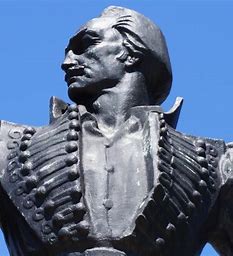 Franklin was impressed with what he could learn about Pulaski and sent him on to America with a letter of introduction to George Washington. Franklin described the Pole as “an officer famous throughout Europe for his bravery and conduct in defence of the liberties of his country against the three great invading powers of Russia, Austria and Prussia … may be highly useful to our service.”
Casimir told Washington “I came here, where freedom is being defended, to serve it, and to live or die for it.” During the summer of 1777 the 30-year-old Pole was made Chief of Cavalry by Congress. Continue reading
 It may be my fondness for mythology that makes me love to watch particular movies around particular holidays. I say that because many of the well- known myths were recited on ancient holidays when their subject matter was relevant to those festivities. The stories helped accentuate the meaning of the special events and that’s the reason I love holiday-themed movies.
  The 4th of July is fast approaching, so Balladeer’s Blog will be squeezing in a few more holiday-themed posts up til then. In the past I’ve examined Revolutionary War privateers like John Haraden and Silas Talbot. This time around I’ll take a look at the controversial Luke Ryan.
 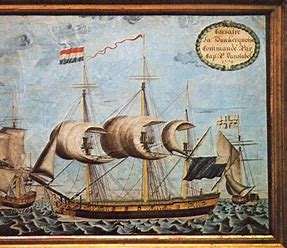 Some of Ryan’s crew didn’t like the way the spoils were divided from this extracurricular activity and informed the authorities about Luke’s smuggling offense. The Friendship was seized and hauled to Poolbeg and all crew members on board were arrested, then thrown into Black Dog Gaol. This happened on the night of April 11th into 12th.
 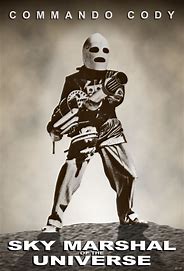 COMMANDO CODY: SKY MARSHAL OF THE UNIVERSE (1953) – This will be a comprehensive look at the winding saga of Commando Cody, the character’s changing names and his status as the inspiration for the much later Rocketeer figure. As a quick preface to this look at the short-lived half-hour television series Commando Cody: Sky Marshal of the Universe I will recap the three Republic serials that preceded it.
 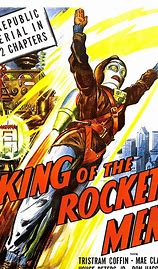 King of the Rocket Men (1949) – This 12-episode serial was directed by Fred C. Brannon and written by Royal K. Cole, William Lively & Sol Shor. An organization called Science Associates finds its major scientists being killed off one by one through the efforts of a mysterious villain calling himself Dr. Vulcan.
  With Dr. Millard playing dead, Jeffrey King dons the experimental rocket pack invented by Millard and takes to the air. King, the title “King” of course, also arms himself with a ray-gun pistol that he and Millard developed together. To keep his identity a secret, Jeffrey wears a helmet that conceals his face in addition to providing protection.
  CAPTAIN SILAS TALBOT – Even if he had never gone on to a career in Privateering, Talbot would still have been a fascinating figure from Revolutionary War history. On June 28th, 1775 Silas was commissioned as a Captain in a Rhode Island regiment and served in the military operations which ended with the British surrender of Boston in March of 1776.
  RAIDERS OF ATLANTIS (aka ATLANTIS INTERCEPTORS) – This 1983 Italian film is my guiltiest of guilty pleasures. Even though it’s directed by horror legend Ruggero Deodato, Raiders of Atlantis combines science fiction and horror with testosterone-fueled action in a Pulp Magazine premise that makes for fun, mindless escapism.
 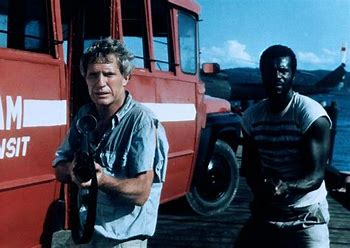 Christopher Connelly stars as mercenary Mike Ross, a Vietnam War veteran who does any dangerous and dirty job for the right amount of money. Tony King is his black fellow mercenary who used to go by Washington but has recently converted to Islam and now calls himself Mohammed.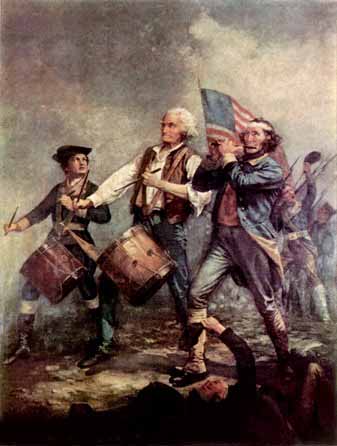
 Ethan Allen and his Green Mountain Boys and Daniel Morgan’s Kentucky Rifles, a unit that will see impressive action throughout the entire war, from Canada to the Deep South.
 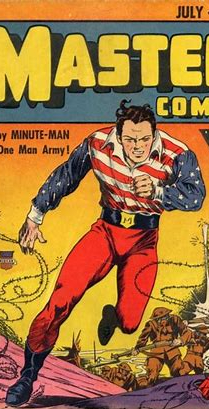 MINUTE-MAN
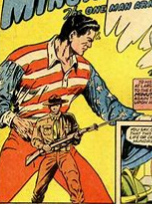 STORY 1: The Origin of Minute-Man
 A.D. 2000 (1890) – Written by Alvarado M. Fuller, this was one of the earliest imitations of Edward Bellamy’s 1888 work Looking Backward. The main character is a Cavalry Lieutenant named Junius Cobb.
  With the cooperation of friends, Lt. Cobb seals himself away in a San Francisco replica of the Statue of Liberty with an alarm set to revive him in the year 1987. Due to a mathematical error, however, our main character is not awakened from suspended animation until the year 2000 A.D.
 INVASION FROM INNER EARTH (1974) – This hilariously bad science fiction film was one of the early efforts from Bill Rebane, whose low budget movies were to Wisconsin what Larry Buchanan and his productions were to Texas. Invasion from Inner Earth is a perfect example of “so bad it’s good” filmmaking … for the first half hour or so. After that the story drags on agonizingly and the apparently improvised dialogue pushes your sanity to the breaking point.
  Some news broadcasts take the events seriously but others present the victims of the chaos as bone-headed rubes deserving of ridicule. We are even shown viewers laughing at these victims but we never understand why, since the Earth is obviously under attack with millions of dead and missing. At no time are we shown the mockers getting their comeuppance for their smirking callousness despite how wrong they are. It’s that kind of movie.
  Balladeer's Blog