
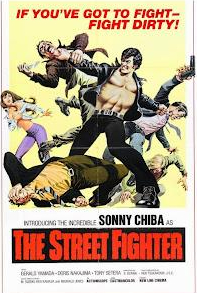
 THE STREET FIGHTER (1974) – Long before the Street Fighter video games there was this ultra-violent cult film from Japan starring the one and only Shinichi “Sonny” Chiba. Long before Riki-Oh: The Story of Ricky and Romeo Must Die, this 1970s grindhouse actioner featured an “x-ray vision” scene of the damage being done to a villain’s skull and brain by a powerful blow from the star.
Sonny Chiba had been a television and movie star in Japan for decades by this point, starring in everything from serious action films to kid-friendly ventures like Invasion of the Neptune Men and The Golden Bat. The Street Fighter, titled Clash! Killer Fist in Japan made Chiba an international sensation.
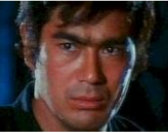 The iconic Chinese superstar Bruce Lee had passed away by this point, and Japan’s Sonny Chiba was hailed as Lee’s true successor in martial arts cinema, albeit with karate, judo and other skills that differed from Lee’s. There is a degree of truth to such claims, but Sonny was a much darker, grittier figure even if he DOES make the same kind of noises that Bruce made.
The Street Fighter is notorious as the first U.S. film to be tagged with an X-Rating based purely on violence. Chiba’s character Takuma “Terry” Tsurugi is a brooding, bitter man of half-Japanese and half-Chinese background, and he grew up as an outcast due to such a mixed heritage. Hell, he was even imprisoned in an Imperial Japanese concentration camp as a child.
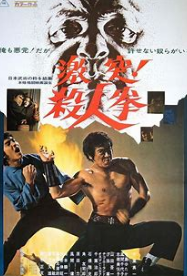 A lifetime of fighting in the streets of Japan has molded Terry into a legendarily hardened and ruthless man who is now a high-priced mercenary badass for hire. He’s not quite a “hero” since this film doesn’t have any, he’s just the main character like Michael Corleone in the Godfather movies.
The Street Fighter begins with Tsurugi being hired to bust out a Japanese gangster before his scheduled execution. Posing as a Buddhist Priest who’s come to the prison to comfort the condemned criminal before revealing his kickass abilities, Terry accomplishes this mission with backup from his lackey/ live-in servant Ratnose. Continue reading
 THE PHANTOM OF THE OPERA (1925) – Lon Chaney Senior’s makeup and performance as the title character were envelope-pushing for 1925 audiences. To me this is the ULTIMATE silent horror film. It may sound odd, but in my opinion this movie is the very best cinematic adaptation of the Gaston Leroux novel.
  Halloween Season is underway here at Balladeer’s Blog! This time around I have so many new readers that I’ll start out with this look at some VERY old horror stories that are basically Halloween versions of the Ancient Science Fiction reviews I write.
  CONCORDIA CONQUERS DIVISION TWO – The NAIA’s CONCORDIA (MI) UNIVERSITY CARDINALS traveled to face the upper-level WAYNE STATE WARRIORS from NCAA Division Two. The Cardinals joined so many other NAIA teams who toppled D2 teams this year in a 24-23 Instant Classic.
 HILLSDALE AT HOME – NCAA Division Two’s storied HILLSDALE COLLEGE CHARGERS played host to the NORTHWOOD UNIVERSITY TIMBER WOLVES. The Chargers proved their determination to right this disappointing season, leading the Timber Wolves 17-7 at Halftime before winning it in a 40-18 blowout.
  DOWN GOES NUMBER TEN – Staying in D2 for a moment, the MISSOURI WESTERN STATE GRIFFONS welcomed the number 10 team in the nation – the EMPORIA STATE HORNETS. This was a tale of two Halves, as the Griffons led 24-6 by the midpoint, but then had to hold on by their fingertips to pull off the Upset 34-31.
  AGZCEAZIGULS – Pronounced “Agzceaziguls”, this was a fictional country between Chile and Bolivia.
  NUMBER THIRTEEN (1922) – This film marked the first time that Hitchcock worked as a director on a movie, but was the thirteenth film project he had worked on in some capacity, hence the title. The production went unfinished from lack of funds and the original title may have been Mrs. Peabody but even that is uncertain.
 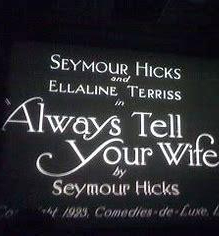 ALWAYS TELL YOUR WIFE (1923) – Hitchcock started out as a co-director of this 20-minute comedy short but had to step into the top spot when the original director quit over creative differences with the studio. Though Alfred’s previous directing effort had gone unfinished, this comedy short was completed but he was not credited since he had not directed the entire film.
  THE PLEASURE GARDEN (1925) – The third time was almost the charm as this 75-minute movie was not only completed, but Hitchcock was credited as the director!
  The Rivals of Sherlock Holmes was a 1971-1973 British television series about London by Gaslight detectives from both the Victorian and Edwardian Ages.
 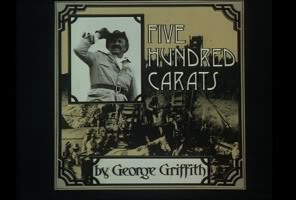 Episode: FIVE HUNDRED CARATS (February 5th, 1973)
 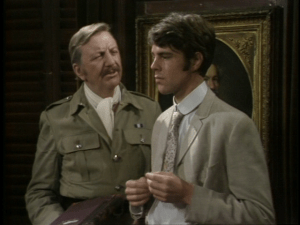 For the first time in this series we have a story set outside Great Britain, which I found to be a welcome change of pace. Leo Lipinzki (Barry Keegan) works as a Detective Inspector for the Cape Police, but technically the already wealthy and powerful De Beers Diamond Corporation is who he really answers to.
  “THAT WAS NUMBER FIIIIIVE!” – In NCAA Division Three, the ENDICOTT COLLEGE GULLS welcomed the number 5 team in the nation – the HARDIN-SIMMONS UNIVERSITY COWBOYS. For once Endicott didn’t choke in the spotlight, leading the Cowboys 3-0, 17-3 and 37-3 in the 1st, 2nd and 3rd Quarters respectively. In the 4th, a garbage time TD from HSU made the final score 37-10.
 NUMBER SEVEN TAKES A FALL – Up in the NAIA, the number 15 MONTANA TECH OREDIGGERS faced the visiting 7th ranked COLLEGE OF IDAHO COYOTES. The Orediggers parlayed a 17-7 opening Quarter lead into a 34-21 Halftime advantage. The 3rd Quarter ended with the Coyotes making it a 37-35 game before Montana Tech added a 4th Quarter TD to win out 44-35.
  USCAA GAME OF THE WEEK – This USCAA (United States Collegiate Athletic Association) affair pitted the WILLIAMSON COLLEGE OF THE TRADES MECHANICS against the CAPP ACADEMY CRUSADERS. In a driving rain, the Mechanics led the Crusaders 7-0 in the 1st and 10-0 at the Half. A scoreless 3rd Quarter was followed by a CAPP rally attempt in the 4th as Williamson won the game 25-14.
  GIANT-SIZE SUPERVILLAIN TEAM-UP Vol 1 #1 (March 1975)
 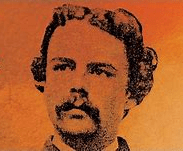 AN AUTOMATIC ENIGMA (1878) – By Julian Hawthorne, son of Nathaniel Hawthorne. In the past Balladeer’s Blog has reviewed some of
  Balladeer's Blog