
Balladeer’s Blog continues its examination of the many facets of Fool Killer lore. FOR PART ONE, INCLUDING THE HISTORICAL CONTEXT, CLICK HERE
 Previously I examined Joel Chandler Harris’ 1902 story Flingin’ Jim And His Fool-Killer, set in Georgia in October of 1872, plus Ridgway Hill’s Facts for the Fool-Killer, set in and around Buffalo, NY in 1909.
Now we back up a year for the great O. Henry’s story The Fool-Killer, published as part of The Voice of the City in 1908. In his younger years O. Henry (William Sidney Porter) had personally known Charles Napoleon Bonaparte Evans, the editor of the Milton Chronicle.
Evans was the man behind the earliest written examples of Fool Killer stories and published them as if they were letters from the “real” Fool Killer himself, who claimed Jesse Holmes was his actual name. O. Henry started his short story The Fool-Killer by recapping the fame of the folk-figure, claiming he was known “from Roanoke to the Rio Grande.”
In apparent deference to his old friend Charles Evans, Porter kept Jesse Holmes as the Fool Killer’s “real” name but introduced some of his own innovations to Fool Killer lore. Continue reading
 MELUNGEON VARIATIONS PART ONE
 If he had, one possible source would be the Fool Killer figure from Melungeon folklore in East Tennessee and other Appalachian areas. Or, since we have no way of checking exact dates, Evans’ darkly satirical tales may have influenced the existing Melungeon lore since Melungeons at the time were scattered from Tennessee to North Carolina, Kentucky and Virginia.
 Over five years ago Balladeer’s Blog began a detailed look at the neglected folklore surrounding the Fool Killer figure. It’s been a while since I left off and I’m about to dive back in. There are so many new readers here that I’m posting a recap of the very first Fool Killer item from the 1850s. Next time I’ll resume where I left off – in 1913.
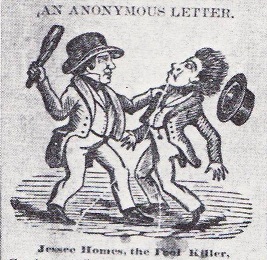 Balladeer’s Blog kicks off a multi-part examination of the neglected 1800s folk figure called the Fool Killer. I will cover the various stories featuring the Fool Killer and the different ways the character was used by the authors. If I ever examine the related character called the Rascal Whaler it will be in a separate series of blog posts.
 However, since Evans was all about the written word, he used the Fool Killer as a much more active figure. Evans’ Fool Killer – claiming Jesse Holmes as his real name – roamed North Carolina and Virginia (which at the time still consisted of what would become West Virginia) looking for fools to kill with a club/ walking stick he always carried with him. The character would then send letters to Editor Evans explaining why he had chosen victims, defending his actions with puckish commentary.
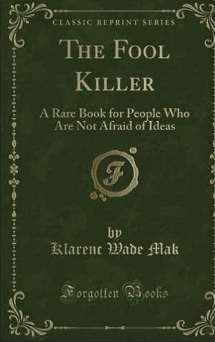 THE FOOL KILLER (1918) – The 1918 one-shot publication called The Fool Killer collected written works by Dr Klarenc Wade Mak, poet, author and socialist political candidate for mayoral office in Kansas City, MO around 1918. Mak had also written Ekkoes (sic) from the Hart (sic) and Mental Dinamite (sic).
 PART 66 – Some of the Fool Killer’s targets on both sides of the aisle in the July of 1913 edition of James Larkin Pearson’s version of the folk figure:
 PART 65 – Some of the Fool Killer’s targets in the June of 1913 edition of James Larkin Pearson’s version of the figure:
 64. The May of 1913 edition of James Larkin Pearson’s Fool-Killer was lacking in urgency and satirical bite, but I found it to have a certain slice of life feel to it that captured its era yet also underlined certain tableaus that are seemingly eternal.
 63. Some of the Fool Killer’s targets in the April of 1913 edition of James Larkin Pearson’s Fool-Killer:
 Those were the days when not even the elected officials owned by wealthy families like the Morgans accumulated anywhere near as much money as those who owned them. Think of today’s abusive and repulsive families like the Bidens, Cheneys, Pelosis, Bushes, Clintons, Romneys and so many others from both political parties who have COMBINED obscene wealth with political influence to be sold. They plunder the public treasury while making shady money on the side and breaking laws that the rest of us are expected to abide by.
 *** Forever chaotic Mexico. The Revolution of 1910 led to the final downfall of decades-long dictator Porfirio Diaz in 1911. Diaz’s reform replacement, Francisco Madero, was overthrown and arrested by Victoriano Huerta, who had just had Madero killed in 1913. The Fool-Killer bitingly observed “They sure don’t waste any time in Mexico deliberating over what to do with their ex-presidents.”
 Some of the Fool Killer’s targets from the January of 1913 edition of James Larkin Pearson’s Fool-Killer –

