
Here is another fragmentary work by Eupolis who, along with Aristophanes and Cratinus, was one of the Big Three of Attic Old Comedy.
Dr Frank N Furter
BAPTAE was a comedy satirizing the latest faddish belief system to hit Athens: the cult of the Dorian and Thracian goddess Cotyto. Just like Kabala or transcendental meditation and other systems have enjoyed a brief vogue with entertainers and even some movers and shakers various foreign deities would periodically develop a following in ancient Athens.
Eupolis was lampooning the fashionable appeal of one such cult and also ridiculed other elements of Cotyto worship as we will see.
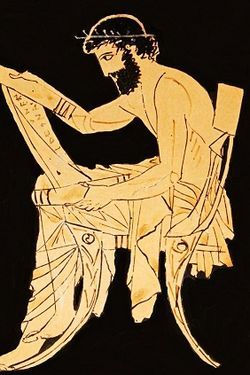 The title Baptae came from the fact that the worshippers of Cotyto would immerse or “baptize” their garments in blue, green or purple dye, an expensive and very ostentatious indulgence for the time period. And yes, Baptae and baptizing are from the same root word, since it originally referred to immersion in any liquid, not just water.
The main element of the Athenian version of the cult of Cotyto was the fact that her devotees were exclusively male and all of them dressed as the goddess as part of their rites of worship. Continue reading
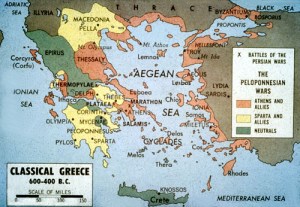 POLEIS – In this post I’m looking at Poleis (Cities), written by Eupolis, one of the Big Three of Ancient Greek Comedy along with Aristophanes and Cratinus. This satirical comedy is dated from approximately 422 B.C. to 419 B.C. Like so many other such comedies it has survived only in fragmentary form.
 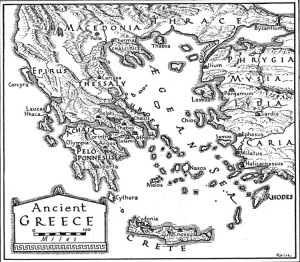 For some prep as I at last get back into reviewing the surviving fragments of ancient Greek comedy every now and then, here’s my 2011 review of Demoi by Eupolis. Along with Aristophanes and Cratinus, Eupolis was one of the Big Three of Attic Old Comedy. Background info is
 AUTOLYCUS (420s B.C.) – Balladeer’s Blog examines the ancient Greek comedy Autolycus. This play was written by Eupolis who, along with Aristophanes and Cratinus, constituted the Big Three of Attic Old Comedy. As with so many comedies of the time period Autolycus has survived only in fragmentary form, unfortunately.
  BAPTAE – Written by Eupolis, one of the Big Three of ancient Greek comedians. Aristophanes and Cratinus were the other two. This comedy satirized the latest “hot new cult” to hit Athens – worship of the Dorian and Thracian goddess Cotyto.
  THE BANQUETERS – By Aristophanes. This was the very first comedy from the Athenian whose name is synonymous with ancient Greek comedies, especially political satires. The nineteen-year-old presented a landowner from Athens whose two sons were being introduced to his phratry brothers at a banquet dedicated to Herakles.
 WEALTH GODS (PLUTOI) – By Cratinus. In this satirical comedy the Titans are depicted overthrowing Zeus in a metaphor for the fall of the political leader Pericles. This was a reference either to his actual death or to the loss of his position as Strategos (Commander in Chief) depending on which year you go with for the comedy.
 As for how people can be “costumed” as cities, picture how it would be done with American cities. The chorus member representing New York might be depicted as the Statue of Liberty, Saint Louis as the Arch, Pittsburgh as a steel worker, Los Angeles as a brain-dead movie star and so on.
  Balladeer's Blog