
 HURRICANE NELL, THE GIRL DEAD-SHOT (1877) – Written by Edward L. Wheeler. This blog post is dedicated to the prolific author and fellow blogger Jacqui Murray from WordDreams here at WP. Her blog is ideal for blogging tips, information on her latest book releases and much more. Jacqui had expressed interest in Dime Novel heroes and heroines for my Frontierado Holiday coverage this year, so here is the first of many more posts I will make about these often forgotten characters.
In general, the Dime Novel period of westerns, detective, science fiction and horror tales lasted from 1860 to around 1919 or the early 1920s. Pulp magazines took over from there. Many Dime Novels were very loosely based on real-life figures like Buffalo Bill, Calamity Jane and others. Many more were purely fictional.
 That brings us back to Hurricane Nell, the Girl Dead-Shot, also known as Hurricane Nell, the Queen of the Saddle and Lasso, and, in a misleading re-titling, as Bob Woolf, the Border Ruffian. (NOT three separate books.) Though published in May of 1877, Nell’s adventures were set earlier in the 1800s than most of the other big-name heroines of Dime Novels, so I am starting with her and will move on to the others in the next few weeks.
Hurricane Nell started life as Nelly Allen, and was around 13 years old when Bob Woolf and his gang of Missouri outlaws set fire to her family’s home in Kansas intent on murdering her parents (who were already dead of small pox anyway). In typical pulp fiction fashion, Nelly vowed to get revenge on the men who burned her home. Continue reading
 DAREDEVIL AND THE BLACK WIDOW Vol 1 #95 (January 1973)
 When the Man-Bull begins rampaging through Frisco in order to flush out our hero, the Black Widow and Daredevil swing into action against him. Eventually the villain renders Daredevil unconscious, leaving the Black Widow alone against him for the cliffhanger ending.
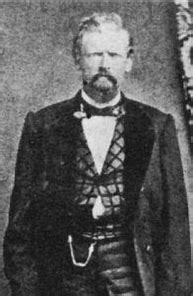 FERD THE DANDY (1821-1866) – The Frontierado holiday is coming up on Friday, August 4th this year, so here is another seasonal post from Balladeer’s Blog. This one covers a ruthless, yet often forgotten, gambler-gunslinger.
 Come 1859 Ferd the Dandy had acquired too big a reputation as a professional gambler to even get in a game anymore, so he gravitated to the Sailors’ Diggings Gold Rush near Waldo, Oregon. The mining town had already known the murderous rampage of the Triskett Gang by the time Patterson arrived to stain Waldo with his own activities.
 Balladeer’s Blog’s recurring feature Forgotten Television returns with this look at four television presentations of works by the Russian writer Anton Chekhov.
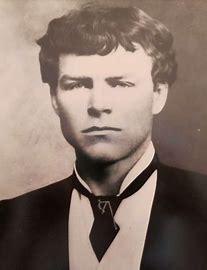 TEMPLE LEA HOUSTON (August 12th, 1860-August 15th, 1905) – This future gunslinging lawyer and last child of Sam Houston with his wife Margaret Lea-Houston was born in the Governor’s Mansion in Austin, TX. His storied father, the first president of the short-lived Republic of Texas was then serving as governor for the state of Texas.
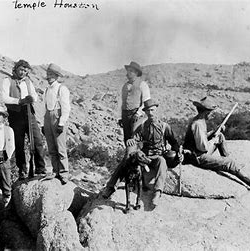 It was during this time that Temple met an old friend of his father, who arranged a job for the young man as a Senate Page in Washington, DC. Working in that capacity for 3 years, Temple developed an ambition to study law and enter politics himself someday.
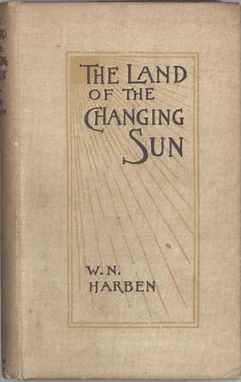 THE LAND OF THE CHANGING SUN (1894) – By William N. Harben, a former American literary giant who has since been forgotten.

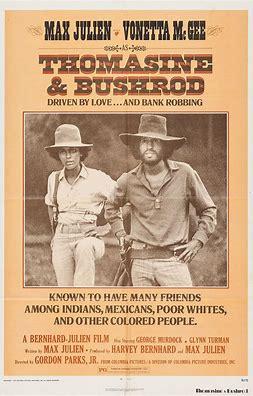 THOMASINE & BUSHROD (1974) – The Frontierado Holiday is Friday, August 4th this year, so here is another seasonal post – a review of the black western Thomasine & Bushrod. This tale of a pair of outlaw lovers is a nice change of pace since it is set in the fading Wild West of 1911-1915. Automobiles are beginning to show up here and there, making Thomasine & Bushrod a fascinating fusion of “Robin Hood Outlaw” tales bridging both the old west and the later Pretty Boy Floyd era.
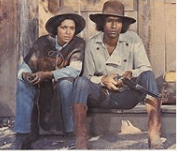 While collecting the money from her most recent success, Thomasine sees a fresh Wanted poster for her old boyfriend J.P. Bushrod, a gunslinging bank robber and rustler portrayed by Max Julien from the previous year’s blaxploitation hit The Mack.
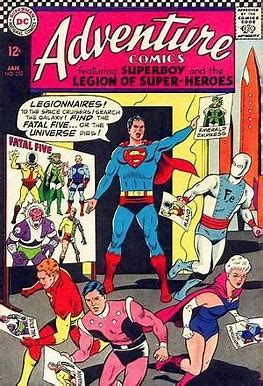 ADVENTURE COMICS VOL 1 #352 (January 1967)
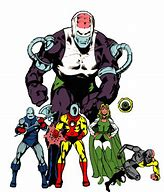 The Fatal Five are Tharok, a cyborg whose cybernetic brain makes him more intelligent than Brainiac 5; Validus, a huge purple monstrosity whose insanity drives it to perpetual violence; the Emerald Empress, evil ruler of an entire planet whose populace recently won a war to overthrow her; the Persuader, a killer and plunderer whose armor and Atomic Axe make him unstoppable; and Mano, a mutant whose hand wields energies so powerful that the hand destroyed his entire home planet.
 Frontierado is celebrated the first Friday of every August, so this year it will be marked on August 4th. This holiday celebrates the myth of the old west, not the grinding reality. Here’s a seasonal post regarding my look at an opera version of the original Django spaghetti western from 1966, which strips the story down to its essentials, with no gold subplot.
 DJANGO: AN OPERA – Here at Balladeer’s Blog I love sharing my enthusiasms. My blog posts where I provide contemporary slants to Ancient Greek Comedies to make them more accessible have been big hits over the years, so I’m trying it with operas. A little while back I wrote about how Philip Wylie’s science fiction novel Gladiator could be done as an opera. This time I’m addressing the 1966 original version of the Spaghetti Western titled Django.
 LANGUAGE: Spanish. I’ve resigned myself to the fact that most of my fellow English-speakers find English-language operas to be silly. The prosaic nature of the forced rhymes in a language we are well-versed in does seem to rob opera of its mystique and its grandeur.
 Scene One: The opera would open with a stage version of one of the most iconic visuals from the 1966 film. Our title character, DJANGO, clad in his long blue jacket with his well-worn Union Army uniform underneath it, slowly, wearily drags a coffin behind him as he walks along singing his mournful song. He pulls the coffin via a rope slung across one shoulder.
 THE CLONES (1973) – This neglected sci-fi item from the 70s was directed by Lamar Card & Paul Hunt, based on Hunt’s story. The Clones falls into that category of films that I always refer to as “X-Movies” because of the way they put one in mind of the paranoid and conspiratorial air of the best X-Files episodes.
 Gregory Sierra, best known to trivia buffs as “And Gregory Sierra” for the number of times he was credited like that in various television shows and movies, plays Nemo, a government agent tasked to keep the clone project a secret and bring in the escapee.

