
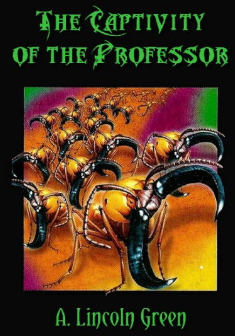
 THE CAPTIVITY OF THE PROFESSOR (1901) – Written by A. Lincoln Green, a presumed pen name, this story was first published in Blackwood’s Edinburgh Magazine in the February 1901 isssue.
Years before H.G. Wells’ short story The Empire of the Ants came this tale for which that might have been a more appropriate title. The Captivity of the Professor is set in the jungles of Brazil. Our narrator is an entomologist from Scotland who is so intent on studying rare ant species that he ignores warnings of an indigenous tribe and travels into a forbidden region of the vast rainforest.
Before long the professor discovers an unusual ant of unknown species, possessing an oversized head and huge mandibles. The rest of the ant’s fellows fall upon our narrator and, proving to be incredibly intelligent, manage to herd him to their colony using painful bites to spur him along. Continue reading
 THE NEW NORTHLAND (1915) – Written by Louis Pope Gratacap. The main character is explorer Alfred Erickson, who recruited a few associates of varied backgrounds to join him in a search to prove the existence of an isolated warm weather land mass in the far north.
 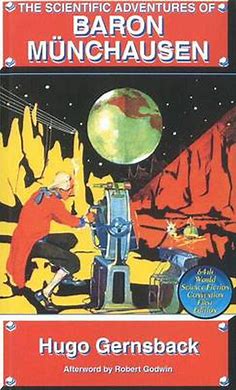 THE SCIENTIFIC ADVENTURES OF BARON MUENCHHAUSEN (1915-1917) – Written by the iconic Hugo Gernsback in the years before he launched his own publication, these sci-fi tales presented the 1700s Baron being alive and having wild adventures. (The cover spelling does not match the one Gernsback used.)
 THE EMPEROR OF THE AIR (1910) – Written by George Glendon, this is a story about two visionaries – the German-American tycoon Hans Kreutzer and the Italian inventor Anatole Lonari.
  THE WARSTOCK: A TALE OF TOMORROW (1898) – Written by the British William Oliver Greener under the pen name Wirt Gerrare. Despite this book’s Great Britain origins, the two lead characters are American inventors from Plainfield, New Jersey – Robert Sterry and Willie Redhead.
  While hitting the social circuit in London, our heroes meet Madeline Winship, who connects them with backers who are part of an exclusive Royal Society-inspired group of scientific minds. The group are called the Isocrats, and they devote themselves to science and similar intellectual pursuits, like elevating dancing to what we might call performance art.
  BELLONA’S HUSBAND (1887) – This book was written by West Point graduate (Class of 1867) William James Roe under the pen name Hudor Genone.
  Garrett constructs a disc-shaped spaceship that uses hydrogenium as its anti-gravity agent. Holt and Professor Garrett are joined by Trip, a shady friend of Garrett’s, who travels with them on a flight to the planet Mars.
  MARS REVEALED (1880) – Written by Henry A. Gaston, this is another work that combines science fiction with religious and spiritual concepts.
 THE RAINBOW OF ADAMANT (1897) – Written by Charles Kelsey Gaines, this short story is an excellent example of how slowly word of scientific discoveries was spread in the 19th Century compared to our lightning-fast communications of today. The Rainbow of Adamant was written during the period when most of the world was still going by assumptions and theories about helium.
  THE SICKLE OF FIRE (1896) – Written by Charles Kelsey Gaines, an American author who set this particular short story in British Columbia. The main characters are our narrator and a scientist named O.D. McKazy.
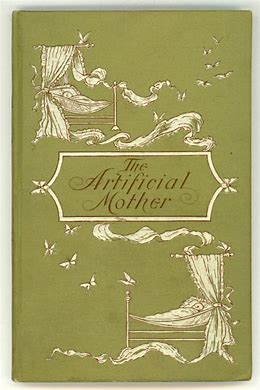 THE ARTIFICIAL MOTHER (1894) – This short story was written by George H. Putnam, who served in the Union Army during the U.S. Civil War and was also a Prisoner of War. He was part of the Putnam publishing empire and in 1901 authored the children’s story The Little Gingerbread Man.
  Balladeer's Blog