
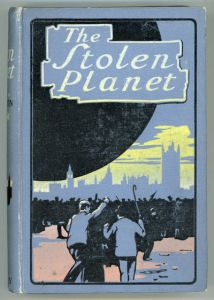
 THE STOLEN PLANET (1906) – Written by John Mastin. Jervis Meredith, a wealthy young British man and his equally wealthy friend Fraser Burnley are so brilliant they invent anti-gravity. Next the young tycoons have a spaceship built so they can use their anti-gravity device to tour outer space.
The battleship-sized craft is named The Regina and combines propellers with Meredith and Burnley’s anti-gravity invention. The friends set off with a ten-man crew and – oddly enough – they are so paranoid about people stealing their secrets they have rigged an elaborate bugging system throughout the Regina so they can know what the crew members talk about.
 The explorers make the eccentric decision to explore the region around Sirius first, rather than our own solar system. Enroute the Regina accidentally pulls an uncharted planet out of its orbit (?) and causes it to collide with another uncharted planet. This collision causes a new sun to be born. (Regular readers of Balladeer’s Blog will remember that this was apparently a big idea for a time since a lot of these old stories feature suns forming from colliding planets.)
Eventually our heroes decide to explore some planets on their way to the star Sirius. On the first planet they visit the explorers find enormous ruins obviously built by a gigantic race that is now extinct. The structures were beautiful from what can be made out and are made of materials unknown on Earth. Continue reading
 A FLIGHT TO THE MOON (1813) – Written by George Fowler. This story introduces readers to Randalthus (no last name given), an 1800s American man who has come to regard the moon with a mixture of near-pagan worship and pioneer longing.
 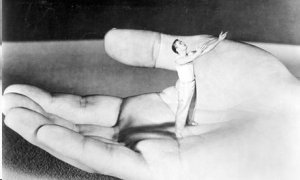 THE ADVENTURES OF A MICRO-MAN (1902) – This work of vintage or “ancient” science fiction was authored by Lancelot Bayly under the pen name Edwin Pallender. The central character of the story was Doctor Geoffrey Hassler, a wealthy eccentric scientist who has discovered “microgen” a gas which shrinks objects down to a very small size.
  Dr Hassler’s demonstrations of the procedure in a diving-bell shaped chamber convinces even the skeptics and he rakes in even more money plus scientific recognition. One day when he, his daughter Muriel, her fiancee Gerald and a family friend named Reverend Eden are all inside the chamber a fluke accident causes them all to be shrunk down to a fraction of an inch.
 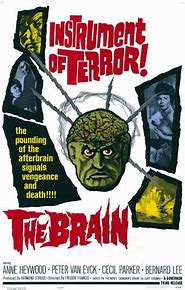 THE BRAIN (1962) – Freddie Francis directed this black & white film, which was the third movie adaptation of Curt Siodmak’s science fiction novel Donovan’s Brain. The characters’ names were changed and the sci fi elements were mixed with detective story elements this time around.
  THE HAMPDEN-SHIRE WONDER (1911) – Written by J.D. Beresford. The story centers around Victor Stott, the remarkable son of Cricket star Ginger Stott. A news reporter who is on friendly terms with Ginger Stott meets his one year old child Victor during a train trip.
  THE AURORAPHONE (1890) – Written by Cyrus Cole. This fun piece of vintage or “ancient” science fiction features the character Gaston Lesage, an eccentric genius who moves to the mountains of Colorado to continue his pet experiments. Lesage is obsessed with perfecting transmission and reception of radio signals, especially regarding potential contact with other planets.
 THE LAST GENERATION – A STORY OF THE FUTURE (1908) – Written by James Elroy Flecker. A poet longs to see beyond his own era and experiences. He is visited by a time-travel phenomenon which is similar to a wind. The Time Wind transports him to various periods in the future.
  Here at Balladeer’s Blog I love sharing my enthusiasms. My blog posts where I provide contemporary slants to Ancient Greek Comedies to make them more accessible have been big hits over the years, so I’ve been trying it with operas, too. Previously I wrote about how Philip Wylie’s science fiction novel Gladiator could be done as an opera. Then I looked at how an opera version of the 1966 Spaghetti Western Django could be done and then an opera based on the novel Venus in Furs.
  ROLLER BLADE (1986) – They’re the Cosmic Order of the Roller Blade and they’re female Jedi Knights on roller skates. Well, sort of. Where does one begin when reviewing this film that is so beloved by all of us fans of bad movies? Let’s start with the setting and then tackle the characters as well as Roller Blade’s legendary director Donald G Jackson (R.I.P.).
  “Skate or Die” is the ugly motto of the survivors in this kill or be killed future. That’s because the filmmakers absurdly pretend that traveling via roller skates or skateboards is the only way to move swiftly enough to have a chance of evading the dangerous gangs and mutants.
 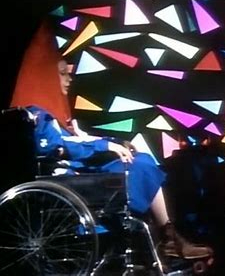 MOTHER SPEED (Katina Garner) – The Mother Superior of the Order of the Roller Blade. She is in a wheelchair yet still wears roller skates on her feet since such skates are part of the Order’s sacred garments. Mother Speed, like all the good guys in Roller Blade, speaks in grandiose faux-Shakespearean littered with “thees” and “thous” and “yea, verilies.” ESPECIALLY “yea, verilies.”
 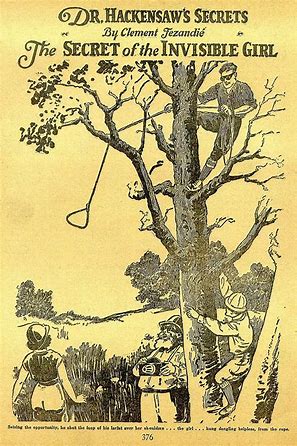 THE SECRET OF THE SUPER-TELESCOPE (August 1923) – Doctor Hackensaw’s new invention, a super-telescope, provides the most detailed looks at Earth’s moon ever seen. A secret civilization is detected and photographed. NOTE: This is the start of the first serialized Hackensaw storyline.
  Balladeer's Blog