
Balladeer’s Blog’s month-long celebration of Halloween continues.
 THE OCTAVE OF CLAUDIUS (1897) – By Barry Pain. This obscure little Gothic honey is just good enough that you wish it had been better. There are so many elements that make it appealing but it falls just short of being a worthwhile read for anybody except obsessive fools like me.
Claudius Sandell, a once-promising young man who has wound up disinherited and poverty-stricken is broken and suicidal but is saved by mad scientist Dr Gabriel Lamb. Lamb is a wealthy sadist whose macabre experiments on human beings have already cost his wife her sanity and their infant child its life.
Since Claudius feels he has nothing to lose he accepts Dr Lamb’s proposition to become his most recent human guineau pig in exchange for eight days (the “octave” of the title) with enough money to indulge himself in ways Oscar Wilde would have found gaudy and excessive. He can also pretend to be wealthy and successful to impress all the people in his life who had written him off as a failure. Continue reading
 A THOUSAND DEATHS (1899) – This story was the first published work by Jack London and it definitely shows, but it still has certain merits. The protagonist – who is never named – is the scion of a wealthy British family. Feeling stifled by his rigid upbringing he ran off in his teens to roam the world. He’s fallen into various shady professions over the years and now at age 30 he’s begun having regrets.
  He seems to feel himself going under but then wakes up after an indeterminate time on board a luxurious yacht. The man has various tubes and wires connected to his body and soon learns that he has been saved from drowning by the crew of … his estranged father. That father (who also goes unnamed – it’s early Jack London all right) fails to recognize his son because of the changes the younger man’s rough life has inflicted on him.
 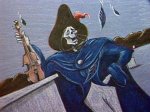 THE DEAD DANCE BY MOONLIGHT – Manetti the mad violinist terrorized the New England states in the late 1700s. His favorite instrument was made out of enchanted wood from the forests of the infamous White Mountains. When Manetti chose to he could play his violin in such a way as to bring the dead up from their graves and make them do his bidding. FOR THE FULL STORY CLICK
  THE MARQUETTE MONSTER – This horrific monster was sighted by Jacques Marquette in the 1670s near what is now Alton, IL. Native Americans of the region called it the Piasa Bird and had been making artwork depicting the beast since around 1200 AD according to archaeological findings. The creature was supposedly the size of a horse with the torso of a cougar, huge wings like a bat and a human head sprouting deer antlers. FOR THE FULL STORY CLICK
 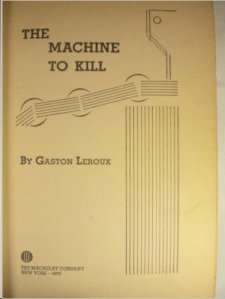 Gaston Leroux – the author of The Phantom of the Opera – wrote The Machine to Kill in NINETEEN TWENTY-FOUR. Many book sites list it as 1935, but that was just the year it was finally translated into English. It has also been published in English under the titles The Bloody Puppet and The Gory Puppet.
 Balladeer’s Blog’s month-long celebration of Halloween continues with this look at a variety of forgotten or neglected horror legends from American lore.
  THE CORPSE-SMITH OF CONNECTICUT – Also called the Cadaver Master and the Carrion Engineer this mad scientist of Eastern European descent was the cause of the many vanished graveyards from Connecticut’s past. The Corpse-Smith scandalized 1770s America with his brilliant but macabre uses for every single resource he could possibly harvest from the bodies of the recently deceased.
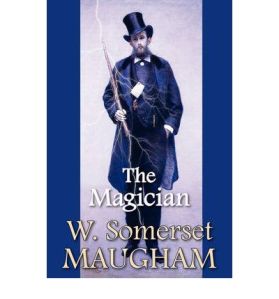 THE MAGICIAN – During Halloween Season a few years back Balladeer’s Blog reviewed the 1926 silent movie adaptation of The Magician. This time around I’ll review the original Somerset Maugham novel from 1908. It’s no secret at this late date that the malevolent sorceror of the title, Oliver Haddo, was based on the real-life Aleister Crowley. In fact, Crowley would accuse Maugham of plagiarism when he reviewed The Magician under the name Oliver Haddo, his fictional counterpart.

 Balladeer's Blog