
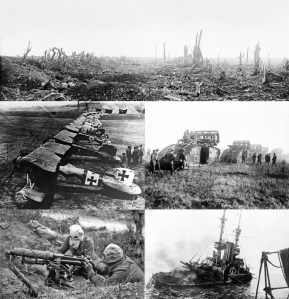
 Yes, the first eleven days of November are about World War One here at Balladeer’s Blog – with my other topics thrown in as well.
This blog post combines World War One with my Ancient Science Fiction category to present vintage stories regarding that conflict.
Many of them feature dieselpunk inventions like I covered in my reviews of the pulp magazine G-8 And His Battle Aces.
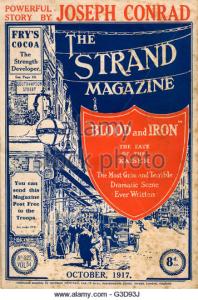 BLOOD AND IRON (1917) – Written by Robert Hobart Davis & Perley Poore Sheehan. Dramatic depiction of advanced technology being used in World War One. In Germany one of the Kaiser’s scientists is experimenting with replacing lost limbs and organs with mechanical replacements. He has been trying to create cyborgs out of maimed German soldiers from the front lines.
After many failures, Experiment Number 241 is the scientist’s first success. His replacement arms and legs possess superhuman strength plus his replacement ears and eyes have granted him long-range vision and hearing.
Kaiser Wilhelm is thrilled, since this means that previously mortal wounds will now pave the way for cyborg soldiers. The Kaiser interrogates and drills Number 241 and expresses annoyance with the cyborg’s robotic way of speaking.
Number 241 at length has enough and kills the Kaiser, leaving a bloody pulp of a corpse. The horrified scientist’s expression of shock is met with a robotic reply of “Blood – and – iron.” (As in Otto Von Bismarck’s motto.)
IN THE CHANNEL (1907)- Written by B.T. Stewart. Though penned seven years before the Guns of August blazed this story featured Kaiser Wilhelm’s forces launching an offensive in the English Channel and the surrounding waters.
The short story centers on naval battles, with the Germans unseating the Britons as “rulers of the waves.” The Germans then go on to win the entire war in this combination of the Future War sub-genre with the “are we fully prepared for war” exploitation tales. Continue reading

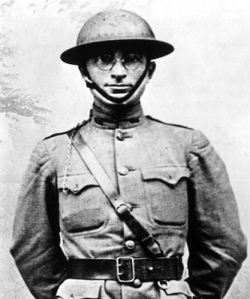
 Balladeer’s Blog had proceeded from the assumption that most readers were familiar with flying ace Eddie Rickenbacker but comments and emails indicate otherwise. Here’s a look at him as we lead up to another November 11th, now called Veterans Day but formerly known as Armistice Day since November 11th, 1918 marked the end of World War One.

 THE IACCACI BROTHERS – In the 1960s young American men would head to Canada to avoid serving in the Vietnam War. During World War One a number of young American men headed to Canada to serve in British Military Units because the U.S. had not yet entered the conflict.
 Previously Balladeer’s Blog examined the gods and goddesses of the Merina people of Madagascar. This time around I’ll move on to the Betsimisaraka people, the second most populous group in that island nation.


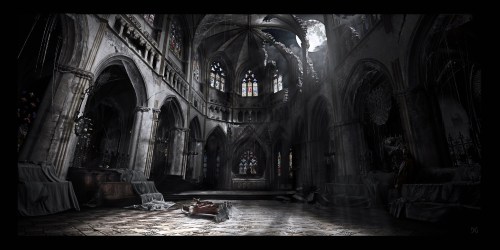 ALL HALLOWS (1926) – Written by Walter de la Mare. In recent decades Walter de la Mare’s horror stories have begun to get as much attention as his poetry. This particular tale is about a haunted cathedral but there is also a blatant subtext.
 Appropriately for a horror story our protagonist has arrived as the sun is going down. The odd, perhaps half-crazed Verger (Anglican Church Caretaker) impatiently leads the new arrival on a tour of the degenerating interior. Almost like a Halloween Funhouse host the Verger emphasizes the creepy lore about All Hallows.

