
Balladeer’s Blog continues reviewing the 1927 book Trader Horn, the quasi-autobiographical account of the British Trade Agent Alfred Aloysius Horn’s adventures in Africa during the late 1800s. For Part One click HERE.
 PART FOUR – We pick up this time with Trader Horn’s reflection on how the British and German firms in Africa dominated the European trade in ivory and rubber, while France was a distant third. There were whispers that the French (whom Horn referred to far more insultingly than he ever referred to the indigenous Africans) were strategizing about using their Colonial Governments to limit the success of Great Britain and the German Empire wherever they could.
The French and Belgians also pressed further and further into Central Africa, encountering tribes who had literally never seen white people before. Alfred’s employers at Hatson & Cookson kept him closer to the coast, but he added the Como, Remwe, and Belagona Rivers to his trading route.
All the trading firms in Africa at the time had their expeditions fired upon by Fan tribesmen, and Trade Agent Horn’s were no exception. As the years rolled by, Alfred was moved to a higher position with his firm. Continue reading
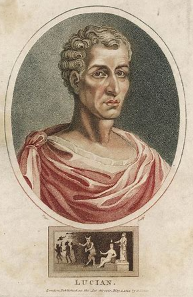 These two works were written by Lucian, the Greek philosopher and satirist who lived in the 2nd century A.D. Lucian was noted not just for his philosophical observations but also for two works that defied definition by his contemporaries but would easily fall into the category of science fiction today. Both works are from roughly 150 A.D. and feature trips to the moon by pseudo-scientific means.
 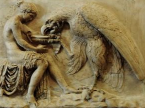 He discovered that the moon (on which he could breathe just like on Earth) was populated by the souls of the deceased (roughly twelve hundred years before Dante’s Paradiso). From the moon Menippus made the astonishing observation that the Earth was round and not flat, in a wry addition to the then-ongoing philosophical debate about the subject.
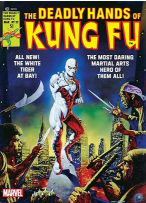
  DEADLY HANDS OF KUNG FU Vol 1 #22 (March 1976)
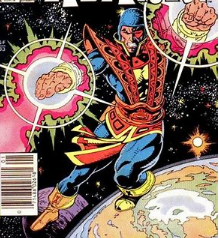
  While fleeing those villains, Jonathan was accidentally exposed to the Zero Fluid, transforming him into a super-powered being able to shoot Zero Energy from his hands in the form of rays of concussive force. That concussive force from his hands could allow him to fly, as well, the same way the Fantastic Four villain Blastarr does.
  PART THREE – Trader Horn’s skills at bartering and deal-making with the indigenous people grew as he acquired more and more experience. His account always expressed his awe at the high populations of animal life throughout the region in the 1870s-1880s.
 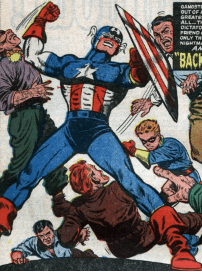 YOUNG MEN Vol 1 #24 (December 1953)
 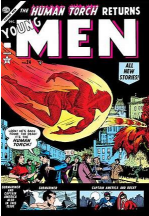 Synopsis: Steve Rogers aka Captain America is now teaching at a prep school called the Lee School in a New York suburb. James Buchanan Barnes aka Bucky is one of his students. In old school comic book disregard for the passage of time, Bucky is still that young despite having been a teen in 1941.
  PART TWO – Aboard the S.S. Angola, the teenaged Alfred Horn approached Africa on his first assignment as a Trade Agent for the firm of Hatson & Cookson, whose business operated from Bonny Brass to Old Calabar and up the Niger River as well as coastal ports along Cameroon.
 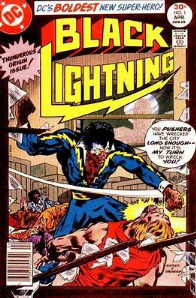 BLACK LIGHTNING Vol 1 #1 (April 1977)
  Jefferson Pierce was a gifted athlete from high school on up and even won medals in the Olympics. Disdaining celebrity, he became a teacher and ultimately moved back to the slums where he grew up and taught at Garfield High.
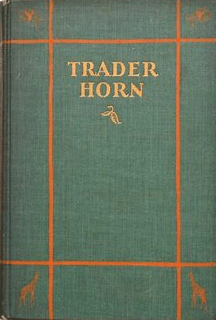
  TRADER HORN (1927) – This book was the quasi-autobiographical account of Alfred Aloysius Horn (1854-1931), a British trader in Africa during the 1800s. Ethelreda Lewis added pertinent commentary to each chapter.
  This weekend’s light-hearted and escapist superhero post from Balladeer’s Blog is a Double Feature. The main event is a look at the early adventures of Marvel’s neglected hero El Aguila (the Eagle).
 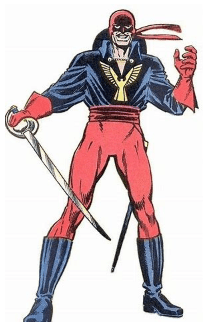 EL AGUILA
  Through trial and error, Alejandro found that long, slender metal objects were the best conductors for his bioelectricity and gave him the most accuracy with his energy blasts. He began using a sword through which to shoot his rays but to conceal his mutant nature publicly pretended his swords contained micro-generators that accounted for the rays he projected.
  THE VIOLET FLAME (1899) – Here is another of the science fiction works written by THE Frederick Thomas Jane, of Jane’s Guides fame. Previously, Balladeer’s Blog reviewed Jane’s works
  Balladeer's Blog