
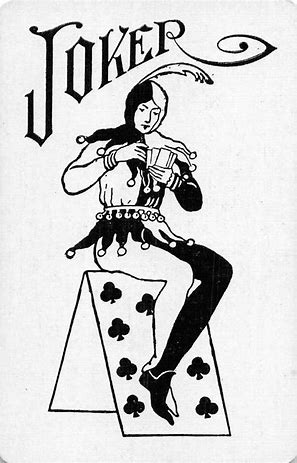
 THE JOKER (1919) – With the Joker sequel reportedly stinking up theaters around the country I figured why not look at the 1919 pulp magazine hero who used that nom de guerre?
Why not, indeed! Here’s another neglected Pulp Hero in the tradition of Balladeer’s Blog’s looks at the Moon Man, Silver John, the Nyctalope, G-8 & His Battle Aces and Northwest Smith. This time it’s the Joker, but not THAT one. Before the comic book villain and even before Conrad Veidt’s turn as Gwynplaine in The Man Who Laughs (1926), came the 1919 Pulp Magazine figure called the Joker.
NOTE: Sometimes people mistakenly think Pulp Magazines were the same as comic books, only earlier. However, the Pulps were TEXT STORIES, not sequential art like comic books. The Pulps did have colorful, striking covers like later comic books would have and sometimes a few illustrations in the stories, but the Pulps were a much higher level of storytelling.
The 1919 Joker was created by Hugh Kahler, who the year before had created the White Rook, another hero/ villain of the Pulps. In some ways the Joker was a rehash of Kahler’s own White Rook crossed with Guy Boothby’s Simon Carne/ Klimo crime figure from 1897. Continue reading
 EZRA PEDEN – This was Allan Cunningham’s tale about the deeds of Scottish Presbyterian Minister Ezra Peden and his encounters with the forces of the supernatural in Scotland from the late 1600s to around 1706. It makes for nice Halloween Season reading and practically makes you feel the chilliness of Scotland in late October as Cunningham depicts the brave, if humorless, Ezra adventuring in the moonlight.
 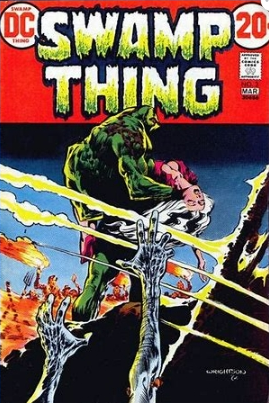 SWAMP THING Vol 1 #3 (March 1973)
 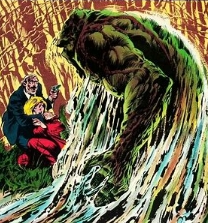 Alec’s body was dumped in the swamp, where the bio-restorative chemicals his body had been soaked in interacted with his own anatomy, the mud and the plant life in the swamp, letting him rise from the dead as a murk-monster. The Swamp Thing retained Alec Holland’s intelligence but could not speak for the first several issues.
  The Halloween Season has rolled around once again! For newcomers to Balladeer’s Blog let me point out that I post about more than just horror topics in October. I also cover my usual recurring subjects but throw in reviews of neglected, centuries old novels and short stories from around the world in a Gothic Horror equivalent of my Ancient Science Fiction blog posts. I also review horror films throughout the month.
  A NOVA CALIFORNIA (1921) – This short horror story from Brazil was written by Lima Barreto. The tale is set in a fictional Brazilian town called Tubiacango after the river along whose banks it stood. Tubiacango’s population was roughly 4,000.
  NOTE: Something I’ve been struck by as I read more and more Brazilian literature is how even the smallest towns could boast an international population. There will be native Brazilians, newly arrived Portuguese, white Europeans, and – as the literature itself points out – every shade of dark colored people from all over the world.
  THE DEADLY HANDS OF KUNG FU SPECIAL Vol 1 #1 (June 1974)
 Synopsis: Storywise, this tale features three separate sections as Iron Fist, the Sons of the Tiger and Shang-Chi the Master of Kung Fu go up against Fu Manchu in three separate stages of his “master plan.”
 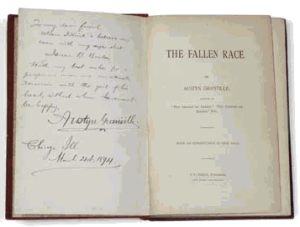 THE FALLEN RACE (1892) – Written by Austyn Granville. If you’ve ever thought to yourself “How come nobody ever combined science fiction, H. Rider Haggard-style Lost Race tales AND kangaroo-human hybrids” then THIS is the story for you.
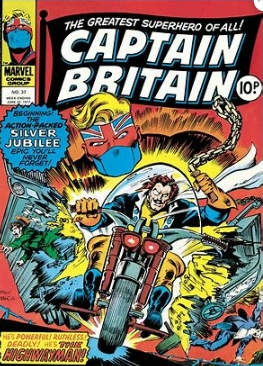 CAPTAIN BRITAIN Vol 1 #37 (June 22nd, 1977)
  The event is crashed by a new supervillain called the Highwayman, who rides a high-tech motorcycle which uses laser cannons and other weaponry. The villain also wears a monocle that shoots energy blasts and wields a battle chain.
 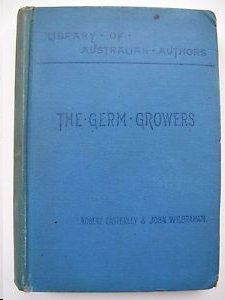 THE GERM GROWERS (1892) – Robert Potter wrote this work of “ancient” or vintage science fiction dealing with biological warfare and alien abductions.
 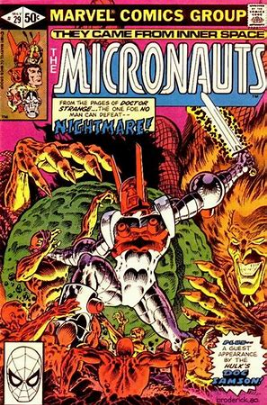 MICRONAUTS Vol 1 #29 (May 1981)
 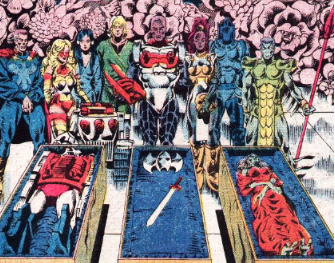 Acroyear’s wife, Cilicia, condemns her husband for using the Worldmind against Karza, thus causing so much damage to Spartak that it is now uninhabitable. Even now, the survivors must be leaving the planet to find another home elsewhere in the Microverse/ Quantum Realm. Cilicia quits the Micronauts in disgust.
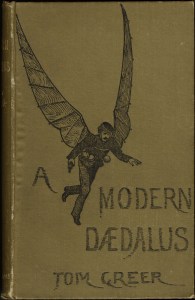 A MODERN DAEDALUS (1887) – By Tom Greer. No, the title’s not referring to James Joyce’s character Stephen Dedalus (sic) but this tale IS about Ireland. The main character is a young man named Jack O’Halloran, a recent college graduate who returns to his native Ireland.
