Back in 2021 I reviewed the first 12 1970s stories featuring Marvel’s martial arts hero Shang-Chi HERE. Then in 2024 I reviewed several stories which teamed up Shang-Chi and another 70s Marvel kung fu hero – Iron Fist, HERE.
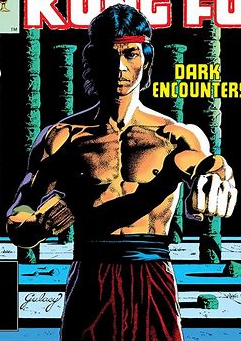 For newbies to this IP, in 1973 Marvel licensed the use of Sax Rohmer’s Fu Manchu plus other characters from the Fu Manchu tales. Rather than just churn out a Fu Manchu comic book series “the House of Ideas” instead combined it with the Kung Fu craze of the time and created Shang Chi, the son of Fu Manchu.
Shang Chi, as a surrogate Bruce Lee, and Sir Denis Nayland-Smith, as a surrogate Braithwaite from Enter: The Dragon, were the core of the new series. Shang Chi started out as an operative of his evil father Fu Manchu but realized the error of his ways and threw in with Sir Denis and his team to battle his father’s malevolent schemes.
Many of Sax Rohmer’s other characters showed up in the series, including Fah Lo Suee, the daughter of Fu Manchu. The series expanded from just Fu Manchu storylines. Writer Doug Moench and artist Paul Gulacy churned out some of the best stories in this title, with Gulacy often drawing Shang-Chi to resemble the late Bruce Lee.
 Shang-Chi, Master of Kung Fu had its own inimitable style and was largely one of the most innovative comic books of the 1970s and early 1980s. “Largely” is the key word.
Idiotically, Marvel depicted Shang-Chi forever barefoot and forever wearing a goofy outfit like he was advertising a local martial arts academy. It mars the MOKF series as surely as the artwork for Ebony drags down 1940s and 1950s Spirit stories. So, when possible I will sprinkle in pics of 1970s martial arts movie star James Ryan who genuinely looked like Shang-Chi but wearing regular clothing.
 MASTER OF KUNG FU Vol 1 #29 (Jun 1975)
Title: The Crystal Connection
Villains: Velcro and Razor-Fist
Synopsis: Sir Denis Nayland Smith has Shang-Chi join him and other team members in a mission against international heroin dealer Carlton Velcro. The other team members are series regular Black Jack Tarr, former Royal Marine Commando, and semiregular Clive Reston, a walking meta reference.
NOTE: Clive Reston is a capable espionage agent whose schtick was that offhand references he makes establish something that is never specifically spelled out – his father must be James Bond and his grand-uncle must be Sherlock Holmes. It was kind of clever at first but eventually grew tiresome.
 Our heroes take a seaplane to Velcro’s mansion in a grotto near France’s Gulf of Lions. Reston poses as a buyer of a large amount of heroin who then burns all of his purchase and an enormous amount of the drug dealer’s additional inventory of smack.
All this was a distraction to allow Shang-Chi and Black Jack Tarr to infiltrate the mansion. Reston ends up captured and Shang-Chi comes face to face with Velcro’s bodyguard Razor-Fist in their VERY FIRST encounter. Continue reading →

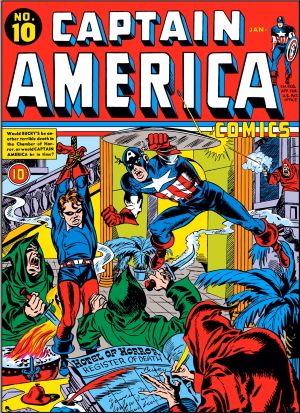 CAPTAIN AMERICA COMICS Vol 1 #10 (Jan 1942)
  Our heroes don their costumes and as Captain America and Bucky they find Mara’s lair and defeat all her Nazi troops and her booby-traps. Then Cap defeats the countess and her purse’s weaponry – grenades, a gas-gun and a regular gun. Continue reading
 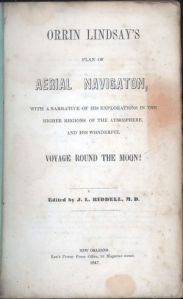 Full Title: ORRIN LINDSAY’S PLAN OF AERIAL NAVIGATION WITH A NARRATIVE OF HIS EXPLORATIONS IN THE HIGHER REGIONS OF THE ATMOSPHERE AND HIS WONDERFUL VOYAGE ROUND THE MOON (1847) – This work was written by J.L. Riddell.
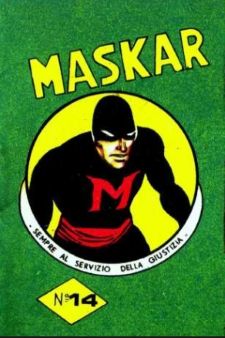 MASKAR
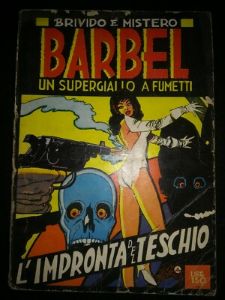 BARBEL
  Full title: THE REV. JOHN SMITH DIED – AND WENT TO JUPITER VIA HELL (1908) – This bizarre but memorable work was published by the Juno Society of the time and was written by an anonymous author. The title clergyman passes away and finds himself in Hell – not forever, but as an ambassador to Jupiter.
 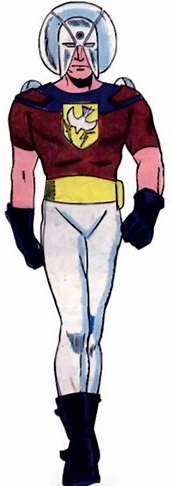 PEACEMAKER
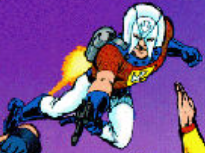 Powers: Peacemaker was in peak physical condition and was a master of armed and unarmed combat. He designed and tested his own weapons in his secret “Peace Palace” lair in the Swiss Alps. Peacemaker’s action outfit included body armor, a jetpack for flight, plus a helmet for protection AND for radio communication. This hero’s weapons included his powered laser gun and the sonic beams shot from his helmet.
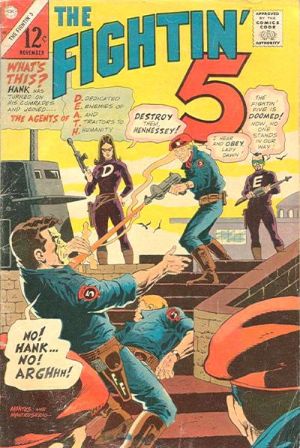 FIGHTIN’ FIVE Vol 1 #40 (Nov 1966)
 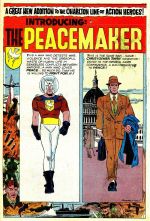 The following day Christopher attends an embassy dinner in Geneva, at which Bork and Smith needle each other. Smith dons his Peacemaker outfit and assembles his weapons, then flies out to Bork’s mansion in the Alps. Bork’s private army tries to kill Peacemaker but he outfights them all.
  SIX THOUSAND YEARS HENCE (1891) – Written by Milton W. Ramsey. Regular readers of Balladeer’s Blog may remember that I’m usually enthusiastic about these works of “ancient” science fiction and look for any bright spots. In this novel’s case that is very, very difficult. For a book written in 1891 it seems more like an 1820s piece.
 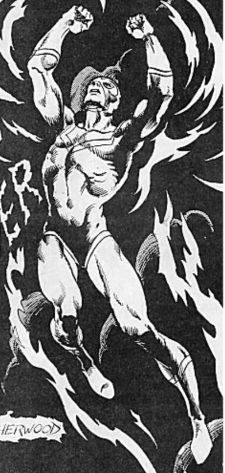 WHITE THUNDER
 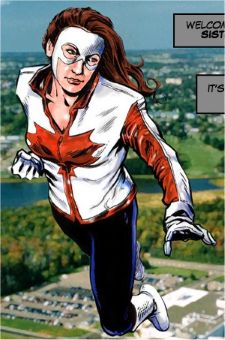 CANADIANA
 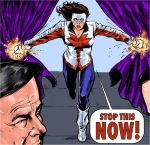 Jennifer proved strong enough to rebel against Robertson and use her powers against him and against his other female acolytes. She adopted the costumed identity Canadiana.
  CREATURES ON THE LOOSE Vol 1 #22 (Mar 1973)
  Synopsis: Thongor (at right), as always wielding his father’s god-forged sword Sarkozan, is working as a thief in the city-state of Zangabal. During one caper Thongor comes close to being captured by the authorities but is given shelter by Kaman Thuu, a Priest of the Seven Gods of Zangabal.