
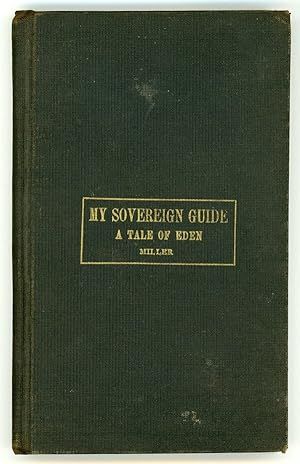
 THE SOVEREIGN GUIDE: A TALE OF EDEN (1898) – Written by American William Amos Miller and published under the title My Sovereign Guide: A Tale of Eden, so I have no idea why everyone now starts the title with The instead of My. Regular readers of Balladeer’s Blog know that many works of “ancient” science fiction mixed in religious elements with the sci-fi. The Sovereign Guide is one of the most inventive and features angels using advanced technology. Taking the novel section by section:
PART I: JOURNEY TO ROME – Miller himself serves as our narrator. He has received word that Manethoe, a former household aide who had embezzled money from him long ago, is on his deathbed in Rome.
Miller is filled with such a strong desire to see the man one last time and openly forgive him that an actual angel appears to him and offers to take him to Rome to see Manethoe. The angel – who has neither eyes nor ears but functions perfectly without them – has our narrator fly off with him in his chariot.
High above the Earth they pass by a multitude of angels singing a song which William’s guide joins in. At length the chariot descends toward Rome.
PART II: A SCENE IN THE CHAMBER OF DEATH – At Menethoe’s bedside, our narrator and the angel behold the Angel of Death waiting to claim the dying man’s soul. Miller sees the Angel of Death studying a high-tech instrument which it has implanted in Menethoe’s heart.
William forgives his former aide and when the device in the dying man’s heart indicates that he has died, Mary, Mother of God appears at the bedside, a vision so dazzling that our narrator faints. He comes to later on his angelic companion’s chariot. The angel informs him that he is taking him to see Eden and what is left of its Garden.
A weakness of the book is that we never get any indication why William Amos Miller is being granted this privileged tour.
PART III: SUBTERRANEAN VOYAGE TO EDEN – The chariot lands at the seashore, where our narrator is accompanied aboard a futuristic submarine crewed by angels. The vessel is egg-shaped but with spires at both ends.
As the submarine travels beneath the sea, Miller is shown the elaborate machines which run the craft as well as the electro-magnetic energy sources which power it. The sub travels to a section of the seabed through which they enter the Inner Earth’s sea and eventually surface near one of the continents inside the Earth.
PART IV: DESCRIPTION OF EDEN AND ITS PRISTINE GARDEN – The narrator describes how the Inner Earth has its own clouds and receives light via openings at both the North and South Poles. It’s an inadequate description and readers are left not understanding how those two openings illuminate the entire subterranean realm.
The angelic companion shows William the underground continent called Eden, of which its famed Garden is only a small part. Animals of all kinds, some of them extinct on the planet’s surface, still live in Eden’s idyllic forests. The Garden itself is a wasteland of rotted vegetation with only the Tree of the Knowledge of Good and Evil thriving.
The Forbidden Fruit still grows from it and Miller describes it as very much like apples but with blooms that look like miniature angels on the bottom. Next our narrator spots the massive, domed Tomb of Adam and Eve, where they were buried long after their exile from Eden. There is also a literal Rock of Ages upon which stands the Tower of Time which rises far into the subterranean sky. The Tower grows with every moment which passes.
PART V: A PALACE ON THE SEA – William and the angel return to the sub crewed by angels and continue traveling on the surface of the waters. In time they pass a similar but much larger vessel filled with people from one of the subterranean nations. They are all perfect in face and form and are clothed in white robes.
The men wear their hair down to their shoulders and the women wear theirs far longer but in ringlets. Everyone wears jewelry as well as large pendants in which they carry everyday items.
At present the other vessel’s commander – the King of Adavonia, one of the underground countries – invites our narrator and his angelic companion to come aboard his virtual floating palace and so they do. Miller is shown the engine room and its machinery as well as the library. The king keeps a Bible in his library and William learns that every home in the subterranean realms has a Bible.
After a time, our main characters return to their submarine and while the king’s vessel heads back to Adavonia they set course for a place called Adam’s View.
PART VI: A FAIR SCENE FROM THE PROMONTORY ON ADAM’S VIEW – William and his guide arrive at the stone island called Adam’s View, where Adam and Eve had rested on the first Sabbath after their exile from the Garden of Eden. The pair climb to the very top of the highest hill, which provides a spectacular view of the surrounding waters as well as glimpses of far-off lands.
The angel explains that on this peak Adam had wept over the thought of what Jesus Christ would one day have to endure in order to redeem humanity from the sin he and Eve committed. Adam wished that he could take on that burden in order to spare the Son of God.
Our leads descend from Adam’s View and return to their vessel crewed by angels. Next, they come to another subterranean continent and disembark at a town called Adam’s Mount. The town rests at the foot of a mountain so named because of Adam’s long-ago victory in which he defeated his foes seven times in one day to begin his conquest of the land.
A large statue of Adam has been erected there in memory of his deeds. The angel leads Miller to where two separate seagoing vessels await. William is taken aboard one while the angel boards the other and heads off across the sea. Our narrator passes out with exhaustion and fear but wakes up hours later as the ship on which he travels is in the middle of a great storm.
Miller was too late to evacuate with the other passengers and was left alone on the ship, which has run aground on rocks.
PART SEVEN: THE TEMPEST – For a long time William and the ship are stranded on the labyrinth of rocks called the Devil’s Cages. After the intense storm subsides, he is rescued by a passing ship and towed into port at the nearest continent.
PART EIGHT: A NEW WORLD AND A NEW RACE POSSESSES THE REMAINS OF SIR JOHN FRANKLIN – Miller gets welcomed into a new land in which he does not understand the language being spoken. He is taken by a horse-drawn metal wagon and placed in the care of a group of scholars who understand English and they teach him to speak the local language.
The Edenic language contains 36 letters but is so easy to learn that it only takes days before he is fluent in it. He is in a place called Zevae. Like the other nations of the Inner Earth it is ruled by an absolute monarch who has a council of 12 advisors. The throne is hereditary.
War has become unknown in the subterranean realms. Any differences between countries are solved through mediation by a dozen of the nearest kings to the warring nations. The high-tech weapons they used to wield in warfare are lightweight but far more destructive than those on the surface world and are now merely relics in museums.
Their museums also contain preserved remains of surface dwellers who accidentally discovered the Inner Earth, among them Sir John Franklin of the notorious Franklin Expedition in the 1840s. Other preserved specimens are humans of all races plus a few monkeys and apes who managed to reach the Edenic continents.
Edenic science is so advanced that they are capable of erecting buildings of immense size through procedures incomprehensible to Miller. The telescopes used below ground are much stronger than normal humans possess. Subterranean scientists can observe planets very far away from our solar system. Our narrator is told the life-forms on those worlds are far different from ours.
Everyone of Inner Earth has a personal, portable telegraph device with which they can communicate with everyone else in the underground continents. The streetcars and railroads are powered by electricity and chemicals. Physicians use what we would call x-ray machines and tools which can enter the body through our cavities and cure any illness or injury.
The vegetarian diets of the Edenic people contribute to their overall good health. Plants unknown to the surface world provide many services, including the petrification of the corpses of anyone who dies. Burial is done with the deceased standing upright in the coffin.
Edenic people are able to read each other’s facial expressions so completely that it borders on telepathy. Rain falls only during one forty-day period each year in the Inner Earth and is a time of constant indoor festivals.
PART IX: SPIRITUAL WORSHIP IN EDEN – After six months, Miller gets tasked with writing everything he knows about the surface world. After his writings are approved by the king they are published in book form as Tales and Fables of the Outer World. When it comes to religion, the people of Eden feel Catholicism is the faith most like their own.
The temples in which the subterraneans hold their services are constructed with an elevated section in the middle which serves as the altar and the platform from which the clergy members direct the mass. The parishioners’ seats look up at the priests, Sermon on the Mount style. Three masses are held on each Sabbath day.
The author chose now to finally explain that Zevae is the capital city of a country called De Vo Nia. William Miller has become renowned in every nation of Inner Earth and he embarks on a tour of the underground world.
PART X: THE BAITING AND CATCHING OF A SUCKING SOKONAI – In the country called Me Von Da Za our narrator spends some time aboard the ship of a man called Va Lo Na, a participant in the major trade of Me Von Da Za – fishing, hunting and fur trading. In addition to normal whales, the Inner Earth seas contain large subaquatic creatures called Sokonai and Orkinos.
The latter have offensive tusks in their long mouths and protective tusks all over the rest of their bodies. Sokonai are even larger than whales and they feed by sucking in a huge quantity of seawater and letting their digestive system filter all the edible creatures and seaweed from the rest. William Amos Miller was very good at world-building and he explains the methods of catching Sokonai and Orkinos in great detail.
Me Von Da Za is also rich with relics from the distant past, when the inhabitants waged war with what we would call Iron Age weapons.
PART XI: THE TRANSPORTATION OF MINERALS IN A MINERAL BALLOON – Captain Va Lo Na takes our narrator to an island called Fon Fe Dor, which is so supercharged with electricity that some objects float around in the sky above it, almost like they’re in orbit around the island. On Fon Fe Dor the subterranean nations mine for fictional minerals called Swaja and Volna, which are used in metal working and for conducting electricity.
Aboard aircraft called rubus William accompanies Va Lo Na and his crew to mine for Swaja and Volna from the floating bodies above Fon Fe Dor. The rubus are lighter than air vessels which move by way of propellers. When each rubu is full it is flown lower to drop its Swaja and Volna into the opened hull of the main seaship.
After obtaining a full load, our characters return home.
PART XII: DESCRIPTION AND HISTORY OF MOUNT AFHOE – The next stop in William’s travels is the Star Continent, an entire continent in the shape of a seven-pointed star. At the very center of the huge land mass is a mountain that Adam and Eve named the Rock of Penance because they prayed penitent prayers there frequently along with many generations of their children and grandchildren and more.
At long last, God sent the angel Gabriel to tell them all that their prayers had been heard and they would soon be permitted to move to the surface world. Eve was allowed to select a mountain to be carved into a monument to God and so she did, naming it Mount Afhoe.
After 5 years spent traversing the underground world, William decides to explore the lands under the South Pole.
PART XIII: THE AURORA BOREALIS OF EDEN – Enroute to the South Pole, our narrator stops off at the island called Uleha. The author says the Inner Earth atmosphere around this island trickles upward and manifests as the Aurora Borealis on the surface world. Uleha is the center of manufacturing for the continents of Eden.
For a time, Miller stays with Le Vo Zu, a weaver of the fine gold, silver and bronze cloths used by the Edenites for their robes and other items. He also attends the funeral of Le Vo Zu’s mother, who died at age 113 – the point at which most subterranean people pass away.
PART XIV: THE LAST INTERVIEW WITH MA VO ZU – Our narrator passes a lot of time with Ma Vo Zu, the priest son of Le Vo Zu. During their many conversations they discuss matters of religion, usually after a lunch of cooked fruits and nuts plus bread and fruit-flavored water.
Ma Vo Zu explains the Inner Earth’s version of the fall of Lucifer, which – long before Scientology – was presented in terms of interplanetary warfare. Ultimately, Lucifer and the planets ruled by himself and his fellow rebellious angels lost to God and the planets of his loyal angels. The losers were then cast into Hell. This chapter ends with the sudden return of the angel who first met William Amos Miller at the beginning of the novel.
PART XV: DECLARE, O MUSE – The angel transports himself and William to Hell, which consists of several levels of burning lands with each level devoted to sinners of particular types like in Dante’s Inferno. After the bottom level comes the Gulf of Despair.
Once sinking their way to the bottom of that gulf, the duo behold each of the rebellious angels wearing Crowns of Misery and holding Scepters of Despair. At their center is Lucifer himself, wearing a crown of fire and making endless entries in the book on his lap regarding the latest arrivals in Hell for punishment.
Again, science fiction elements are brought in. The Chief Electrician of Hell informs Satanic Majesty Lucifer that his forces on Earth who figuratively besiege Houses of Worship require reinforcements. God, Jesus and Michael forever come to the aid of any who devote themselves to them, empowering even the lowliest human wretch to persevere against the armies of Hell.
Still, Lucifer and his subordinates vainly strive against all that is Holy, hoping in vain to one day grasp an opportunity to storm the heights of Heaven itself.
PART XVI: HOW HELL CAME INTO EXISTENCE – As if this novel hasn’t already been all over the place, we now get a virtually Gnostic explanation from the angel regarding how Hell was born. Ancient beings of spiritual energy called Avedores inhabited the ancient planets before they fell under the rule of Lucifer and his legions.
The Avedores subsequently became trapped within human flesh beginning with Adam and thenceforth all other humans as they were created or born. Jumping around in time now, the narrative gets even more jumbled. We’re told Lucifer rebelled against God because God would not make him a fourth member of what was the Holy Trinity.
How any of this has anything to do with Avedores inhabiting human flesh is beyond me. The author describes all this in long, rambling and contradictory blathering. I reread it all several times, but it doesn’t come together in my opinion. If anyone else is ever bored enough to read this part of the novel, let me know if it makes any more sense to you.
Anyhow, all of that results in the fiery realm of Hell coming into being. Well, duh!
PART XVII: CONCLUSION – And so after more quasi-religious gobbledy-goop William is returned to his home in the mortal realm. And after all he has witnessed he is now blind and deaf, which SPOILER: William Amos Miller already WAS in real life when he wrote this.
*** So, there you have it! The Sovereign Guide includes some imaginative yet baffling sci-fi concepts crossed with scatter-brained religious principles but in the end it all just collapses under its own weight. Individual parts are riveting but the novel is overall disappointing because of the confusing and nonsensical ending.
FOR MORE “ANCIENT” SCIENCE FICTION CLICK HERE.


Pingback: ANCIENT SCIENCE FICTION – THE SOVEREIGN GUIDE: A TALE OF EDEN (1898) – El Noticiero de Alvarez Galloso
Logged, thanks!
💙
Thank you so much!
Wonderful post as always. Your post about the ancient science-fiction story “The Sovereign Guide” is engaging to read. It brought to mind great sci-fi movies having elements of religion that I have seen and loved.
Thanks! I appreciate you saying that!
Intriguing the way that ancient sci-fi is mixed with religious elements here; I had no idea that was a thing!
Yes, that surprised me too when I first got into these old works long ago.
I find it interesting religious themes mixed with sci-fi / fantasy! Nice write-up.
Thank you very much for saying so, Capn!
You’re most welcome!
😀
Great post! Having the Garden of Eden at the center of the earth is an interesting idea. Mother Nature renews the world as needed especially after disasters. Eden could be the center of her resources. Cool. Thanks for sharing!
Thank you! Glad to do it! Another old sci-fi work that put the Garden of Eden in the Inner Earth was Casanova’s 1780s novel Icosameron, and Godwin’s 1600s novel put the Garden on the moon.
Wow! Thanks for the info. You are so knowledgeable on nostalgic movies, hosts, and books! Have you considered writing your own book? Thanks again!
I really appreciate the nice comment! I’ve considered it from time to time, but have never gotten around to it.