Tag Archives: Attic Old Comedy

LYSISTRATA (c 411 B.C.) THE FIRST ANCIENT GREEK COMEDY I COVERED BACK IN 2011

Lysistrata

LYSISTRATA (c 411 B.C.) – When I first started examining ancient Greek comedies here at Balladeer’s Blog I jokingly stated that surely readers would want me to start with Aristophanes’ most notorious and bawdiest satire. 

Lysistrata was written by the Big A himself, Aristophanes, and this comedy always makes a perfect introductory play for newcomers to Ancient Greek Comedy. Part of its accessibility to modern audiences obviously comes from the risqué premise of the play, of course. For me the notion that we can understand and laugh at the same simplistic but brilliant story that Athenian audiences from over 2,400 years ago laughed at and appreciated embodies the value of these ancient works.  

THE PREMISE
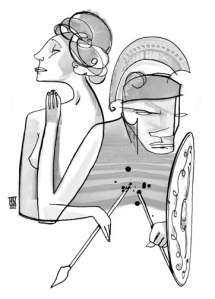
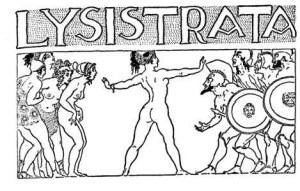
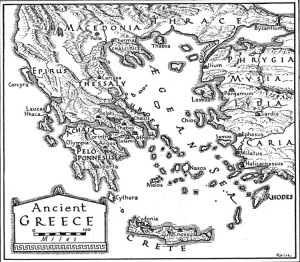
By 411 BC the Peloponnesian War between Athens (and its allied city-states) and Sparta (and its allied city-states) had been raging for roughly 20 years. The war provides the backdrop for many of Aristophanes’ surviving comedies and is especially relevant where Lysistrata is concerned.   Weary of the long, drawn-out conflict the women of Athens, led by the title character Lysistrata (supposedly based on Lysimache, the Priestess of Athena in Athens at the time), join forces with the women of Sparta and decide to withhold sex from the men until they agree to bring an end to the war. 

THE PLAY Continue reading
20 Comments

Filed under Ancient Greek Comedy

THE KNIGHTS (424 B.C.) ANCIENT GREEK COMEDY

For background info on ancient Greek comedies see my original post on the topic:  https://glitternight.com/2011/09/22/at-long-last-my-ancient-greek-comedy-posts-begin/

THE KNIGHTS – In The Knights  Aristophanes pioneered a new sub-genre of Attic Old Comedy: the  Demagogue Comedy. The villain of this masterpiece of political satire was a figure called the Paphlagonian, who was patterned on Cleon, a notorious Athenian politician of the time period.
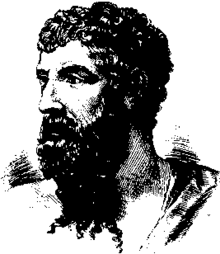
I’ll have more on the long political feud between Aristophanes and Cleon in the commentary after my synopsis of the play. The “Knights” of the title were the comedy’s chorus and were the landed, wealthy “chevalier” class of Athens and their role will be explained in the commentary as well.  

SYNOPSIS 

In the time of the Athenian Democracy political leaders, as they do today, liked to depict themselves as “servants of the people”. Taking his cue from this less-than- sincere (yet enduring) claim, Aristophanes metaphorically depicted the Paphlagonian/ Cleon and his rival politicians as literal servants of a kindly and naive estate owner named Demos or, in other words, “The People”. 

Though technically in a subordinate position, the Paphlagonian and the other servants constantly con and deceive Demos, robbing the household blind and otherwise attending to their own interests to the detriment of the figure they supposedly serve.

Aristophanes

Once again we see how 2,400 years later the political situation in the Athenian forerunner of modern democracies is very similar to our own and their political satires still resonate. 

The Paphlagonian, like Cleon in real life at the time, is proving so masterful at the arts of deception and self-aggrandizement that he is developing a monopolistic hold over the benighted Demos, who mistakenly thinks the Paphlagonian is his most devoted servant.  Continue reading

18 Comments

Filed under Ancient Greek Comedy

THE CLOUDS (C423 B.C.) ANCIENT GREEK COMEDY

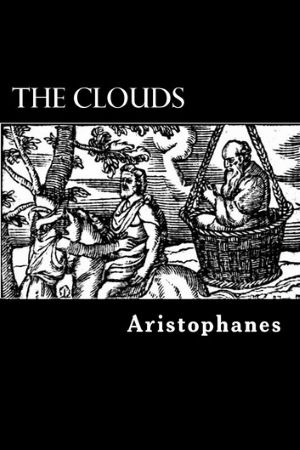
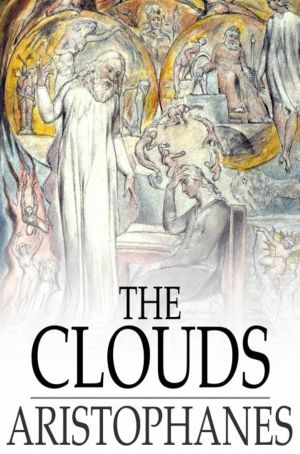
The Clouds was written by Aristophanes around 423 BC and next to Lysistrata is the Big A’s most- discussed satire, mostly because of its lampooning of the philosopher Socrates, a contemporary of Aristophanes.
Many modern readers, who have been programmed to sneeringly deconstruct old works of art rather than understand them, love to regard this comedy with hostility. They accuse Aristophanes of being “anti – intellectual” for subjecting Socrates in particular and the Sophist philosophers in general to the same satirical criticism that every other aspect of Athenian society was subjected to in comic plays.

There are many arguments I can use to refute this claim, and  I’ll present them below following my synopsis of the play itself.

To provide just a brief argument right now since you may be curious, let me remind everyone that Shakespeare is famous for the line about killing all the lawyers, but I’ve never met one rational person who thinks that line means Shakespeare was seriously proposing the execution of all lawyers or the elimination of the law and/or the  judiciary system. By the same token I hardly think Aristophanes was railing against every form of education or intellectual inquiry. More on this controversy, including the trial of Socrates, below. 

THE PREMISE

In the ancient Greek democracy Athenian citizens were expected to represent themselves in court in both criminal and civil proceedings.
Since juries are the same no matter what the time period a guilty person who was a good speaker could get acquitted while an innocent person who was an inept speaker could get found guilty.

Conversely, since there were no public prosecutors, citizens could charge their fellow Athenians with crimes and if they were skilled enough at speaking they could railroad an innocent person. Many Athenian citizens who faced a court date would pay some of the “streetcorner” Sophist philosophers to teach them rhetorical skills to make them better prepared for their appearance in court.

The Sophists were often criticized in the same way that we criticize lawyers today, because the Sophists believed in using elaborate rhetorical games to win arguments without regard to any moral or ethical considerations. Our modern words “sophisticated” and “sophistries” (especially appropriate to The Clouds) come from the same root word.   Continue reading

6 Comments

Filed under Ancient Greek Comedy

DIONYSALEXANDROS (430s B.C.) ANCIENT GREEK COMEDY

This blog post looks at Dionysalexandros by Cratinus. For my post providing background info on ancient Greek comedies click here: https://glitternight.com/2011/09/22/at-long-last-my-ancient-greek-comedy-posts-begin/ 

Cratinus was one of the Big 3 in Attic Old Comedy along with Aristophanes and Eupolis, both of whom were much younger than he was. From the fragmentary evidence available on Dionysalexandros, it appears to be a possibly unique hybrid of Attic Old Comedy and traditional Satyr Plays.   

THE PLAY

In Dionysalexandros Cratinus pushed the envelope by  blurring the line between comedy and Satyr Plays, which were the traditional mythical burlesques that the ancient Greek tragedians wrote as a comical piece after each of their tragic trilogies.

Satyr plays always featured Dionysus’ followers the satyrs, the drunken Silenus and often Dionysus himself. As in the comedies Dionysus would be depicted in Satyr Plays as a bumbler and a coward, because though the tragedies and comedies were part of the festivals devoted to that god he was able to laugh at himself.

At any rate the tragedians would write the satyrs and their divine leader into traditional myths for comic effect. Think of Simpsons episodes where the characters were written into classical stories or movies. Satyr Plays were, according to some scholars, the origin of the word satire, but others dispute this. (Scholars arguing over something? Big surprise!)  Continue reading

18 Comments

Filed under Ancient Greek Comedy

CALLIPIDES (C 400 B.C.) ANCIENT GREEK COMEDY

Not pictured: Callipides

Balladeer’s Blog examines another ancient Greek comedy. Callippides was written by the comedian Strattis and falls into that comic poet’s specialized area: Parathespian Comedies.

Another fun element of our shared humanity with the ancient Athenians who flocked to attend these plays is the fact that even 2,400 years ago audiences were fascinated and entertained by the trappings of “showbiz”. “Parathespian Comedies” were just one of the many sub-genres of ancient Greek comedy but Strattis is the writer most associated with them … by me and the .000001 percent of the population who are into such things.

Yes, a few thousand years before I Love Lucy, The Dick Van Dyke Show, Seinfeld and other such sitcoms the spectators at the Theatre of Dionysus were laughing at comedies depicting what it was like to be one of the performing, writing and singing stars of the Athenian stage. 

The Parathespian Comedies sometimes featured fictional stars as the characters but would also depict real-life figures of the stage in stories that were either wholly fictional or based on backstage gossip of the time.

Callippides was based on the real-life actor and megastar of ancient Greek tragedies. In this particular case Strattis presented a very unflattering comedic poke at Callippides, making jokes that depicted him as a William Shatner-esque ham instead of the accomplished thespian he was often hailed as. Continue reading

10 Comments

Filed under Ancient Greek Comedy

POLEIS (422-419 B.C.) ANCIENT GREEK COMEDY

Balladeer’s Blog resumes its examination of ancient Greek comedies. 

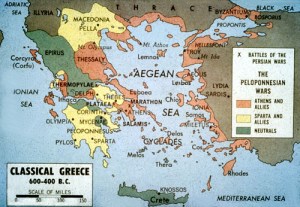
classical greecePOLEIS – In this post I’m looking at Poleis (Cities), written by Eupolis, one of the Big Three of Ancient Greek Comedy along with Aristophanes and Cratinus. This satirical comedy is dated from approximately 422 B.C. to 419 B.C.  Like so many other such comedies it has survived only in fragmentary form.
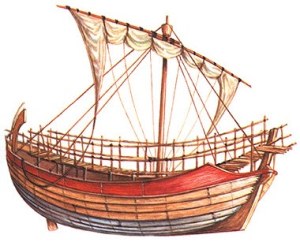
The title refers to the all-important Chorus in ancient Greek comedies. In this case the chorus consisted of actors costumed to represent some of the city-states which were under the influence of Athens at the time.

As for how people can be “costumed” as cities, picture how it would be done with American cities. The chorus member representing New York might be depicted as the Statue of Liberty, Saint Louis as the Arch, Pittsburgh as a steel worker, Los Angeles as a brain-dead movie star and so on.

Part of the political satire dealt with the love-hate relationship that many subject- states had with Athens. Being the combination Paris/ Tokyo/ New York City of its time, Athens had a lot to offer its allied polities, but a certain air of tension always existed because of what some of those locations felt were Athens’ high-handed ways of dealing with them.

Eupolis depicted the personified subject-states/ allied states as workers with a not altogether beloved “boss,” Athens. Continue reading

12 Comments

Filed under Ancient Greek Comedy

MERCHANT SHIPS (424-421 B.C.) ANCIENT GREEK COMEDY

Balladeer’s Blog presents another examination of an ancient Greek political satire. In this case it is one of those works of Aristophanes which have survived only in very fragmentary condition.

MERCHANT SHIPS

Merchant Ships was written and publicly staged in approximately 424 B.C. to 421 B.C. according to the available data. It was another of Aristophanes’ comedies protesting the pointlessness of the Greek city-states warring among themselves instead of uniting against the encroachments of the Persian Empire.

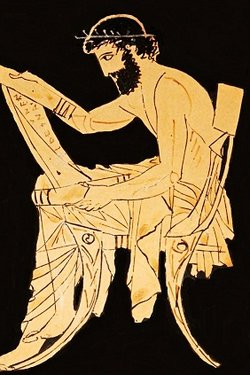
Aristophanes’ most popular surviving comedy about this topic is of course, Lysistrata, in which the women of Athens and Sparta unite to withhold sex from their men until those men agree to end the war. Merchant Ships has more in common with another of Aristophanes’ Peace Plays – The Acharnians, in which a separate peace with Sparta is made by an Athenian man named Dikaiopolis. (I always picture Rowan Atkinson in full Blackadder Goes Fourth mode playing him.)

In the case of Merchant Ships it’s more than just one person establishing a personal peace treaty with Sparta.  

In this comedy the captains of two separate merchant ships – one from Athens and one from their foe Sparta – have grown weary of the pointless conflict and make a separate peace with each other. They and their crew members get to spend the play enjoying the food and drink from their cargoes and living out a metaphorical return to the prosperous days before the Peloponnesian War when peace reigned among the various Greek city-states. 

Franchises aka Merchant Ships

If enough of Merchant Ships had survived to be staged, in a modern-day adaptation (as opposed to a straight translation) the situation could be depicted by having a Chick Fil-A restaurant right next to a Starbucks coffee shop. The managers and employees of these stereotypically Republican (Chick Fil-A) and stereotypically Democrat (Starbucks) establishments could grow tired of the political feuding, especially since both political parties often call for boycotts of the opposing business.

The managers and employees of the two franchises (in fact Franchises would be an ideal title) would make a truce separate from their home offices. Continue reading

6 Comments

Filed under Ancient Greek Comedy

PYTINE (423 B.C.) ANCIENT GREEK COMEDY

Welcome to another one of Balladeer’s Blog’s posts about ancient Greek comedies, this one written by Cratinus, who was one of the Big Three of Attic Old Comedy with Aristophanes and Eupolis the other two.
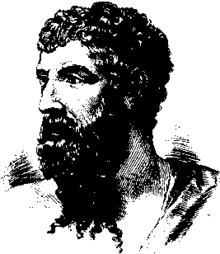
If Pytine was an episode of Friends it would be titled The One Where Cratinus Fires Back At Aristophanes. This play is also known under English language titles like Wine Flask, Flagon, The Bottle, and others along those lines. 

Cratinus, galvanized by the tongue-in-cheek caricature that Aristophanes presented of a drunken, washed-up Cratinus in his previous year’s comedy The Knights, turned that caricature into the premise of his final comedy. 

THE PLAY

From the fragments of Pytine that remain it seems Cratinus had an actor portraying himself (Cratinus) as the booze-soaked Grand Old Man of Attic comedy at the time. I always picture the character as a cross between Dudley Moore in Arthur and Tom Conti in Reuben, Reuben. Anyway, in the play Cratinus is married either to Thalia, the Muse of Comedy or to simply a female personification of Comedy. 

Comedy complains to Cratinus’ friends, who make up the chorus, that she wants to take her husband to court for abandonment. She states that he is neglecting their marital bed because he has been spending too much time sleeping around with Methe, in this comedy a personification of Drunkenness. Continue reading

6 Comments

Filed under Ancient Greek Comedy

THE BANQUETERS (C 427 BC) ANCIENT GREEK COMEDY

For background info on ancient Greek comedies and my previous reviews of them, click here (also features a list of my source books): https://glitternight.com/ancient-greek-comedies/

What Meet the Beatles was to the British Invasion, The Banqueters was to Attic Old Comedy. (Yes, I love silly comparisons) This play was the first comedy written by Aristophanes, the leading light of ancient Greek comedy, and was performed at the Lenaea festival of 427 BC when Aristophanes was nineteen years old. The Banqueters won second prize, making it a very auspicious debut for the man often considered the greatest political satirist of the ancient world.
THE PLAY

The Banqueters is a comedy that once again lets us feel our shared humanity with the ancient Athenians, in this case over the perennial conflicts caused by Generation Gaps and the tension between pointlessly clinging to the past and pointlessly embracing new ideas just because they’re new, even though they may be just as flawed as the older ideas they replace. This is one of the many comedies of Aristophanes that survive in fragmentary form, not in their entirety. 

SYNOPSIS

An Athenian landowner with staid, old-fashioned views is hosting a lavish banquet in honor of Heracles. The attendees are the landowners’ Phratry- brothers (think of a cross between college fraternity brothers and social lodge brothers) and they are the title banqueters who make up the chorus of the play, offering wry commentary on the action of the comedy, often with jokes that break the fourth wall and address the audience directly.

The landowner is using the event to Continue reading

10 Comments

Filed under Ancient Greek Comedy

DEMOI (C 417 BC) ANCIENT GREEK COMEDY

For some prep as I at last get back into reviewing the surviving fragments of ancient Greek comedy every now and then, here’s my 2011 review of Demoi by Eupolis. Along with Aristophanes and Cratinus, Eupolis was one of the Big Three of Attic Old Comedy. Background info is HERE.

THE PREMISE

Demoi is considered to be Eupolis’ greatest political satire. The premise is simplicity itself. An Athenian named Pyronides, like many of his fellow citizens, is disgusted with the pettiness, corruption and incompetence of the current crop of political and military leaders in the great city-state. Thus motivated, Pyronides retrieves four of the greatest figures of Athens’ storied past from the Netherworld and brings them back with him so they may set things right.

THE PLAY

In my introductory post about AGC (see above) I illustrated the similar problems faced by the Athenians’ ancient experiment in popular rule and our own often teetering enterprise. Corruption, partisanship and a tendency to subordinate the general good in the name of personal gain were as rampant then as now. 

As all societies are prone to do, the Athenians romanticized the leaders of the past, believing them to be of a heroic stature lacking in the current crop of Athenian politicians and generals. Pyronides sets out to restore the cultural and political capital of the Hellenic world to its glory days by descending into Hades’ realm and returning with Pericles, Miltiades, Aristeides and Solon the Lawgiver (just in case you thought I meant Solon the Bus Driver).  Continue reading

10 Comments

Filed under Ancient Greek Comedy