
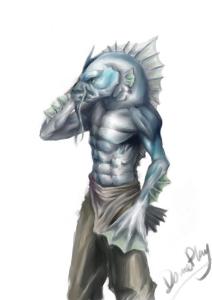
Picture by Doneplay at Deviant Art
THE SEA DEMONS (1916) by Victor Rousseau Emanuel aka H.M. Egbert. Set in contemporary times this story features Lt Donald Paget of the Royal Navy battling sea creatures. World War One is raging but Paget’s scientist friend Masterman warns him about invisible humanoid sea beings who are mutating into air-breathers.
That development means the Sea Demons are looking to conquer the surface world and with their respectable intelligence they just might succeed. Paget dismisses the story as lunacy even after the Sea Demons kill Masterman to prevent him from rallying the surface world against them.
Lt Paget remains skeptical even after he encounters Sea Demons going through the late Masterman’s papers to find out how much he knew about them. Not even Agent Scully would still be doubting the existence of the sea creatures by this point but Donald remains skeptical until he goes back on duty at sea where he and his crew encounter the Sea Demons in action. Continue reading
 UP IN THE AIR AND DOWN IN THE SEA (1863) – Written by William S Hayward, this story was originally serialized in The Boy’s Journal from February to August of 1863. In 1865 it was published in novel form as The Cloud King.
  Years later, when Volans was a teenager, his parents moved the entire family to California to try to cash in on the Gold Rush. Victor took jobs to earn his own money and returned to his ballooning experiments.
 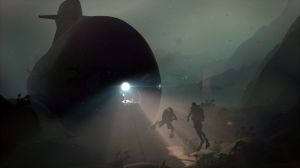 THE WAR UNDER THE SEA (1892) – Written by Georges Le Faure. This sci-fi work was intended as an escapist societal salve to a French public still smarting from their loss to Germanic forces during the Franco-Prussian War just over two decades earlier.
  Interestingly enough, despite this threat the Germans are not depicted as being any more bloodthirsty than the alleged “heroes” of this story as we will see. Though the Count and his allies prove equally callous about large-scale killing (and worse) their attitude is romanticized and approved of by the narrative since Andre and the others are fighting France’s traditional Continental foes the Germans. Instead of Film Noir think of this novel’s approach as callous enough to be called World Noir. Or at least Politics Noir.
 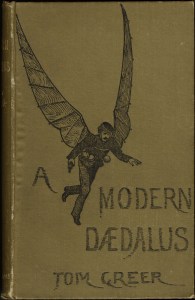 A MODERN DAEDALUS (1887) – By Tom Greer. No, the title’s not referring to James Joyce’s character Stephen Dedalus (sic) but this tale IS about Ireland. The main character is a young man named Jack O’Halloran, a recent college graduate who returns to his native Ireland.
  THE SPIDER OF GUYANA (1860) – Written by the team of Emile Erckmann and Alexandre Chatrian. Balladeer’s Blog’s previous looks at ancient works of science fiction have established how far back the “big bug” trope goes. Creature Feature movies were far from the first appearance of oversized insects and arachnids. And atomic radiation wasn’t needed to justify such outrageous mutations.
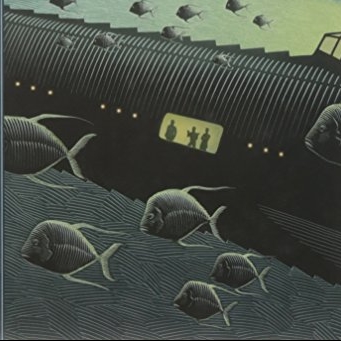
 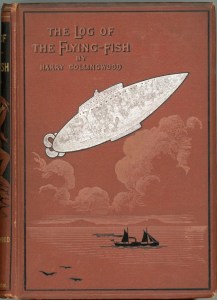 THE LOG OF THE FLYING FISH: A STORY OF AERIAL AND SUBMARINE PERIL AND ADVENTURE (1887) – Written by Harry Collingwood (William J.C. Lancaster).
 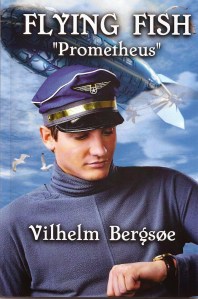 MEMOIRS FROM A JOURNEY WITH THE FLYING FISH “PROMETHEUS” (1870) – Written by Danish author Vilhelm Bergsoe. I shortened the title in the heading for this blog post. Some editions shorten it even more, to just Flying Fish Prometheus.
  William’s American colleagues send the new airship Prometheus to fetch him. The Prometheus is cigar-shaped (like so many UFOs would be described decades later) and sports wings plus propellors. Our man Stone boards the airship in Koege, along with other passengers including his love interest Anna Blue.
  THE ADVENTURES OF AN ENGINEER (1898) – Written by Weatherby Chesney, better known as C.J. Cutcliffe Hyne. This is a collection of short stories about the scientific adventurer Richard Felton.
  A FANTASTICAL EXCURSION INTO THE PLANETS (1839) – Written by an unknown author. The anonymous narrator of this novel is taken on a visit to assorted planets and other celestial bodies. The figure who transports him is a winged, rainbow-colored sprite whose face and body constantly change slightly, allowing no lasting impression to be made out.
  These beings devote all their time to frolicking, singing and making music on other-worldly stringed and wind instruments that the narrator compares to lyres and flutes. The closest thing to actual labor that the Mercurians do is to cultivate flowers then weave them into chaplets and garlands with which to adorn themselves.
  THE DOMINION IN 1983 (1883) – Written by “Ralph Centennius,” the presumed pseudonym of an unknown author.
  Balladeer's Blog