
 TALES OF TWENTY HUNDRED (1911-1912) – Written by William Wallace Cook, originally serialized in the monthly publication Blue Book Magazine from December of 1911 to May of 1912. This is Balladeer’s Blog’s third look at a work by THE William Wallace Cook and in this case it’s a six-part serial consisting of a half-dozen interconnected short(ish) stories.
PART ONE: THE BILLION DOLLAR CARGO (December 1911) – The year is 2050 A.D. Airships run by solar energy fill the skies while land vehicles are powered by radium engines. At hospitals “germicide treatments” can heal people of virtually any illness. Mind-reading machines called psychographs are used to read the thoughts of people who are on trial.
The United States, Great Britain, Japan, Germany, Austria and the nations of Scandinavia comprise a huge geopolitical entity called the Quadruple Alliance. That alliance’s greatest global rival is the Federated States of South America, made up of the nations of Central and South America.
 Geo-engineering on a massive scale has become possible. Wealthy industrialist Vincent Blake has already completed a project involving the elimination of the Aleutian Islands to allow the warmer waters of the Pacific Ocean to turn the Arctic region into a place with more moderate temperatures. Hilariously, this is depicted as having no adverse effects on the planet. (Hey, it’s a 1911 story.)
Next on the schedule for Blake is an even more ambitious project – he plans to straighten the Earth’s axis and provide mild summer conditions year-round all over the world. This type of absurd notion was also featured in the 1894 book A Journey in Other Worlds, previously reviewed here at Balladeer’s Blog.
In that earlier story the establishment of year-round moderate weather was presented as a fait accompli and had had no negative side-effects. In this tale the Federated States of South America are convinced that Vincent Blake’s project will negatively impact them and launch violent plans to stop him. Continue reading
 ADRIFT IN THE UNKNOWN (1904) – Written by William Wallace Cook (like our previous story), this tale was originally serialized in Argosy magazine from December of 1904 to April of 1905. Our previous Cook story dealt with time travel, while this one deals with space exploration.
 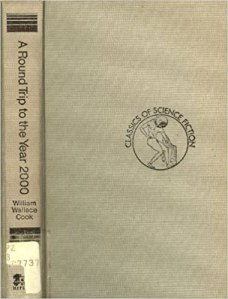 A ROUND TRIP TO THE YEAR 2000 aka A FLIGHT THROUGH TIME (1903) – Written by THE William Wallace Cook, this story was originally serialized in Argosy magazine from July through November of 1903.
  Since Lumley was already on the verge of ending his life anyway, he agrees to be the human guinea pig for Dr Kelpie’s time-car. Just as he’s driving off to the future, however, the relentless Detective Klinch shows up and leaps into the vehicle beside our hero.
 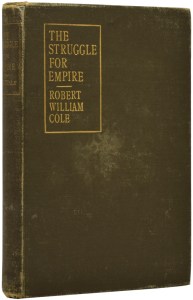 THE STRUGGLE FOR EMPIRE: A STORY OF THE YEAR 2236 (1900) – Written by Robert W Cole. I left out the first half of the title for the headline, since The Struggle For Empire sounds like a mundane history book. In reality this novel was a very, very early example of the Space Opera sub-genre.
  Initially the Earth colonized and inhabited the planets and certain moons of our own solar system all the way out to Neptune. (Pluto was not discovered until 1930.) In a quaint quasi-Steam-Punk way, all of those planets and moons have Earth-like atmospheres and conditions.
 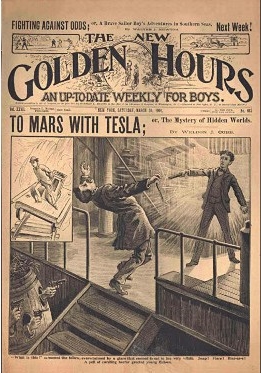 TO MARS WITH TESLA (1901) – Written by Weldon J Cobb, To Mars With Tesla (not to be confused with To Hell With Alexander Graham Bell) momentarily turned the”Edisonade” sub-genre of science fiction into a “Tesla-ade.”
  That intern sees most of the action and is supposedly a distant relative of Thomas Edison. Young Edison relays messages between his scientist bosses and this makes him a frequent target of the nefarious schemes of the villainous Heinrickson, a mad tycoon who has evil designs on the planet Mars.
 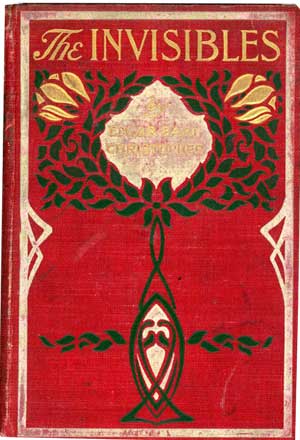 THE INVISIBLES (1903) – Written by Edgar Earl Christopher, this novel nicely anticipates cinematic serials and integrates science fiction and slight occult touches into its storyline.
  The organization can also help the British youth get revenge on Czarist Russia for the torture of his Russian mother years earlier. It turns out that the Invisible Hand is a secret society determined to overthrow the Czars and install a new Russian government.
  PSI CASSIOPEIA, or STAR: A MARVELOUS HISTORY OF WORLDS IN OUTER SPACE (1854) – Written by Dr Charlemagne Ischer Defontenay, a French M.D. and author. Long before J.R.R. Tolkien churned out obsessive amounts of fine detail about his fictional Middle Earth, Defontenay produced this volume of history, poetry and drama from his fictional planets in the star system Psi Cassiopeia.
 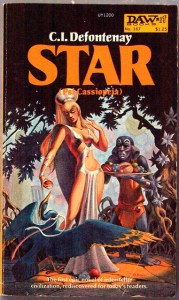 The system where that planet is located is a three-star system. Ruliel is the large, white star at the center, around which orbit the two lesser stars Altether (green) and Erragror (blue). The planet called Star is orbited by large planetoids/ moons named Tassul, Lessur, Rudar and Elier. Throwing all science to the winds the planet is also orbited by a small red star called Urrias.
 UP IN THE AIR AND DOWN IN THE SEA (1863) – Written by William S Hayward, this story was originally serialized in The Boy’s Journal from February to August of 1863. In 1865 it was published in novel form as The Cloud King.
  Years later, when Volans was a teenager, his parents moved the entire family to California to try to cash in on the Gold Rush. Victor took jobs to earn his own money and returned to his ballooning experiments.
 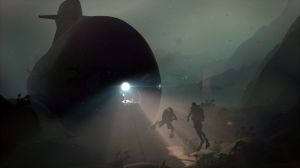 THE WAR UNDER THE SEA (1892) – Written by Georges Le Faure. This sci-fi work was intended as an escapist societal salve to a French public still smarting from their loss to Germanic forces during the Franco-Prussian War just over two decades earlier.
 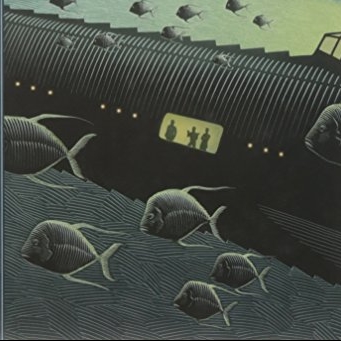 Interestingly enough, despite this threat the Germans are not depicted as being any more bloodthirsty than the alleged “heroes” of this story as we will see. Though the Count and his allies prove equally callous about large-scale killing (and worse) their attitude is romanticized and approved of by the narrative since Andre and the others are fighting France’s traditional Continental foes the Germans. Instead of Film Noir think of this novel’s approach as callous enough to be called World Noir. Or at least Politics Noir.
  Balladeer's Blog