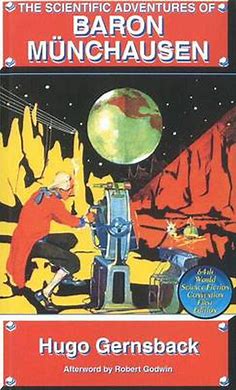
 THE SCIENTIFIC ADVENTURES OF BARON MUENCHHAUSEN (1915-1917) – Written by the iconic Hugo Gernsback in the years before he launched his own publication, these sci-fi tales presented the 1700s Baron being alive and having wild adventures. (The cover spelling does not match the one Gernsback used.)
Like most people I know, I just roll my eyes at the Baron Muenchhausen tall tales, so that’s why I used Hugo’s name in the blog post title. Hugo as the writer of this series of short stories is the REAL draw. The following items first appeared in the magazine Electrical Experimenter.
I MAKE A WIRELESS ACQUAINTANCE (May 1915) – Gernsback’s fictional counterpart I.M. Alier is a radio enthusiast and one day picks up transmissions from THE Baron Muenchhausen. The Baron tells him that in the 1700s he was injected with special embalming fluid which actually put him in suspended animation.
He emerged from that state a few years back and, forced to flee Germany over past offenses, has been having amazing scientific adventures. Alier is skeptical, but the Baron proves his claim by using some of the advanced science he has discovered to change the color of part of the moon. This convinces the narrator.
HOW MUENCHHAUSEN AND THE ALLIES TOOK BERLIN (June 1915) – Alier learns that the Baron has been helping the French in the World War. Among his inventions was a tunneling device for launching sneak attacks but the Central Powers were able to reverse-engineer the technology, resulting in another deadlock.
The Baron and his friend Professor Flitternix have devised anti-gravity screens for a spaceship. They plan to fly the vessel – called the Interstellar – to the moon. Continue reading →

 FIVE HUNDRED YEARS HENCE (1818) – Written under the pseudonym “D” this work was published the same year as Mary Shelley’s novel Frankenstein. The story is presented as written observations of the world in October and November of the year 2318.
  THE BRICK MOON (1872) – Written by Edward Everett Hale, best known for The Man without a Country. This novella started out as a serialized story published in 1869 in the October, November and December issues of Atlantic Monthly. A follow-up installment, titled Life in the Brick Moon, was published in the February 1870 issue.
 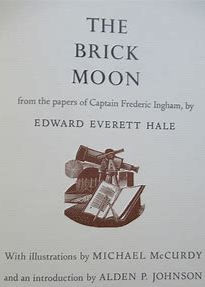 The story begins in the 1840s when Frederic Ingham, the tale’s narrator, and his college friends Orcutt and Halliburton plan a dream project which winds up taking decades to fulfill – a manmade artificial satellite, the first recorded in science fiction stories.
 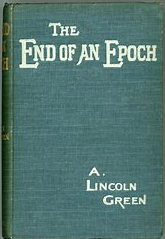 THE END OF AN EPOCH (1901) – Written by A. Lincoln Green, this novel about a world-threatening disease presented the tale of brilliant young Adam Godwin, a recent Oxford graduate who pursues his interest in microbiology. During the course of his research into antitoxins, Adam becomes aware of the controversial Dr. Azrael Falk.
  Ultimately, Adam starts neglecting Evelyn to the point that she lays down an ultimatum: Godwin must choose between her and his research. Adam chooses his research, so the engagement is ended, and the willful Evelyn joins her father’s expedition to the North Pole.
 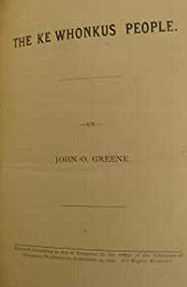 THE KE WHONKUS PEOPLE aka A Tale of the North Pole Country (1890) – The author John O. Greene was American, but the main character in this story is a Canadian named Sampson De Lilly. Sampson survives a shipwreck and is picked up by a steamship headed for the North Pole.
 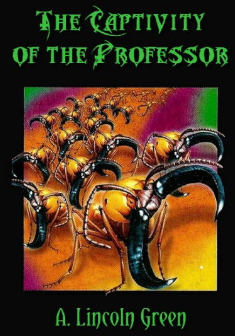 THE CAPTIVITY OF THE PROFESSOR (1901) – Written by A. Lincoln Green, a presumed pen name, this story was first published in Blackwood’s Edinburgh Magazine in the February 1901 isssue.
  THE NEW NORTHLAND (1915) – Written by Louis Pope Gratacap. The main character is explorer Alfred Erickson, who recruited a few associates of varied backgrounds to join him in a search to prove the existence of an isolated warm weather land mass in the far north.
 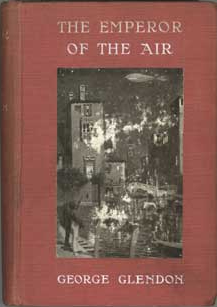 THE EMPEROR OF THE AIR (1910) – Written by George Glendon, this is a story about two visionaries – the German-American tycoon Hans Kreutzer and the Italian inventor Anatole Lonari.
  THE WARSTOCK: A TALE OF TOMORROW (1898) – Written by the British William Oliver Greener under the pen name Wirt Gerrare. Despite this book’s Great Britain origins, the two lead characters are American inventors from Plainfield, New Jersey – Robert Sterry and Willie Redhead.
  While hitting the social circuit in London, our heroes meet Madeline Winship, who connects them with backers who are part of an exclusive Royal Society-inspired group of scientific minds. The group are called the Isocrats, and they devote themselves to science and similar intellectual pursuits, like elevating dancing to what we might call performance art.
  BELLONA’S HUSBAND (1887) – This book was written by West Point graduate (Class of 1867) William James Roe under the pen name Hudor Genone.
  Garrett constructs a disc-shaped spaceship that uses hydrogenium as its anti-gravity agent. Holt and Professor Garrett are joined by Trip, a shady friend of Garrett’s, who travels with them on a flight to the planet Mars.
  Balladeer's Blog