
 AFTER LONDON aka WILD ENGLAND (1885) – Written by Richard Jefferies. A post-apocalypse saga in which the shifting of the Earth’s axis has reduced the British Isles to a medieval level with feral animals and pockets of toxic wasteland. There are scattered “kingdoms” and roving bands of marauders but no contact with the world outside the area.
The setting is roughly 130 years after a dark celestial body passed very close to Earth, tilting the axis, unleashing tectonic shifts, damaging the climate, and altering the planet’s magnetic field. The post-apocalypse kingdoms are separated by toxic, uninhabitable regions and by forests filled with altered, deadly dogs, cattle and hogs.
 The Thames and Severn Rivers have backed up, forming a large central lake in England. What was once London is a toxic marsh so deadly to human life that its gases and vapors, when carried by the winds, kill or drive mad humans exposed to them.
The buildings and streets of central London are covered in a black liquid – seemingly from deep beneath the Earth – that chokes out all life. Continue reading
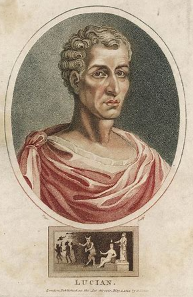 These two works were written by Lucian, the Greek philosopher and satirist who lived in the 2nd century A.D. Lucian was noted not just for his philosophical observations but also for two works that defied definition by his contemporaries but would easily fall into the category of science fiction today. Both works are from roughly 150 A.D. and feature trips to the moon by pseudo-scientific means.
 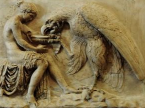 He discovered that the moon (on which he could breathe just like on Earth) was populated by the souls of the deceased (roughly twelve hundred years before Dante’s Paradiso). From the moon Menippus made the astonishing observation that the Earth was round and not flat, in a wry addition to the then-ongoing philosophical debate about the subject.
  THE VIOLET FLAME (1899) – Here is another of the science fiction works written by THE Frederick Thomas Jane, of Jane’s Guides fame. Previously, Balladeer’s Blog reviewed Jane’s works
  GUESSES AT FUTURITY – This was a series of nine full-page illustrations by THE Frederick Thomas Jane, the man behind the Jane’s manuals. He devoted as much attention to detail here as he would go on to do in illustrations of military hardware in later years.
 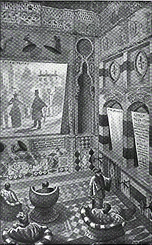 I. HOME LIFE IN ANNO DOMINI 2000 (October 1894) – Jane depicted Brits of the “future” living in homes with very high ceilings. The interior decoration is decidedly eclectic while the wardrobe of these Brits is a kind of retro revival of Medieval clothing.
 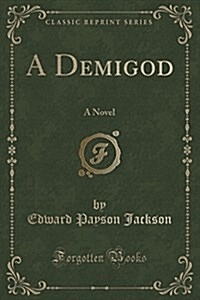 A DEMIGOD (1886) – Written by American author Edward Payson Jackson, this work preceded Philip Wylie’s Gladiator by more than 4 decades.
  THE MILLTILLIONAIRE (1895) – This novel was written by American author Albert Waldo Howard under the pen name M. Auburre Hovorre. A second edition came out in 1898.
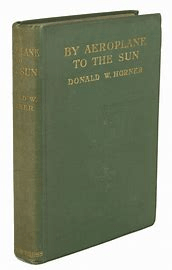 BY AEROPLANE TO THE SUN (1910) – Written by Donald W. Horner. This British novel features ideas that wouldn’t have been out of place decades earlier but in 1910 it’s astounding to encounter concepts like an alleged scientist believing that the sun is inhabited.
 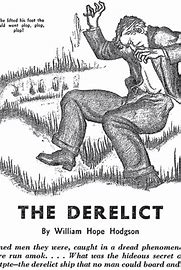 THE DERELICT (1912) – This short story was originally published in Red Magazine in December of 1912. The author was William Hope Hodgson, whose other works have already been reviewed here at Balladeer’s Blog.
  A TALE OF THE X-RAY (1898) – Written by Clara H. Holmes. This short story was first published in her collection titled Floating Fancies Among the Weird and the Occult, but it’s more science fiction.
 A JOURNEY TO THE WORLD UNDERGROUND BY NICHOLAS KLIMIUS (1741) – This novel was written by Danish author Ludvig Holberg and became a European sensation. Like Swift’s Gulliver’s Travels, Holberg’s work in this book had satirical political meaning and though the issues and social criticism no longer apply to the modern-day world, the fundamental story structure still holds up on its own.
  The rope breaks, and Nicholas falls so far that his colleagues assume he was killed. Actually, Klimius fell down into the often-theorized Hollow Earth. In this case with an interior sun and small worlds in orbit around it.
