
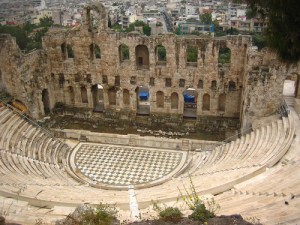
The Ruins of the Theater of Dionysus in Athens.
Balladeer’s Blog takes another look at an ancient Greek comedy. This time around I’m examining Cothurnus by Philonides, a comic poet who may also have acted and produced for the Athenian stage as well. It cannot be definitively determined if the “Philonides” referred to in those capacities are all one and the same or separate figures.
THE PLAY
Like most ancient Greek comedies Cothurnus has survived only in fragmentary form and with very few fragments at that. The title refers to a type of footwear of the time period. A cothurnus could be worn on either the left foot or the right foot because of its softness and looseness. Because of this the word “cothurnus” also became a sarcastic term for a politician who tried to position themselves on both sides of an issue, claiming victory no matter which way the political winds blew.
This is certainly another element of Old Comedy that we can still relate to 2,400 years later. Philonides was specifically using this term and this comedy to target Theramenes.
To give a comprehensive look at Theramenes’ political juggling act would take too much time, suffice it to say he would flip-flop not just on specific issues but would retroactively claim to have supported whichever side won, would change political affiliations again and again and even set up other public figures to take the fall for his own failures (like arranging for six generals to be blamed and executed for his own part in the Arginusae travesty). Continue reading

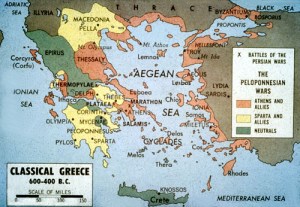 POLEIS – In this post I’m looking at Poleis (Cities), written by Eupolis, one of the Big Three of Ancient Greek Comedy along with Aristophanes and Cratinus. This satirical comedy is dated from approximately 422 B.C. to 419 B.C. Like so many other such comedies it has survived only in fragmentary form.
 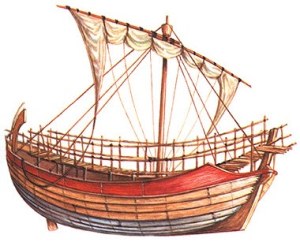 Merchant Ships was written and publicly staged in approximately 424 B.C. to 421 B.C. according to the available data. It was another of Aristophanes’ comedies protesting the pointlessness of the Greek city-states warring among themselves instead of uniting against the encroachments of the Persian Empire.
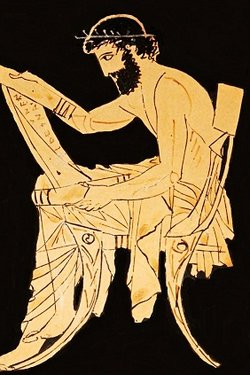 Welcome to another one of Balladeer’s Blog’s posts about ancient Greek comedies, this one written by Cratinus, who was one of the Big Three of Attic Old Comedy with Aristophanes and Eupolis the other two.
  What Meet the Beatles was to the British Invasion, The Banqueters was to Attic Old Comedy. (Yes, I love silly comparisons) This play was the first comedy written by Aristophanes, the leading light of ancient Greek comedy, and was performed at the Lenaea festival of 427 BC when Aristophanes was nineteen years old. The Banqueters won second prize, making it a very auspicious debut for the man often considered the greatest political satirist of the ancient world.
  For some prep as I at last get back into reviewing the surviving fragments of ancient Greek comedy every now and then, here’s my 2011 review of Demoi by Eupolis. Along with Aristophanes and Cratinus, Eupolis was one of the Big Three of Attic Old Comedy. Background info is
 BAPTAE – Written by Eupolis, one of the Big Three of ancient Greek comedians. Aristophanes and Cratinus were the other two. This comedy satirized the latest “hot new cult” to hit Athens – worship of the Dorian and Thracian goddess Cotyto.
  THE BANQUETERS – By Aristophanes. This was the very first comedy from the Athenian whose name is synonymous with ancient Greek comedies, especially political satires. The nineteen-year-old presented a landowner from Athens whose two sons were being introduced to his phratry brothers at a banquet dedicated to Herakles.
  Balladeer's Blog