
Readers want more Marvel more of the time! With their What If? cartoon series off to a widely-panned start (I didn’t watch it) let’s take a look at some of the best What If? stories from its original run.
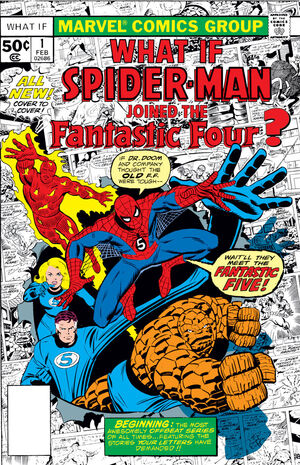 WHAT IF? Vol 1 #1 (February 1977)
Title: WHAT IF SPIDER-MAN HAD JOINED THE FANTASTIC FOUR?
Pivotal Event: In Spider-Man #1 the web-slinger tried to join the Fantastic Four but was turned down. But what if they had let him join the team?
Synopsis: Uatu the Watcher, from his headquarters in the ancient city in the Blue Area of Earth’s moon, ponders the multitude of alternate time-lines which branched off from the main (Earth 616) Marvel Universe.
With Spider-Man a member of the popular Fantastic Four/ Five, he never becomes an enemy of J Jonah Jameson and is therefore never deceptively painted as a villain to the public at large.
Having a powerful and capable new member like Spider-Man on the team makes Reed Richards (Mr Fantastic) comfortable enough to act on his overly-protective attitude toward Sue Storm (Invisible Girl). In their next mission (Fantastic 4 #13), against the Soviet supervillains the Red Ghost and his Super-Apes on the moon, Reed makes Sue stay behind on the Earth to “monitor” the group’s lunar expedition.
In this divergent reality, since Invisible Girl did not go to the moon with her teammates, she is lured away from the Baxter Building by the Sub-Mariner, whom she was infatuated with after the team’s first few battles with him. In the original reality, this could not happen until the Fantastic 4 got back from the moon. Here it happens earlier since she is by herself and is resentful that Mr Fantastic made her stay behind. Continue reading
 THE WINGED MAN – From Great Britain’s renowned story papers came the Winged Man. British story papers, like Dime Novels and Pulp Magazines, were text stories peppered with a few illustrations. The Wonder, an Amalgamated Press publication, debuted in 1913 and among its offerings was the tragic tale of the Winged Man, whose first story was titled Twixt Midnight and Dawn (the hero’s favorite time to dispense vigilante justice).
 The mysterious Winged Man was “a strange genius” whose real name was never revealed. He possessed such inventive brilliance that he created a suit complete with working wings which allowed him to fly.
  MARVEL SUPER-HEROES #18 (January 1969)
  The Badoon killed every Alpha Centauran because they considered them and their control of the living metal Yaka to be a threat. Similarly, the lizard-like aliens committed genocide on Pluto, Jupiter and Mercury as well, because they felt threatened by large numbers of foemen possessed of the enhanced abilities of those genetically engineered humans.
  MARVEL PREVIEW Vol 1 #4 (January 1976)
 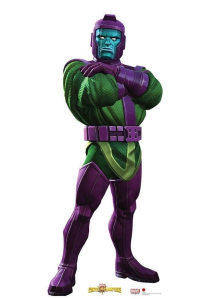 In the past handful of days Balladeer’s Blog’s 2017 blog posts examining the Marvel Comics villain Kang the Conqueror and some of his other selves like Immortus and Rama Tut have been getting incredible amounts of hits. I looked into it and it turns out that when the latest Marvel streaming miniseries, Loki, ended, the cliffhanger involved Kang and Immortus at Immortus’ castle in Limbo, the realm outside the time stream.
 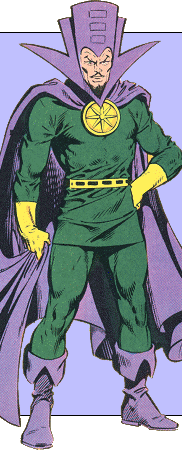 I thought that people were just going to my 2017 blog posts because they had no idea who Kang and Immortus are. Instead, I started getting comments from readers expressing thanks for the clarity of the “Timey-Wimey” nature of Kang’s labyrinthine saga. They said that the people writing the Loki miniseries plopped everything into the far later stages of the Kang/ Immortus stories, bypassing the earlier tales that would help people understand it.
 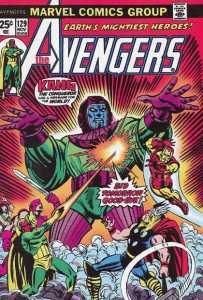 ONE: BID TOMORROW GOODBYE – Kang wants the Celestial Madonna (Mantis, who started out as an Avenger in the 1970s) and reveals she has been the reason he frequently targeted the 20th Century. Agatha Harkness guest-stars, from the years when she was the Scarlet Witch’s mentor. CLICK
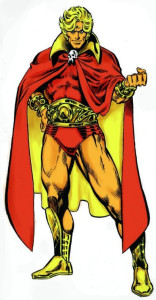 ADAM WARLOCK, THANOS, GAMORA AND THE MAGUS – And speaking of Thanos, and with Adam Warlock having been hinted at since the first Guardians of the Galaxy movie, here’s another 1970s Young Adult Classic from Marvel. Adam took on his vile other self the Magus, his galaxy-spanning 1,000-world empire and Thanos in his first post-Thanos War appearance. Plus Gamora’s very first appearance. Click
  KILLRAVEN – The heroic rebel leader and his Freemen take on Earth’s alien invaders on a war-torn post-apocalyptic world crawling with extraterrestrial tyrants and assorted mutated menaces. Click
 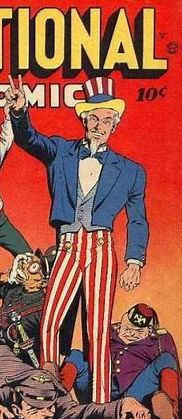 UNCLE SAM
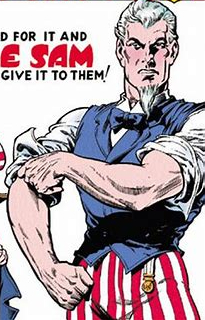 Powers: This hero had Superman-level strength and invulnerability. He could fly in a sense by making enormous Hulk-sized leaps. He had a mystic ability to know where he would be needed. Due to his supernatural nature, Uncle Sam could not be photographed or filmed.
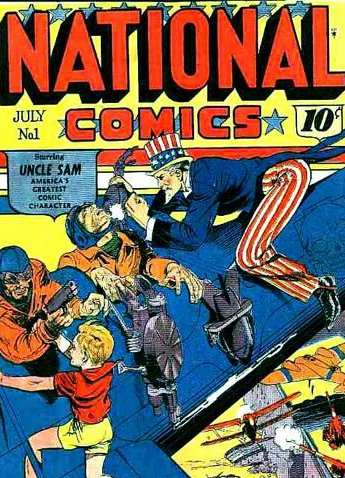 NATIONAL COMICS #1 (July 1940)
  AIR WAVE
  With the big 4th of July holiday coming up, this weekend’s light-hearted bit of superhero escapism will combine some Revolutionary War nostalgia with some World War Two nostalgia. Balladeer’s Blog takes a look at the early adventures of the Nedor Comics hero called the Fighting Yank.
 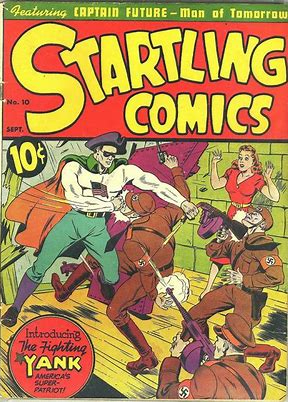 STARTLING COMICS #10 (September 1941)
 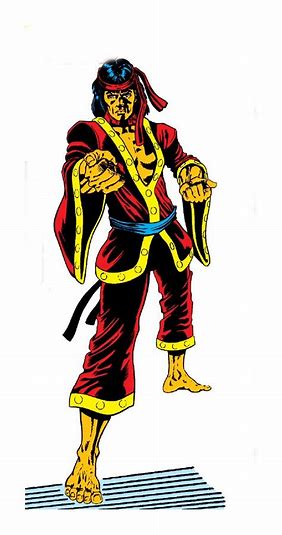 First, a little background information. In the early 1970s Marvel was experimenting with hybrid titles that would combine the old and the new by
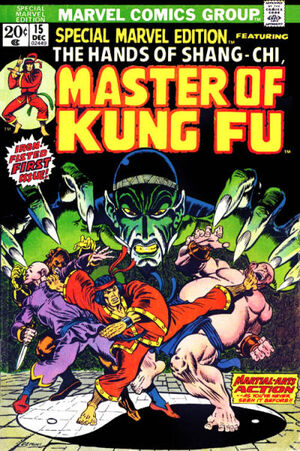 SPECIAL MARVEL EDITION #15 (December 1973)
 Balladeer's Blog