Category Archives: Mythology

ZACA: VOODOO GOD

HaitiVoodoo mythology is a fascinating hybrid of Yoruban, Dahomey, Fon and Christian mythology intermixed with touches from Caribbean belief systems.
Haiti is the central location of the Voodoo belief system but naturally it has spread throughout the world as have other faiths.

Here is a VooDoo god whose Holy Day is today, May 1st.

ZACA – The god of agriculture and the harvest, making him the patron deity of farmers and fieldworkers. Zaca is the friendliest and most approachable of the gods and may be addressed as “Cousin Zaca” if spotted in the fields. He dresses in denims and a straw hat just like the rural Haitians do. In addition  Continue reading

8 Comments

Filed under Mythology

KAUKAUGOGO: POLYNESIAN GODDESS OF BELLONA AND RENNELL ISLANDS

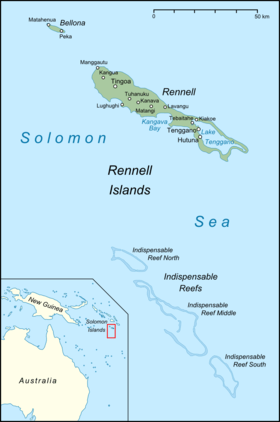
bellona-and-rennellKAUKAUGOGO – This most beautiful of goddesses was the only being to ever be born in Poo’ungi, the land of the dead. Her father and mother – Kangebu and Teatamatu’a – had migrated to and established a residence in the underworld while they were both still alive.

Because they were already in the land of the dead they could not die. When their daughter was born they bathed her (kaukau) in coconut oil (gogo), hence her name. (But she is also known as Koginuku.) Being born in Poo’ungi put Kaukaugogo on a par with the gods. 

Kaukaugogo’s beauty was so overwhelming she caught the attention of all the male deities. Continue reading

4 Comments

Filed under Mythology

SUN GODS FROM AROUND THE WORLD

Balladeer’s Blog’s mythology posts are among the most popular parts of this site. As a change of pace from my examinations of multiple deities from a single mythological pantheon this time I’ll do a light-hearted look at solar deities – both male and female – from around the world.

Seqinek11. SEQINEK

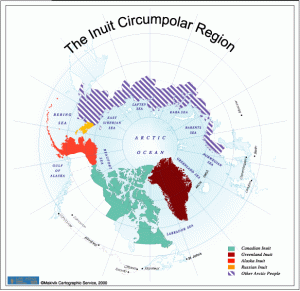
Pantheon: Inuit

Lore: Also called Malina, Seqinek’s home was in Udlormiut, the land that was on the other side of the sky. In Inuit cosmology the sky was the roof of the enormous ice- house (igloo) that enclosed the world and Udlormiut lay on the other side.

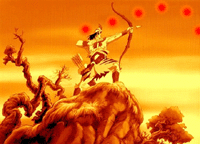
By day Seqinek would leave her home and run across the sky, with the sun itself being the flame from the torch she carried as she ran. The goddess was forever fleeing her brother, the moon god Tatqim, whose partially burnt- out torch was the moon.

For more Inuit deities – https://glitternight.com/inuit-myth/

10. SURYA

Pantheon: Hindu

Lore: The sun was Surya’s chariot racing across Continue reading

20 Comments

Filed under Mythology

TWO MORE ALTERNATE EASTERS

CrossBalladeer’s Blog examines two more ancient works which – if they had been deemed “authentic” (LMAO) – might have resulted in very different versions of Easter celebrations.

THE GOSPEL OF THE EGYPTIANS – This Apocryphal Gospel is also referred to as The Gospel According to the Egyptians. This particular work is dated to around the 100s A.D.

The surviving references to this Gospel center around conversations between Jesus and one of his female followers – Salome. The gist of the material is the Gnostic condemnation of procreation, since in their view the reproductive process does nothing but entrap even more spiritual matter in the physical world created by Yaldabaoth, the Demiurge.

Jesus calls for humanity to reject and despise “the shameful garment” called the body. He also hinted that once spiritual matter returns to the Pleroma that all duality will cease, including the notions of male and female, which will no longer be separate states of being.    

One of the key sayings in The Gospel of the Egyptians is found when Jesus tells Salome “Death will endure as long as women give birth.” This concept is also alluded to when Jesus says “I have come to destroy the works of the female,” referring, of course, to all of us since our bodies – our physical prisons to the Gnostics – all emerged from the wombs of women.   Continue reading

12 Comments

Filed under Mythology

AIWEL LONGAR: THE AFROCENTRIC PASSOVER TALE

Balladeer’s Blog has been examining various dead and resurrected deities from around the world as well as various Apocryphal Gospels. Since this is the season for Passover as well as Easter here’s a look at the Aiwel Longar Epic, which features many parallels with the myth about Moses, Passover and the Ten Commandments. 

Aiwel LongarThe mythic tale of Aiwel Longar comes from the Dinka pantheon. Nhialic is the supreme deity to the Dinka and the first man and woman he created were Garang and Abuk. The Dinka people live in the Upper Nile in Sudan, as they have for centuries.

AIWEL LONGAR

I often cover the way in which cultures which come into contact borrow mythic material from each other to embellish their own respective belief systems. The story of Aiwel Longar clearly influenced (and vice versa) Egyptian, Jewish, Christian and Muslim myths. It also bears striking similarities to the Gnostic Hymn of the Pearl.

PART ONE – Born as simply Aiwel, this figure was a gift from the god of the Nile River to Aiwel’s widowed and childless mother. The infant already had a full set of teeth when his mother picked him up out of the Nile River, where the river god had set him adrift.

Like many mythic figures Aiwel could talk and function like an adult at a very young age. While still a toddler he often stole and drank entire gourds full of milk. After one such binge Aiwel’s mother caught him and the young demigod warned her not to tell anyone or else she would die.  Continue reading

3 Comments

Filed under Mythology

GOSPEL OF THE SAVIOR: COMPARATIVE MYTHOLOGY

Jesus ResurrectedBalladeer’s Blog continues examining various accounts of dead and resurrected deities, as is customary at this time of year.

THE GOSPEL OF THE SAVIOR – The narrative of this gospel centers around dialogues between Jesus and his apostles in the last few days before his arrest and crucifixion.

Some of the material is similar to the Gospels of John and Matthew, but  some is Gnostic, with references to discarding the useless garment of the body so the soul can return to the empyrean realm. 

The most striking departure in this gospel comes in the Garden of Gethsemane segment, when Jesus, as God the Son, traditionally prays to God the Father to spare him the ordeals that lay ahead. In The Gospel of the Savior Jesus transports himself and his apostles to the throne-room of God the Father  where he makes his appeal in person. Continue reading

6 Comments

Filed under Mythology

MORE HAWAIIAN GODS AND GODDESSES

HawaiianislandsBalladeer’s Blog’s examinations of the Hawaiian pantheon of deities have been some of the most popular items here. As a nod to that popularity here are some of the neglected Hawaiian gods and goddesses.  

INANEA – A fascinating lizard-goddess. CLICK HERE 

KUMUHEA – This caterpillar god was a son of Ku, the god of war. CLICK HERE.   Continue reading

2 Comments

Filed under Mythology

TITIKANOHIMATA: GOD OF FLYING FOXES

Flying FoxTITIKANOHIMATA – The god of flying foxes, animals which figure very prominently in the myths and culture of Bel-Ren.

Rituals would be performed in this god’s honor before going out to hunt flying foxes. Titikanohimata was considered the brother of the goddess Tehahine’angiki. Continue reading

6 Comments

Filed under Mythology

COMPARATIVE MYTHOLOGY: THE GOSPEL OF NICODEMUS

Balladeer’s Blog continues examining various accounts of dead and resurrected deities, as is customary at this time of year.

facepalm jesusTHE GOSPEL OF NICODEMUS – Despite the title of this gospel, Nicodemus doesn’t even show up until section five. This alternate scripture started out as The Acts of Pilate, and covered the story of Christ’s trial and execution from the point of view of Pontius Pilate. This half of the gospel serves the purpose of making Pontius Pilate look even more reluctant to prosecute Jesus than the canonical gospels do. Continue reading

Leave a comment

Filed under Mythology

ALEISTER CROWLEY’S CLOUDS WITHOUT WATER (1909)

Clouds Without WaterWhat better way to mark April Fool’s Day than by commemorating one of the wittiest and most daring of practical jokes, one perpetrated by Aleister Crowley in those brilliant years before drugs and/or self-delusion fogged his mind. Decades before the pathetic “Peekaboo Crowley” of much renown Aleister was still churning out some very enjoyable poetry – some of it brilliant. The Sword of Song and Konx Om Pax are my favorite volumes of verse by “the Laird of Boleskine” … AFTER Clouds Without Water, that is.  

Clouds Without Water was not Crowley’s only literary practical joke, of course, but the humor of it resonates to this very day, thanks mainly to the never-changing air of pious self-righteousness that afflicts most of the world’s clergy-members. And not just pious self-righteousness but a habit of condemning in the strongest language works of art which their self-limited minds clearly don’t understand.

aleister crowley

****************  Crowley’s autobiography explained this photo in the poignant chapter titled “I Go Completely Nuts and Start Believing Anything and Everything”

THE JOKE: Clouds Without Water was published under one of Crowley’s pseudonyms – Reverend Charles Verey. It was circulated to various ministries and teaching colleges allegedly as a condemnation of “the type of atheism and socialism” that the young and the bohemian were embracing. Crowley – writing as Reverend Verey – wrote a foreward and a closing prayer for the volume of poetry as well as (when you know the full story) HILARIOUS footnotes expressing the kind of simplistic moral outrage that only the most narrow-minded of holy-rollers can spout. 

Under another assumed identity Crowley ALSO wrote the sonnets being condemned by his Reverend Verey alter ego. On the surface the poems were written by a college professor scandalously celebrating an extramarital affair with one of his female students, a young woman named Lola. The sonnets reflect the supposed couple’s flouting of social and sexual conventions until the affair ends in tragedy for all concerned. Crowley’s fictional persona Reverend Verey was denouncing the poems and the lifestyle reflected in those poems in the strongest possible terms. Continue reading

4 Comments

Filed under Mythology