
 UTOPIA or THE HISTORY OF AN EXTINCT PLANET, PSYCHOMETRICALLY OBTAINED (1884) – Written by Alfred Denton Cridge. An unnamed narrator comes across the remains of a meteor that entered Earth’s atmosphere. This narrator has the gift of psychometry (the author’s uncle was THE William Denton) and after he picks up the tangerine-sized chunk of black rock from another planet he begins getting impressions from it.
At first it seems a separate entity calling itself Psycho appears to the narrator but it gradually becomes clear that his psychometric abilities have actually plugged him into a figurative Worldmind from which he learns the history of the destroyed planet of which the meteor is a fragment.
Our narrator places the meteor against his forehead to facilitate his “readings” from it. He and we readers learn that the fragment’s planet of origin, Utopia, was roughly the same distance from Earth as Saturn, but in an oblong orbital plane.
 The planet was just 2,500 miles across and was home to a race of roughly 5 1/2 feet tall humanoids, some with yellow skin, some with brown skin and others with gray skin. All the races had long, black hair. Utopia sported Earthlike plains, mountains, lakes and rivers with just one huge ocean.
A day on the planet lasted approximately 30 Earth hours, and it took the world nearly 31 Earth years to complete one orbit around the Sun. The lifespan of the Utopians was similar to that of Earthlings but obviously was measured differently. For instance a Utopian who was 62 of our years old would have lived through just two revolutions around the Sun. Continue reading
 DAYBREAK: A ROMANCE OF AN OLD WORLD (1896) – Written by James Cowan. Since we’re now in Easter Week what better time for a look at this work of “ancient” science fiction which features – among other things – an interplanetary visit by Jesus Christ.
  Walter makes a reasonably witty joke about the moon wanting to be annexed by the United States while around the world the human race becomes gripped with fear over the approaching collision. At length our former satellite makes impact, scraping down mountain ranges from the Himalayas to the Andes, before coming to a rest in the Pacific Ocean.
  TRAVELS IN THE INTERIOR (1887) – Nearly eighty years before the movie Fantastic Voyage, this work of “ancient” science fiction detailed a party of shrunken heroes on an odyssey through a human being’s body. This cleverly-titled tale was written by Alfred Taylor Schofield under the name Luke T Courteney.
  TALES OF TWENTY HUNDRED (1911-1912) – Written by William Wallace Cook, originally serialized in the monthly publication Blue Book Magazine from December of 1911 to May of 1912. This is Balladeer’s Blog’s third look at a work by THE William Wallace Cook and in this case it’s a six-part serial consisting of a half-dozen interconnected short(ish) stories.
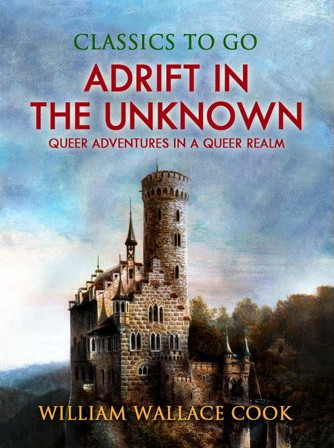 ADRIFT IN THE UNKNOWN (1904) – Written by William Wallace Cook (like our previous story), this tale was originally serialized in Argosy magazine from December of 1904 to April of 1905. Our previous Cook story dealt with time travel, while this one deals with space exploration.
  A ROUND TRIP TO THE YEAR 2000 aka A FLIGHT THROUGH TIME (1903) – Written by THE William Wallace Cook, this story was originally serialized in Argosy magazine from July through November of 1903.
  Since Lumley was already on the verge of ending his life anyway, he agrees to be the human guinea pig for Dr Kelpie’s time-car. Just as he’s driving off to the future, however, the relentless Detective Klinch shows up and leaps into the vehicle beside our hero.
  THE STRUGGLE FOR EMPIRE: A STORY OF THE YEAR 2236 (1900) – Written by Robert W Cole. I left out the first half of the title for the headline, since The Struggle For Empire sounds like a mundane history book. In reality this novel was a very, very early example of the Space Opera sub-genre.
  Initially the Earth colonized and inhabited the planets and certain moons of our own solar system all the way out to Neptune. (Pluto was not discovered until 1930.) In a quaint quasi-Steam-Punk way, all of those planets and moons have Earth-like atmospheres and conditions.
 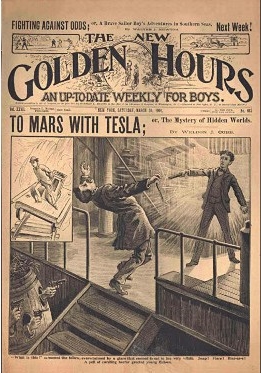 TO MARS WITH TESLA (1901) – Written by Weldon J Cobb, To Mars With Tesla (not to be confused with To Hell With Alexander Graham Bell) momentarily turned the”Edisonade” sub-genre of science fiction into a “Tesla-ade.”
  That intern sees most of the action and is supposedly a distant relative of Thomas Edison. Young Edison relays messages between his scientist bosses and this makes him a frequent target of the nefarious schemes of the villainous Heinrickson, a mad tycoon who has evil designs on the planet Mars.
 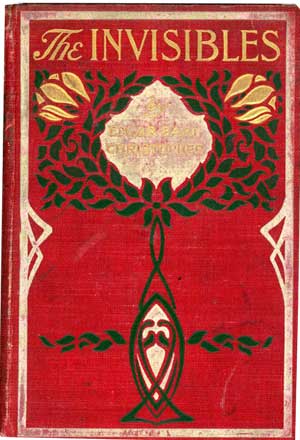 THE INVISIBLES (1903) – Written by Edgar Earl Christopher, this novel nicely anticipates cinematic serials and integrates science fiction and slight occult touches into its storyline.
  The organization can also help the British youth get revenge on Czarist Russia for the torture of his Russian mother years earlier. It turns out that the Invisible Hand is a secret society determined to overthrow the Czars and install a new Russian government.
 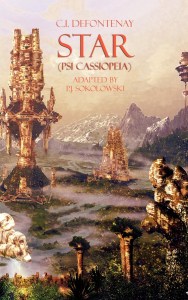 PSI CASSIOPEIA, or STAR: A MARVELOUS HISTORY OF WORLDS IN OUTER SPACE (1854) – Written by Dr Charlemagne Ischer Defontenay, a French M.D. and author. Long before J.R.R. Tolkien churned out obsessive amounts of fine detail about his fictional Middle Earth, Defontenay produced this volume of history, poetry and drama from his fictional planets in the star system Psi Cassiopeia.
 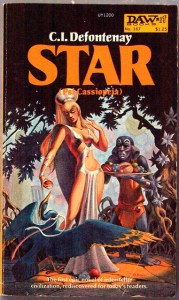 The system where that planet is located is a three-star system. Ruliel is the large, white star at the center, around which orbit the two lesser stars Altether (green) and Erragror (blue). The planet called Star is orbited by large planetoids/ moons named Tassul, Lessur, Rudar and Elier. Throwing all science to the winds the planet is also orbited by a small red star called Urrias.
