
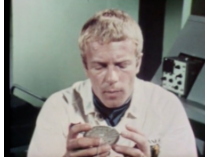
 FIVE TOMORROWS – On February 5th 1970, Kurt Vonnegut Jr. hosted an NET Playhouse presentation of five short films which presented grim visions of the future. Vonnegut was interviewed and offered comments on the international shorts from the high flux beam reactor in Brookhaven (NY) National Laboratories’ center for advanced experimental research.
As NET itself described the 90-minute production, the theme was “the shape of our daily lives should the present trend toward conformity, violence and mindless motion continue unabated.” The films:
L’urlo (The Scream) – This 1966 Italian short – later remade in 2019 – was directed by Camillo Bazzoni. In L’urlo a man of the future struggled to maintain his identity in a super-state which demanded total suppression of the individual. Emotions were forbidden, but a defiant young man (Francesco Barilli) tried to express his love only to wind up a fugitive. Continue reading
 THE ABYSMAL INVADERS (1929) – Written by Edmond Hamilton. This is a nice mish-mash of elements that are part Creature Feature, part Doctor Who and part Jurassic Park. Hamilton gets bashed as a hack but his stories are harmless fun.
  FIVE HUNDRED YEARS HENCE (1818) – Written under the pseudonym “D” this work was published the same year as Mary Shelley’s novel Frankenstein. The story is presented as written observations of the world in October and November of the year 2318.
  ARK II (1976) – In the postapocalyptic 25th Century, the year 2476 to be precise, Earth has been left devastated and transformed by warfare and pollution. Surviving scientists send out a team of explorers in a discount Damnation Alley vehicle and wearing Logan’s Run clothing. The crew of Ark II are to learn what pockets of humanity have survived and help them begin rebuilding civilization.
 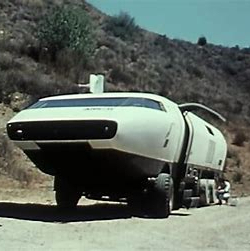 The crew of the “futuristic” vehicle were Jonah (Terry Lester), Samuel (Jose Flores), Ruth (Jean Marie Hon) and the intelligent chimp Moochie (Adam), voiced by Lou Scheimer. Ark II was outfitted with elaborate equipment that was perfect for experiments, medical emergencies and for everyday survival, like the ability to produce whatever kind of food was desired.
  PATHFINDERS IN SPACE (1960) – Balladeer’s Blog’s recurring segment Forgotten Television examines the half-hour per episode British television miniseries Pathfinders in Space. Fans of early British sci-fi will likely remember that in the 1950s and 1960s the BBC aired several episodic serials of 6 or more parts, like the original Quatermass tales,
 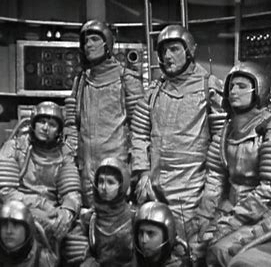 Buchan Island looked as comically unconvincing as the set from Captain Z-Ro, but in my opinion that adds to the charm of these primitive attempts at televised science fiction. Target Luna introduced viewers to Professor Wedgwood and his children, some of whom would appear in the following serials as well. That 6-episode item centered around the Buchan Island personnel testing manned orbital vessels, setting up the 7-part Pathfinders in Space, in which the Wedgwoods and others flew to the moon.
 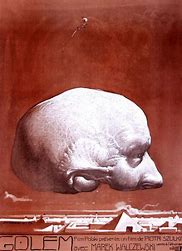 GOLEM (1980) – This science fiction film set in a post-World War Three dictatorship was made in Poland by director Piotr Szulkin and starred Marek Walczewski & Krystyna Janda. It uses the concept of a Golem as an allegory for the creation of artificial humans and examines the motives of those who would do the creating.
 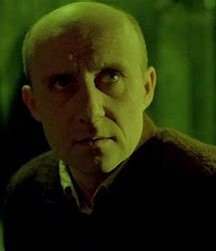 When we first meet Pernat, who has a kind of “Phil Collins in Buster” look, he is being interrogated about a murder committed in his apartment block. We observe how easily subdued and fairly lacking in intelligence he is, but ultimately the authorities release him because they don’t have enough evidence and he is just one of the suspects.
 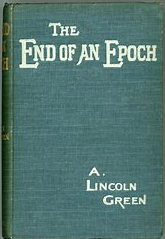 THE END OF AN EPOCH (1901) – Written by A. Lincoln Green, this novel about a world-threatening disease presented the tale of brilliant young Adam Godwin, a recent Oxford graduate who pursues his interest in microbiology. During the course of his research into antitoxins, Adam becomes aware of the controversial Dr. Azrael Falk.
  Ultimately, Adam starts neglecting Evelyn to the point that she lays down an ultimatum: Godwin must choose between her and his research. Adam chooses his research, so the engagement is ended, and the willful Evelyn joins her father’s expedition to the North Pole.
 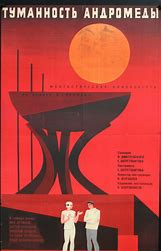 ANDROMEDA NEBULA (1967) – This movie was adapted from the 1957 novel Andromeda: A Space Age Tale by Ivan Yefremov. Unusual for sci-fi writers in the Soviet Union under Stalin, Yefremov courageously defied some of the political limitations that the blood-soaked dictator and his regime placed on fiction. Ivan is credited for, among other things, breaking free of the Soviet policy that limited futuristic tales to just a few years in the future. He continued that trailblazing in his works after Stalin died.
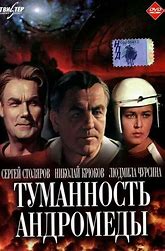 And that brings us back to Andromeda Nebula. The story is set over a millenium in the future, when an Age of World Unification (under a Soviet system, of course) was followed by the establishment of the Ring aka the Great Circle. The Ring is a loosely affiliated assortment of planets who exchange scientific and cultural information and try to facilitate each other’s efforts to colonize space.
  SPACE COMMAND (1953-1954) – Long, long before the recent television series of this name came Canada’s Space Command. James “Scotty” Doohan was Phil Mitchell, Robert Barclay played Frank Anderson, the 20-something young man who was the ostensible star of the show, Harry Geldard portrayed Captain Steve Cassell and Austin Willis was Dr. Fleming.
 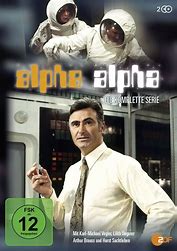 ALPHA ALPHA (1972) – This time around in Balladeer’s Blog’s Forgotten Television category comes this German sci-fi series which ran for 13 episodes from May 17th to August 2nd of 1972. Every episode of Alpha Alpha was written and directed by Wolfgang F. Henschel and ran for 25 minutes, meaning it would nicely fit a half hour time slot with commercials.
 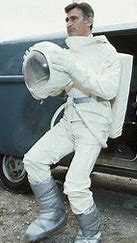 This television series was a German variation of other country’s programs like Quatermass, The X-Files and so many others both before and since.
 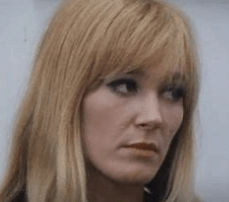 Lilith Ungerer costarred as the operative codenamed Beta, Arthur Brauss played Gamma, Horst Sachtleben was Dr. Simak and Gisela Hoetter provided the female voice of the outfit’s computer. Along with Karl Michael Vogler, these five were the only actors to appear in all 13 episodes. Heinz Engelmann showed up twice as the Chief.
