
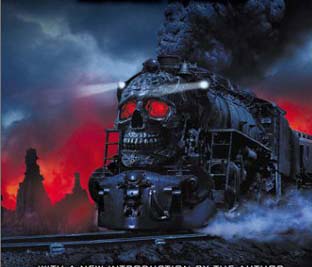
 A MEXICAN MYSTERY (1888) – Written by W. Grove. (No other name available) This is the first of two novels by Grove. This one features a sentient and evil train referred to only as The Engine.
In 1864 Mexico the Emperor Maximillian holds a contest for the best design of a new locomotive. The winner or winners will be awarded a lucrative contract to build trains to run all across Mexico on rail lines already laid – a project overseen by a Scottish engineer named John Brown.
Brown meets Pedro da Luz, the wealthy descendant of Montezuma AND Spanish Conquistadors. The brilliant but mysterious da Luz works out of the Mexican town of Xiqipu and his train engine is a marvel of technology, capable of automatically handling many duties that other trains require human workers for.
One of those duties is piloting the train and another is the feeding of wood into the Engine’s furnace to keep it running. At the contest before Emperor Maximillian da Luz’s creation outshines all the other entrants, but then things begin to go wrong. The Engine has depleted its on-board supply of wood and, in its hunger, uses its mechanical arms to uproot telegraph poles, chop them up and feed them into its furnace.
 The furious Emperor disqualifies Pedro’s Engine and awards the prize to another designer. Da Luz rants and raves to such a bloodthirsty degree that his fiancee Inez dumps him, adding to his anger. Meanwhile, the Mexican people begin regarding the Engine with superstitious awe and claim it is possessed by the Devil.
Pedro da Luz pretends to be repairing the technical glitch in the Engine in order to remove it from the vicinity but in reality he makes further “refinements” to its programming. The next day da Luz feigns surprise when daybreak reveals that the Engine has apparently left on its own and is nowhere to be found.
The story unfolds as diary entries by the Scottish engineer John Brown, mentioned earlier. Da Luz turns up dead days later, a victim of a stabbing in Mestra. Mysterious events start happening at train stations throughout Mexico, like fatal accidents and the disappearance of wood for train engines. Water towers are drained in the dead of night as well. The missing Engine, apparently acting on its own, is sighted around the country. Continue reading
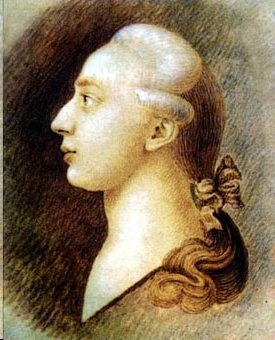
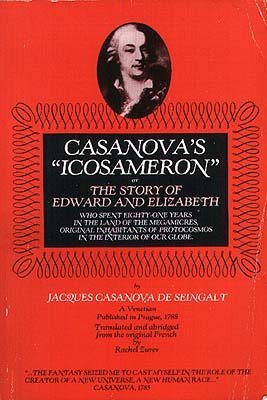 CASANOVA’S ICOSAMERON OR THE STORY OF EDWARD AND ELIZABETH WHO SPENT EIGHTY-ONE YEARS IN THE LAND OF THE MEGA-MICRES, ORIGINAL INHABITANTS OF PROTOCOSMOS IN THE INTERIOR OF OUR GLOBE (1788) – Yes, that IS the actual, complete title of this obscure item and yes, it was written by THE Giovanni Giacomo Casanova, the legendary ladies’ man and adventurer.
  The pair of twenty-somethings prove their identity through that beloved fictional trope of birthmarks and scars, then proceed to tell their tale. When the ship that Elizabeth and Edward were aboard sank at sea the then-children climbed into an empty, water-tight coffin in the cargo hold.
  THE ADVENTURES OF A MICRO-MAN (1902) – This work of vintage or “ancient” science fiction was authored by Lancelot Bayly under the pen name Edwin Pallender. The central character of the story was Doctor Geoffrey Hassler, a wealthy eccentric scientist who has discovered “microgen” a gas which shrinks objects down to a very small size.
  One of the most popular posts here at Balladeer’s Blog was my 2014 list about “ancient” science fiction from 1634-1909. Here is a followup list of sci fi tales that were way ahead of their time. FOR THE ORIGINAL LIST CLICK
  A NARRATIVE OF THE TRAVELS AND ADVENTURES OF PAUL AERMONT AMONG THE PLANETS (1873) – I shortened the title when naming this blog post. Paul Aermont was the pseudonym of an unknown author, so full credit cannot be officially given.

 Balladeer’s Blog concludes its examination of Garrett P Serviss’ odd sequel to Fighters From Mars, his blatant imitation of War of the Worlds.
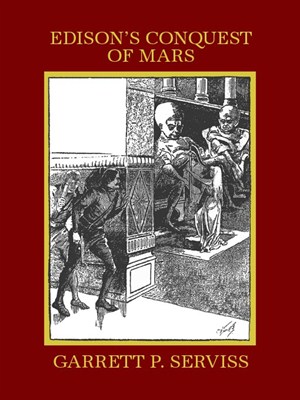 Balladeer’s Blog continues its examination of Garrett P Serviss’ odd sequel to Fighters From Mars, his blatant imitation of War of the Worlds.
  Balladeer's Blog