Tag Archives: mythology

HITTITE MYTHS: THE SECOND VERSION OF TARHUN VERSUS ILLUYANKA

TarhunAs promised here is Balladeer’s Blog’s examination of the second of two different versions of the ancient myth about the Hittite storm god Tarhun battling the supreme serpent Illuyanka. Both versions tie in with the Purulli Festival.

VERSION TWO – Illuyanka, a miles- long serpent, emerged from his lair in the depths of the sea (NOT the Netherworld like in the first version) and unleashed havoc and disorder. Tarhun the storm god clashed with Illuyanka in Kiskilussa and, unexpectedly, the serpent was triumphant. Illuyanka plucked out Tarhun’s eyes and his heart and left him to live blind and helpless (yes, even though he had no heart).

The difference in the two versions centers around the way in which Tarhun eventually gets revenge on Illuyanka. In this version the defeated, blind and “heartless” storm god, seemingly living in exile from his heavenly kingdom following his defeat, marries “the daughter of a poor man”. Neither the name of the daughter or the father is mentioned in the surviving fragments of the myth. Continue reading

12 Comments

Filed under Mythology

HITTITE MYTHOLOGY: THE STORM GOD VERSUS THE SERPENT DEITY

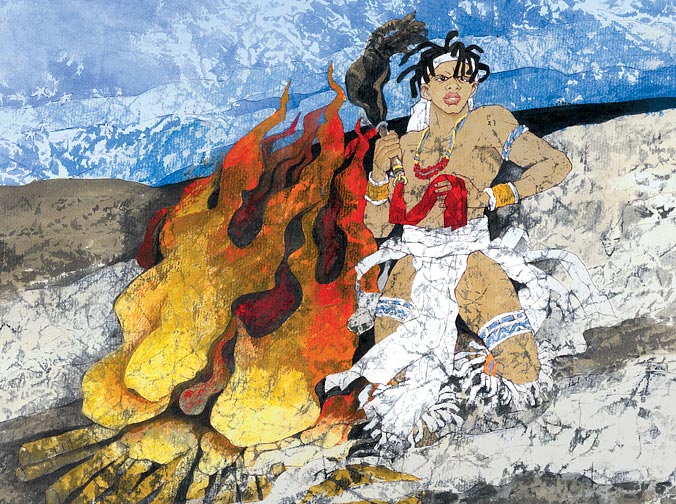
Tarhun and his vizier Suwaliyut confronting Illuyanka

Tarhun and his vizier Suwaliyut confronting Illuyanka

The readers of Balladeer’s Blog have spoken! You want more Hittite mythology! I’m always responsive to my readers so I will now examine two different versions of the ancient myth about the Hittite storm god Tarhun battling the supreme serpent Illuyanka. Both versions tie in with the Purulli Festival.

VERSION ONE – Illuyanka, a miles- long serpent, emerges from his lair in the Netherworld (making him another ally and possible son of the god Kumarbi) and unleashes havoc and disorder. Tarhun the storm god clashes with Illuyanka in Kiskilussa and, unexpectedly, the serpent is triumphant. Illuyanka plucks out Tarhun’s eyes and his heart and leaves him to live blind and helpless (yes, even though he has no heart now). Continue reading

5 Comments

Filed under Mythology

GASYONDETHA: THE IROQUOIS METEOR GOD

meteor showerGASYONDETHA – The Iroquois meteor god. Like the war god Areskoi he tried to woo the goddess Iagentci when she was taking Marriage Bread to Hawenneyu, the Chief of the Iroquois deities. Gasyondetha was associated not just with meteors and comets blazing across the sky but also with ones that struck the earth in Iroquois territory. These fallen meteors were considered Gasyondetha’s teeth, which he would sometimes pluck out of his mouth as a show of fortitude and toss to the earth below.

Many unusual rock formations that were NOT really meteors were mistakenly believed to be fallen meteors by the Iroquois in ancient times. Some stones that were believed to be meteors were said to talk and were the source of ancient stories about the world and the gods in a myth about the origin of Iroquois historical and religious tales.

One of the most famous myths involving Gasyondetha involved the god visiting an Iroquois man- Svengedaigea – in a dream warning him about monsters coming to devour everyone in his village. Continue reading

5 Comments

Filed under Mythology

HITTITE MYTHOLOGY: THE MOUNTAIN GOD AND THE DEER

Hittite empireHere at Balladeer’s Blog I’m nothing if not responsive to readers! The mania over the Hittite myths I’ve been examining lately shows no signs of abating so here is another look – this time at a didactic tale involving the mountain god.

Zaliyanu, the god of the mountain which bears his name, was kind enough to shelter a deer that was fleeing hunters. The pursuit had begun on a neighboring mountain whose god didn’t dare risk the wrath of the hunting god Kurunta by sheltering the terrified creature. Zaliyanu, the greatest of the mountain deities, had no such compunction. Continue reading

10 Comments

Filed under Mythology

KIVIOQ: INUIT MYTHOLOGY’S PREMIER MONSTER SLAYER

For more of my entries on Inuit myths click herehttps://glitternight.com/inuit-myth/

KIVIOQ – The greatest hero and monster- slayer of Inuit mythology. The exact structure of Kivioq’s saga varies wildly from region to region, some of them with a fully Continue reading

4 Comments

Filed under Mythology

HITTITE MYTH: THE SUN GOD AND THE COW


Love Child: Made fun of in school ...

Love Child: Made fun of in school …

Reaction to my recent examination of Hittite gods and goddesses has been through the roof! To keep up a little with the demand here’s a quick look at another Hittite myth, this one involving the sun god Istanu. 

Istanu, the Hittite sun god was riding his solar chariot across the sky one day and noticed that a cow had brazenly wandered into the area where the shepherd goddess Hapantali tended Istanu’s sheep. The sun god let his chariot continue its course, pulled by two of his prized rams with their shining golden fleeces, as he descended to upbraid Hapantali for her oversight in allowing the bovine intruder to graze with his sheep. Continue reading

12 Comments

Filed under Mythology

HITTITE DEITY: LELWANI, THE DEATH GODDESS

amdearl002p1LELWANI – The goddess who ruled over the subterranean land of the dead and was thus answerable to Kumarbi, the deity who ruled over all of the undergound realms. Charnel houses and mausoleums were sacred to her. Continue reading

20 Comments

Filed under Mythology

HITTITE MYTHOLOGY: THE TOP DEITIES

Hittite empireThe Hittite Empire spread throughout Anatolia, covering a large part of what is now Turkey and Syria as well as some parts far eastward and southward of there (accounts vary). The scarce remains of the texts regarding the deities worshipped by the Hittites are tantalizingly fragmentary but reflect and/or influenced myths from Mesopotamia across the west to ancient Greece and south to Canaanite territory.

ARANZAH – The god of the body of water that bore his name – the Aranzah River. The Aranzah is better known as the Tigris, which begins its journey southward from the Taurus Mountains in what is now eastern Turkey. This deity was a brother of the storm god Tarhun (Teshub to the Hurrians) and like him was born in the belly of the god Kumarbi.

ISTUSTAYA and PAPAYA – The Hittite goddesses of destiny. The two deities sat by the shores of the Black Sea where they would spin the threads that are each mortal’s destiny, taking special care with the fates of kings. The two left their seaside location only for special occassions like conferences of all the gods. Collectively the two were called the Gulses by the Hittites and the Hutena by the Hurrians. The ancient Greeks added a third to their number and called them the Morae (Fates).    Continue reading

91 Comments

Filed under Mythology

LEGENDS OF THE SPRING: A LOOK AT THOSE SEASONAL MYTHS WHICH HAVE THE SAME THEME

Persephone and pomegranateSpring keeps trying to arrive but this bitter winter refuses to give up just yet. Our nationwide longing to be liberated from the tyrannical grip of winter made this a good time to examine some of the ancient myths about winter and the coming of spring. The celebration of those myths at this time of year plus the fact that many of those myths centered around dead and resurrected deities necessitated Christianity’s attempt to superimpose its OWN dead and resurrected deity over top of those older stories. Hence the celebration of Easter in springtime. (And it’s not just Christianity that behaved that way – other religions also would superimpose their own celebrations over top of those held in honor of the previously dominant gods in their region. I’ll cover the behavior of those other belief systems – especially Islam and the Incan faith – another time.)

Not all seasonal myths conformed to the following pattern. I’m limiting this list to the ones that did.

PERSEPHONE

Pantheon: Greek (The Romans called her Proserpine)

The Tale: Persephone was the beautiful daughter of the goddess Demeter (Ceres to the Romans). Persephone caught the eye of Hades, the god who ruled over the realm of the dead. Overcome with lust Hades (Pluto to the Romans) emerged from his subterranean domain and stole Persephone away to his realm to become his Queen.

The Savior: Demeter went searching for her daughter throughout the world, often assuming the form of a mortal woman. Her search wore on and on with no results, causing Demeter to fall more and more deeply into despair. Because she was the goddess of nature that despair manifested itself in colder weather, in the leaves falling off the trees, other vegetation dying and some animals hibernating or migrating to flee the cold.  Continue reading

42 Comments

Filed under Mythology

TUPARI MYTHOLOGY: KARAM THE SUN GODDESS

Tupari live near the Rio BrancoKARAM – This deity was the sun goddess of the Tupari people who lived near the Rio Branco in Brazil. Karam was much more pwerful than her husband Puepa the moon god and Continue reading

4 Comments

Filed under Mythology