
 Yes, it’s once again Guy Fawkes Day, the day Balladeer’s Blog celebrates figures who became symbols of the exact opposite things they represented in their actual lives!
Guy Fawkes was a religious fanatic whose face became a symbol of resistance against a fictional theocratic dictatorship thanks to a comic book. Che Guevara was a murderous, homophobic, racist would-be dictator depicted as a symbol of youthful rebellion thanks to the spiteful cluelessness of Left-Wing Archie Bunkers.
Thank the forever-childish 1960s generation leftists for elevating such a repulsive and barely human creature to such heights. Even at HUFFINGTON POST the truth about blood-soaked animal Che has been written. Click HERE
Here are some actual quotes from hatemonger Che:
“Go ahead and try them tomorrow morning — but execute them NOW!”
“We must do away with all newspapers. A revolution cannot be accomplished with freedom of the press.”
 “Crazy with fury I will stain my rifle red while slaughtering any enemy that falls in my hands! My nostrils dilate while savoring the acrid odor of gunpowder and blood.”
“We don’t need proof to execute a man. We only need proof that it’s necessary to execute him. A revolutionary must become a cold killing machine motivated by pure hate.” (Note from Balladeer: Gee, I thought the poseurs and buffoons of the American Left said they’re AGAINST “hate.”)
“What we affirm is that we must proceed along the path of liberation even if this costs millions of atomic victims.”
 Read more of this animal’s own words and you will see what a callous, unfeeling political fanatic this hate-filled scumbag was. He never wanted to overthrow dictatorships to help “the people”, he just wanted to overthrow them to install dictatorships more to his liking.
In other words, dictatorships that would let that bloodthirsty maniac kill as many people as he wanted. Che Guevara was a waste of biomass and was the exact opposite of what delusional and uninformed fools consider him to have been. Continue reading
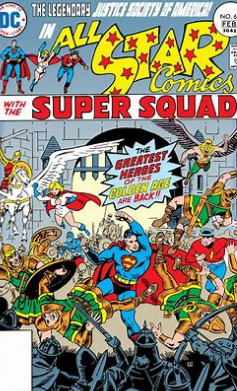 ALL STAR COMICS Vol 1 #64 (February 1977)
 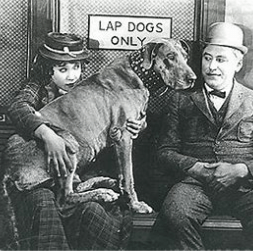 Balladeer’s Blog takes another look at the films of a silent movie star. This time I’m reviewing some of the films featuring trained animal star Teddy the Great Dane aka Teddy the Dog aka Keystone Teddy. From 1915 to 1924 Teddy starred or otherwise appeared in silent shorts as well as feature-length movies.
 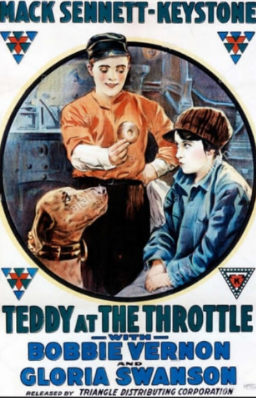 TEDDY AT THE THROTTLE (1917) – This Mack Sennett short at Keystone Studios was one of two films in which Teddy actually got his name in the title. In this light-hearted affair the Great Dane plays the pet of THE Gloria Swanson.
 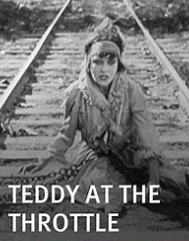 Beery’s villain character is embezzling money from the romantic leads Gloria Swanson and Bobby Vernon. Teddy, the REAL star, is cute and lively, plus he bravely saves Gloria’s life in the end when Beery ties her to railroad tracks after his villainy is exposed.
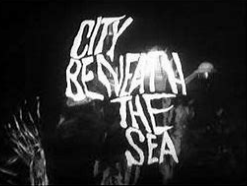 CITY BENEATH THE SEA (1962) – For starters, this is NOT the 1970s movie nor the 1950s movie of this title. This City Beneath the Sea is a seven-part television serial from Great Britain. In the past Balladeer’s Blog has covered similar British tv serials like the original Quatermass adventures, Pathfinders in Space and its sequels, in addition to The Trollenberg Terror, plus Object Z and Object Z Returns.
 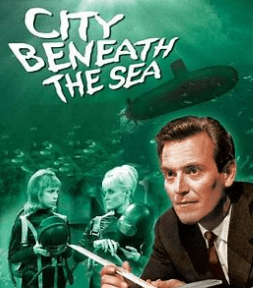 City Beneath the Sea stars Gerald Flood as reporter Mark Bannerman and Stewart Guidotti as his photographer Peter Blake. The villains are led by Germans who served in World War Two, like Denis Goacher as former U-Boat commander Kurt Swendler and Aubrey Morris as mad scientist Professor Ludwig Ziebrecken.
  Has it really been 31 days already? Happy Halloween from Balladeer’s Blog with this look at some more horror stories that are over 100 years old. They make for a nice Monster Rally feel since they feature a variety of supernatural beings.
  The bronze Venus takes a perverse liking to a prosperous young man and steals a ring the man is supposed to put on at his impending wedding ceremony. When the man goes through with the marriage without the purloined ring, the statue visits him and his bride on their wedding night and kills him.
 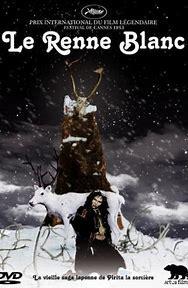 THE WHITE REINDEER (1952) – As Halloween Season nears its end, Balladeer’s Blog takes a look at a fascinating and haunting Finnish horror film. First off, let me assure readers that The White Reindeer is, indeed, a serious movie despite the way that some glib descriptions of it make it sound like just another campy black & white monster movie from long ago.
  Blomberg’s best move was just accepting the fact that he didn’t have a big enough budget for convincing special effects so he relies on stylish editing, shadows and every camera trick in the book for the transformation scenes.
 KNOCKING OFF NUMBER SEVEN – In NCAA Division Two, the WINGATE UNIVERSITY BULLDOGS welcomed the number 7 team in the nation – the LENOIR-RHYNE UNIVERSITY BEARS. Halftime saw the Bulldogs on top 17-14 but the 3rd Quarter ended in a 20-20 tie. In the explosive 4th Wingate U. won the game 34-30.
  AND ANOTHER NUMBER SEVEN TAKES A FALL – Over in the NAIA, the number 9 GEORGETOWN (KY) COLLEGE TIGERS played host to the 7th ranked LINDSEY WILSON COLLEGE BLUE RAIDERS. This was a defensive epic, with the Tigers leading by a mere 7-0 at the Half before beating the Blue Raiders 10-0.
  NUMBER EIGHT GOES TUMBLING AFTER – This game pitted D2’s 24th ranked VALDOSTA STATE BLAZERS against the number 8 UNIVERSITY OF WEST FLORIDA ARGONAUTS. A 21-21 Halftime deadlock remained unchanged in the 3rd Quarter. In the 4th the Blazers pulled off a last minute 31-28 upset.
  EERIE #124
 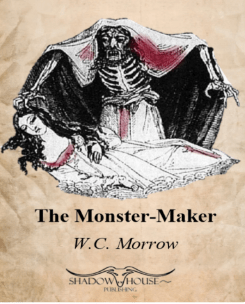 THE MONSTER-MAKER aka THE SURGEON’S EXPERIMENT (1897) – As Halloween Month hurtles toward its conclusion, Balladeer’s Blog takes a look at one of the overlooked horror tales of one of America’s most overlooked writers – W.C. Morrow. This story depicts a mad doctor dabbling in unspeakable experiments.
 Halloween Month rolls along here at Balladeer’s Blog with a look at two notoriously bad horror movies which use Andy Warhol’s name despite him not really having anything to do with them and credit Antonio Margheriti as the director even though Paul Morrissey wrote and directed them.
 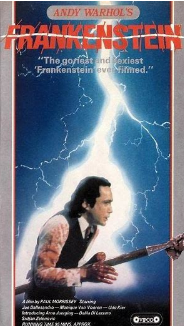 ANDY WARHOL’S FRANKENSTEIN (1973) – Also known as Flesh for Frankenstein, this 3-D monstrosity and its sister film, Andy Warhol’s Dracula (aka Blood for Dracula) used to be among the most well-known “So Bad They’re Good” movies. Oddly, they fell pretty much off the radar long ago, but get rediscovered every so often and enjoy a brief surge in notoriety from successive generations of horror fans.
 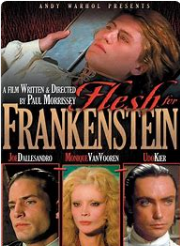 These two movies are also like 1970s time capsules, too. Recently relaxed standards for what could be shown on the big screen yielded a LOT of cheap films that were clearly made just to see how much gory violence and kinky titillation the creative teams could get away with.
 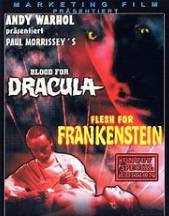 Andy Warhol’s Frankenstein and Andy Warhol’s Dracula deserve my usual warnings to horror fans who really hate extreme violence and bizarre sex. Don’t go below the “Continue reading” line or you’ll probably regret it. These films are mild compared to
