
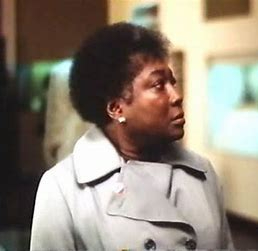
 MOMMA THE DETECTIVE (1981) – Happy Mother’s Day to the ladies who brought all of us into this world! Every single one of us alive today was given birth to by a woman, and to help mark their special day here’s my review of a made for tv production about a sleuthing mother in New York City.
This item was the pilot for a potential series to be titled Momma the Detective and is also known as See China and Die, which would have been the individual episode title had this been picked up as a series. The star was the venerable Esther Rolle, most famous for her role as Florida Evans on Maude (1972-1974) and then Good Times (1974-1979).
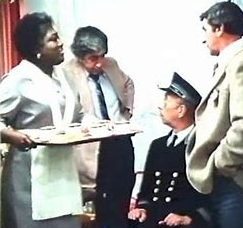 Rolle starred as “Momma” Sykes, a freelance cleaning woman and cook who works for several well-to-do clients in a New York high rise.
When she discovers one of her clients stabbed to death in his bed one morning, she gets the chance to put to use the detective skills that she has honed through years of reading murder mysteries. (It’s television. Just go with it.)
 Momma Sykes’ son Alvin Sykes (Kene Holliday) is a detective with the New York City Police Department and he happens to be the one assigned to this particular case. His gentle exasperation as Momma persistently pursues her own parallel investigation to his sets the tone for what apparently would have been his “Bert Convy in The Snoop Sisters” role if this had gone to series. Continue reading
 It’s been nearly six years since the finale of the 18 episode run of new Twin Peaks chapters on cable. Like many other fans I’m still debating my final verdict on the series in light of the gloriously dark and nightmarish conclusion, so this particular blog post applies ONLY to the original Twin Peaks television series, the 1992 film Fire Walk With Me and its deleted scenes from The Missing Pieces.
 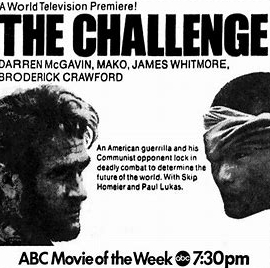 THE CHALLENGE aka Surrogate (1970) – This made for tv movie aired in February 1970. The storyline involves a downed satellite that contains American national defense technology. It landed near a fictional Asian nation which is closely allied with Communist China.
  Neither the U.S. nor Red China want to see this incident escalate into an all-out war, so they agree to a solution. Each side will send one man to a small nearby island. Whichever surrogate manages to kill the other within five days will have “won” the downed satellite for its side.
  ARK II (1976) – In the postapocalyptic 25th Century, the year 2476 to be precise, Earth has been left devastated and transformed by warfare and pollution. Surviving scientists send out a team of explorers in a discount Damnation Alley vehicle and wearing Logan’s Run clothing. The crew of Ark II are to learn what pockets of humanity have survived and help them begin rebuilding civilization.
 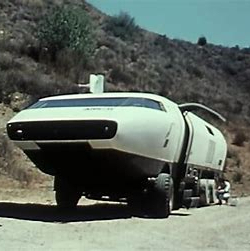 The crew of the “futuristic” vehicle were Jonah (Terry Lester), Samuel (Jose Flores), Ruth (Jean Marie Hon) and the intelligent chimp Moochie (Adam), voiced by Lou Scheimer. Ark II was outfitted with elaborate equipment that was perfect for experiments, medical emergencies and for everyday survival, like the ability to produce whatever kind of food was desired.
  JESUS: A PASSION PLAY FOR AMERICANS (1969) – Happy Easter! Here’s a look at an experimental take on the story of Jesus Christ’s crucifixion and resurrection, all accompanied by music.
  PATHFINDERS IN SPACE (1960) – Balladeer’s Blog’s recurring segment Forgotten Television examines the half-hour per episode British television miniseries Pathfinders in Space. Fans of early British sci-fi will likely remember that in the 1950s and 1960s the BBC aired several episodic serials of 6 or more parts, like the original Quatermass tales,
 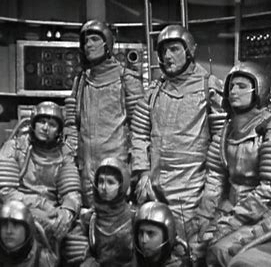 Buchan Island looked as comically unconvincing as the set from Captain Z-Ro, but in my opinion that adds to the charm of these primitive attempts at televised science fiction. Target Luna introduced viewers to Professor Wedgwood and his children, some of whom would appear in the following serials as well. That 6-episode item centered around the Buchan Island personnel testing manned orbital vessels, setting up the 7-part Pathfinders in Space, in which the Wedgwoods and others flew to the moon.
 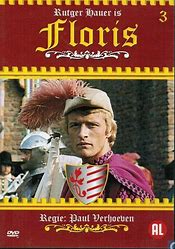 FLORIS (1969 and 1975) – Actor Rutger Hauer and director Paul Verhoeven first worked together for this adventure series set during the very early 1500s. The program aired on Netherlands television in 1969, then was remade – again with Hauer in the swashbuckling title role – in 1975 for German television and ran for even more episodes than the original series.
 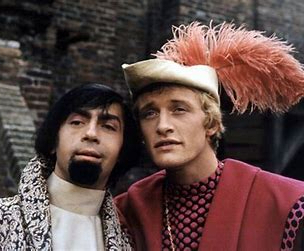 Around the year 1502, word finally caught up with our wandering hero that his father and two older brothers had died. Floris returned home, accompanied by his adventuring sidekick Sindala (Jos Bergman), an Indian Fakir. (Floris and the Fakir was originally going to be the title of the series.)
 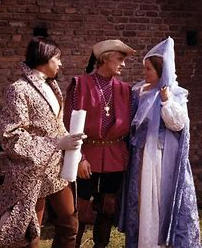 Floris and Sindala fought their way out of the hands of the enemy and wound up allied with Wolter van Oldenstein and his men at Castle Oldenstein. I often wonder if the 1991 film Robin Hood, Prince of Thieves took partial inspiration from the premise of Floris, with a returning nobleman fighting oppression alongside a nonwhite comrade from his overseas adventures.
 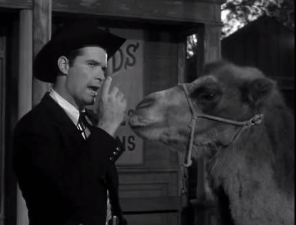 RELIC OF FORT TEJON (November 3rd, 1957) – Here’s something a little different from the usual for Balladeer’s Blog’s Forgotten Television category. The 1950s James Garner series Maverick was an all-time classic, but this particular episode is often overlooked.
 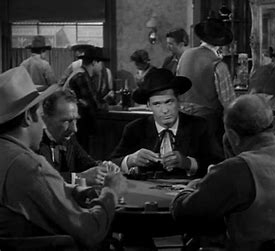 Previously, I’ve examined the
  LORRAINE HANSBURY: TO BE YOUNG, GIFTED AND BLACK (January 20th) – A 90-minute biography of African-American playwright Lorraine Hansbury, whose works include A Raisin in the Sun. Her husband Robert Nemiroff wrote this drama which includes performances of scenes from her plays. Ruby Dee, Roy Scheider, Blythe Danner, Barbara Barrie and Claudia McNeil were among the cast members.
 AN IDEAL HUSBAND (January 14th) – Adaptation of the play by Oscar Wilde. THE Jeremy Brett starred as the good guy, Viscount Arthur Goring, who takes action when the brother of his lady love Mabel Chiltern (Susan Hampshire) is being blackmailed by a conniving socialite (Margaret Leighton). Originally aired in England in 1969. 90 minutes.
  Balladeer's Blog