
 In the realm of pop culture it continues to be Marvel Comics’ world! Over the past few years Balladeer’s Blog has been reviewing some old, old, OLD Marvel stories from decades ago. From the research I’ve done, I feel the late 1960s through mid-1970s were Marvel’s creative height, with only the Uncanny X-Men title retaining consistent art and story-telling quality beyond that time period.
I’ve covered The Celestial Madonna Saga (1973-1975), which also contained The Avengers/ Defenders War and the original Thanos War within its own storyline. I’ve examined the 13-part Black Panther story titled Panther’s Rage (1973-1975), the original Kree-Skrull War (1970-1971) and, most recently, the 7-part Adam Warlock tale The Magus (1975-1976).
Readers requested more Marvel, so, since these are fun and light time-passers, here comes Killraven, the Warrior of the Worlds.
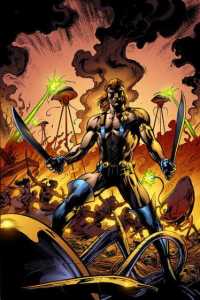 WAR OF THE WORLDS/ WARRIOR OF THE WORLDS/ KILLRAVEN: In the early 1970s Marvel was experimenting with hybrid titles combining the old and the new by fusing licensed properties with unique Marvel twists.
The most famous and longest-lasting example was Shang Chi, Master of Kung Fu. In 1973 Marvel licensed the use of Sax Rohmer’s Fu Manchu plus other characters from the Fu Manchu tales. Rather than just churn out a Fu Manchu comic book series “the House of Ideas” instead combined it with the Kung Fu craze of the time and created Shang Chi, the son of Fu Manchu.
Shang Chi, as a surrogate Bruce Lee, and Sir Denis Nayland-Smith, as a surrogate Braithwaite from Enter: The Dragon, were the core of the new series. Shang Chi started out as an operative of his evil father Fu Manchu, but realized the error of his ways and threw in with Sir Denis and his team to battle his father’s malevolent schemes.
In 1976 Marvel licensed the rights to do a comic book tie-in series with 2001: A Space Odyssey and ultimately incorporated their most popular character from that series – Mister Machine aka Machine Man – into the mainstream Marvel Universe.
The same year as Shang Chi – 1973 (so BEFORE Star Wars) – Marvel had worked similar “synergy” by taking their license to do a comic book series based on H.G. Wells’ War of the Worlds and combining it with sci-fi post-apocalypse action. The main character was Jonathan Raven, aka Killraven, a charismatic rebel leading an uprising against Earth’s 21st Century Martian conquerors.
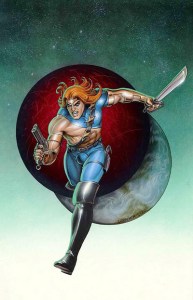 Killraven’s use of a sword AND futuristic firearms in action set against a post-apocalyptic backdrop also brought a little John Carter of Mars appeal into the series. By 1976 the promising saga was canceled due to poor sales but gained a cult following in the decades since then.
Killraven’s influence could be seen in the original 1980s mini-series V, especially the element of humans being used as food by our alien overlords and the sentimental “heroic freedom fighters versus evil tyrants” appeal. Killraven writer Don McGregor incorporated similarly themed stories and characters into Sabre, his other post-apocalypse comic book series.
Even Star Wars reflected some aspects of Killraven’s tales: the Rebel Alliance against the bad guys, the armored badass (The High Overlord in Killraven’s case) and, of course, the way Killraven wielded enigmatic, more than human abilities called simply “the Power” in K.R.’s series. (PLEASE NOTE: Killraven’s use of The Power came years before Star Wars and The Force.) The young sword-wielding hero was slowly mastering the Power as the series went along, but cancellation cut short his development of his paranormal gifts.
 And yes, I know that both Killraven and Star Wars drew on the same vast inheritance of sci-fi tropes but the close proximity of K.R. (1973-1976) to Luke Skywalker (1977 onward) makes the comparisons inevitable.
About fifteen years back, Tom Cruise was set to star as Killraven but eventually all K.R. elements were dropped from the project and Cruise starred in simply another remake of War of the Worlds instead. You have to wonder if the Marvel name would have motivated the filmmakers to keep the Killraven angle if the movie had been done AFTER Marvel became the dominant source for cinematic blockbusters that it is now.
At any rate, let’s dive into the very first appearance of Killraven in 1973: Continue reading
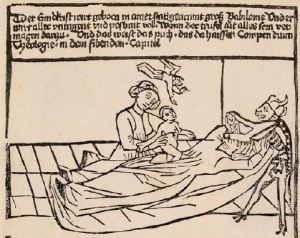 Block Books from centuries ago were a form of illustrated storytelling, most often associated with religious topics. Naturally in a period of limited literacy the graven woodblock picture- stories made theological tales even more popular with the masses. In approximately 1455 – 1480 these “proto- comic books” addressed the Antichrist and the End Times.
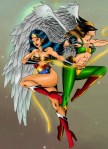 Thank you to readers who reminded me that I did not follow up my examination of the World War Two-era Justice Society of America stories with my usual collection of links. I always did that after similar items like The Celestial Madonna Saga, Panther’s Rage, The Kree-Skrull War and most recently Adam Warlock’s encounter with the Magus, Thanos and Gamora.
 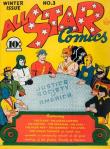 THE FIRST MEETING OF THE JUSTICE SOCIETY OF AMERICA (December 1940)
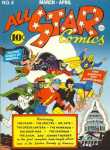 FOR AMERICA AND DEMOCRACY (March 1941)
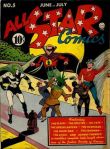 THE MYSTERIOUS MISTER X (June 1941)
 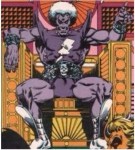 Balladeer’s Blog’s examination of another old, old, OLD Marvel Comics hit continues.
 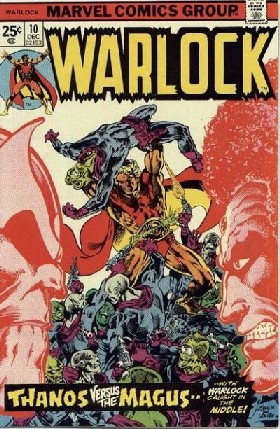 PART SIX
 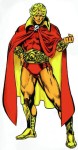 We pick up right where we left off last time: Room #7, Sub-Level 2 of the Sacred Palace, headquarters of the Magus’ galaxy-spanning Universal Church of Truth. The Magus, that Church’s self-proclaimed god, not only defeated Warlock and Pip the Troll but also thwarted Gamora’s attempt to kill him with her God-Slayer Knife.
  The Magus had left Room #7, Sub-Level 2 after defeating Adam, Gamora and Pip, and thus is not aware that Thanos is involved. With Gamora’s interference having already altered the Magus’ past as he remembered experiencing it as Adam Warlock, the mad “deity” sent a legion of his Black Knights of the Church to attack the survivors in Room #7, Sub-Level 2 to prevent any further significant changes.
  PART TWO
 After his clash with Warlock last time around the Magus has alerted his empire’s starships to be on the lookout for any sign of our hero. The first vessel to come across Adam is the spaceship called The Great Divide, commanded by the blue-skinned Captain Autolycus of the Black Knights of the Church (more on them shortly).
 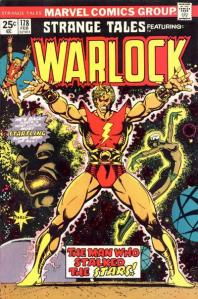 Balladeer’s Blog takes a look at the turning point story for Adam Warlock, a Marvel Comics character … and therefore probably destined to become a pop culture demi-god like almost every other Marvel figure thrown at the screen. (He was already an Easter Egg in their Cinematic Universe)
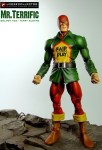 Balladeer’s Blog’s examination of the Justice Society’s World War Two-era stories continues. FOR PART ONE CLICK
 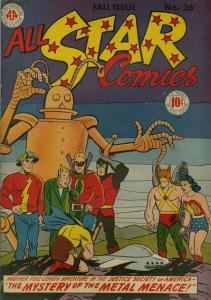 ALL STAR COMICS #26 (Fall 1945)
  Synopsis: The Justice Society members are assembled at their Philadelphia headquarters because of the disappearance of scientist Herbert Crawford. Crawford had fallen into disrepute recently over his claims that a spaceship from Jupiter was headed for the Earth with hostile intentions.
  Balladeer’s Blog’s examination of the Justice Society’s World War Two-era stories continues. FOR PART ONE CLICK
 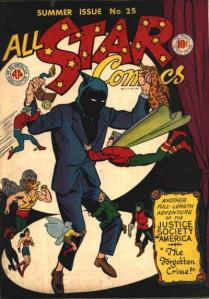 ALL STAR COMICS #25 (Summer 1945)
  Synopsis: At their Philadelphia headquarters the Justice Society of America encounter an amnesiac man who insists he somehow knows that Rob Victor, a man convicted of murdering wealthy Timothy Kimball years earlier, is really innocent.
  Balladeer’s Blog’s examination of the Justice Society’s World War Two-era stories continues. FOR PART ONE CLICK
 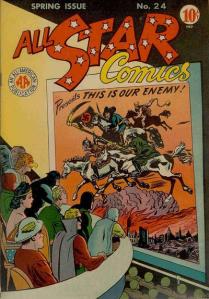 ALL STAR COMICS #24 (Spring 1945)
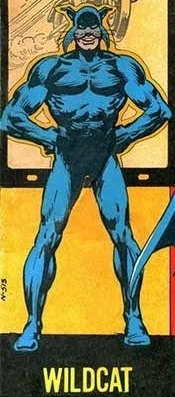
 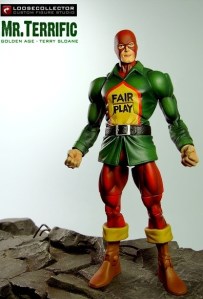 Synopsis: This is the first issue to feature Mister Terrific and Wildcat as part of the Justice Society of America.
 Balladeer’s Blog’s examination of the Justice Society’s World War Two-era stories continues. FOR PART ONE CLICK
  ALL STAR COMICS #23 (Winter 1944)
 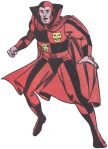 Synopsis: The Courier newspaper has been covering the crime-spree of a supervillain calling himself the Psycho-Pirate because of his power over emotions. The Psycho-Pirate contacts the Courier to issue a challenge to the Justice Society of America to try to stop his crimes.
  Balladeer's Blog