
For this weekend’s light-hearted, escapist superhero post from Balladeer’s Blog we’ll take a look at the early stories of the Legion of Superheroes’ archenemies the Fatal Five. For my recent review of 1970s Legion tales click HERE.
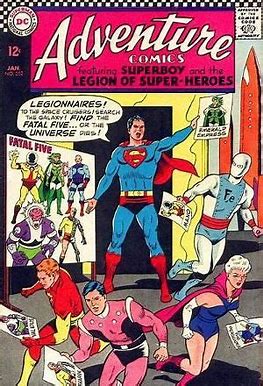 ADVENTURE COMICS VOL 1 #352 (January 1967)
Title: The Fatal Five
Legion Roster: Superboy, Cosmic Boy, Princess Projectra, Sun Boy and Ferro Lad
Villains: The Fatal Five (Emerald Empress, Tharok, Validus, the Persuader and Mano)
Synopsis: In the 30th Century, a space entity called the Sun Eater devours a star, causing the destruction of all life on the planet that orbited it. The Science Police had charted the Sun Eater’s path and warn Earth that its sun is next on the menu for the being.
The only Legion of Superhero members that are not already away on missions are Cosmic Boy, Ferro Lad, Sun Boy, Princess Projectra and Superboy. With a mere two days before the Sun Eater arrives to feed on Earth’s sun, the Legionnaires convince the United Planets to let them recruit the Fatal Five, the collective nickname for the most dangerous criminals in the universe.
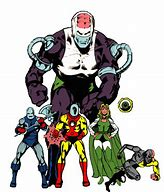 The Fatal Five are Tharok, a cyborg whose cybernetic brain makes him more intelligent than Brainiac 5; Validus, a huge purple monstrosity whose insanity drives it to perpetual violence; the Emerald Empress, evil ruler of an entire planet whose populace recently won a war to overthrow her; the Persuader, a killer and plunderer whose armor and Atomic Axe make him unstoppable; and Mano, a mutant whose hand wields energies so powerful that the hand destroyed his entire home planet. Continue reading
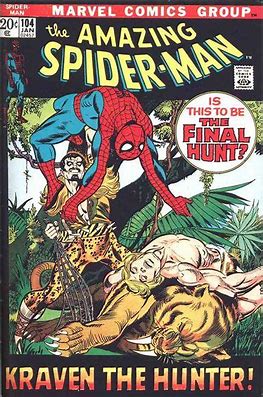 SPIDER-MAN Vol 1 #104 (January 1972)
 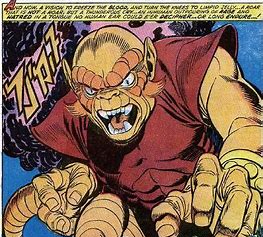 Back to the story, Spider-Man is saved from the quicksand by the timely arrival of
 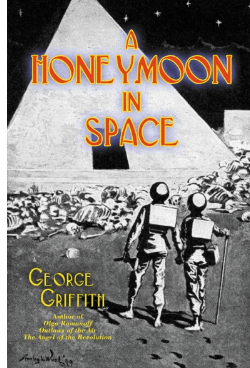 A HONEYMOON IN SPACE (1900) – Written by George Chetwyn Griffith- Jones under the pseudonym George Griffith. Jones had worked as a sailor, a journalist and a teacher before writing a series of novels covering a broad range of topics.
 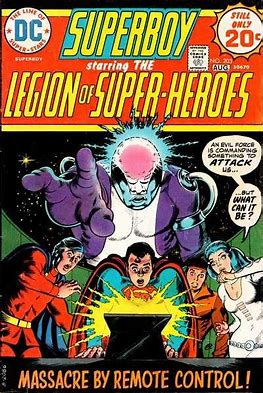 LEGION OF SUPERHEROES (Superboy starring the …) Vol 1 #203 (August 1974)
 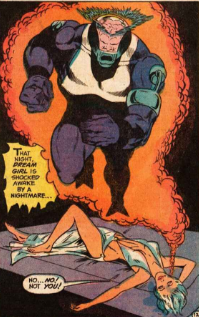 Eventually, Dream Girl has a dream foretelling an imminent attack by Validus – the huge, mindless monster who is strong enough to take on entire teams of Legionnaires at once. Because Validus is usually harmless unless controlled psychically by its fellow Fatal Five member Tharok, the Legion makes sure that the cyborg Tharok is still safely incarcerated at Space Prison Complex X33.
 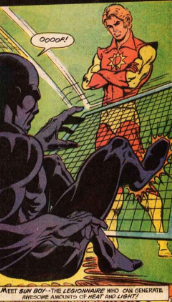 When Validus ultimately attacks Legion headquarters in future Metropolis, he is routing the heroes while withstanding all their counterattacks. Invisible Kid at first seems to have abandoned his post to dally with Myla but it turns out he actually solved the problem at hand.
 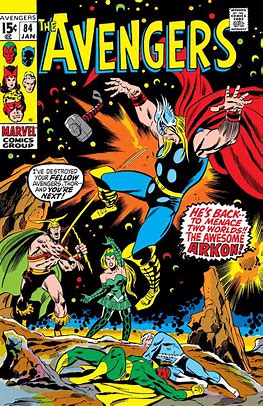 AVENGERS Vol 1 #84 (January 1971)
  While searching for the Well at the Center of Time, the only safe place to hide the Ebony Blade, the Black Knight is captured by Arkon and his new consort –
  MICROMEGAS (1752) – Written by Voltaire. The famed philosopher’s contribution to the nascent science fiction genre dealt with one of the earliest known instances of beings from other planets depicted visiting the Earth. Amid the fantastic elements of the story Voltaire fits in examinations of the philosophies of Aristotle, Locke, Descartes and others.
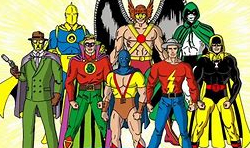 For this weekend’s light-hearted, escapist blog post about superheroes, Balladeer’s Blog goes back to the Justice Society of America, this country’s very first superteam. Years ago, I covered the early years of the JSA, from their first appearance in
 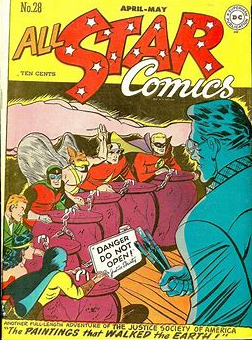 ALL-STAR COMICS Vol 1 #28 (April 1946)
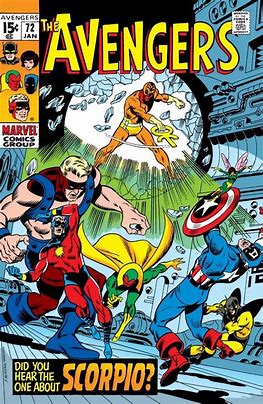 AVENGERS Vol 1 #72 (January 1970)
 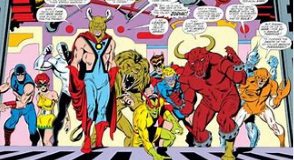 This leads to the Avengers learning that Scorpio is not alone – he is a member of
  JACK LONG or The Shot in the Eye (1844) – With the Frontierado Holiday coming up in early August, Balladeer’s Blog takes a look at this Charles Wilkins Webber short story from 1844.
  In 1853, the author added his original, official version of the story to his collection Tales of the Southern Border. It may be impossible to overstate the legacy of Jack Long. This Texas-set story presented virtually Biblical levels of violence during the Shelby County War (1839-1844) and set the standard for tales of gunslinging revenge quests down to the present day.
  Balladeer's Blog