
A few years back Balladeer’s Blog examined some of the folklore surrounding some very menacing cryptids from tall tales around the nation. This time around, the creatures being covered are much milder.
 THE BILLDAD
Habitat: Boundary Lake in Maine
Lore: The Billdad is said to be roughly the size of a badger, beaver or wolverine. It has hind legs and a torso like a kangaroo, a flat, wide tail like a beaver, a head like a bird of prey, and webbed paws. Their tail slapping the water is often compared to the sound of canoe paddles striking the water.
Billdads feed on fish who venture too near the surface of Boundary Lake. Their powerful hind legs propel them from the shore to the spot of their prey, which they strike dead with their flat tail. They devour the fish then use their webbed paws to swim back to shore. Reproducing asexually, these creatures replenish their numbers from humans or animals foolish enough to kill and eat a Billdad, causing them to morph into another Billdad. Continue reading
 THE RESCUE OF RUGGIERO – In the cliffhanger ending of our previous installment, Ruggiero the Saracen was still on the island divided into separate kingdoms by Morgana’s sisters – the evil sorceress Alcina and the good sorceress Logestilla.
 These are the legends about Charlemagne and his Paladins, not the actual history, so there will be dragons, monsters and magic.
 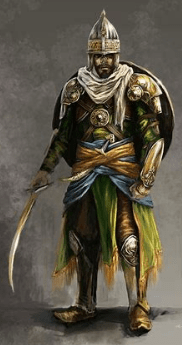 Ruggiero (at left) was hoping that Logestilla would use her own magic to cure the Paladin Astolpho of the spell that Alcina had cast – a spell that had trapped Astolpho in the form of a tree. The hippogriff – the large, winged horse/ eagle hybrid which had flown Ruggiero to the island last time around – refused to accompany the warrior any further, so our hero walked on alone.
  As regular readers of Balladeer’s Blog may recall, December and early January are when I sprinkle in more tales of the Paladins of Charlemagne. These are the legends about Charlemagne and his Paladins, not the actual history, so there will be dragons, monsters and magic.
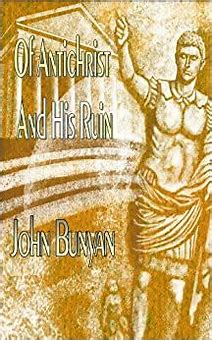 OF ANTICHRIST AND HIS RUIN (1692) – Last week Balladeer’s Blog reviewed John Bunyan’s often neglected work
 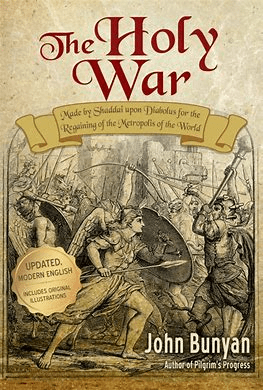 THE HOLY WAR (1682) – The work that John Bunyan is most well-known for is The Pilgrim’s Progress, but given the theme of Balladeer’s Blog, rather than write the 2 billionth review of that book I decided to take a general look at one of Bunyan’s often overlooked writings on mythology/ allegory.
 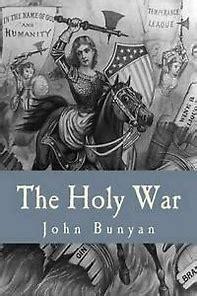 (Hey, it’s John Bunyan. If you’re looking for subtlety, let me introduce you to Mr. You-Won’t-Find-It-Here. Still, his works can be entertaining and thought provoking in a quaint, fairy-tale way.)
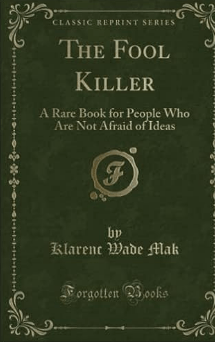 THE FOOL KILLER (1918) – The 1918 one-shot publication called The Fool Killer collected written works by Dr Klarenc Wade Mak, poet, author and socialist political candidate for mayoral office in Kansas City, MO around 1918. Mak had also written Ekkoes (sic) from the Hart (sic) and Mental Dinamite (sic).
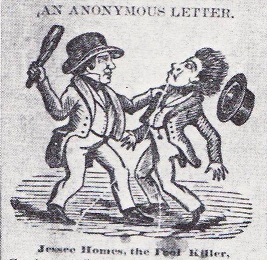 During the 1850s Fool Killer tales were fused with political satire and commentary as Charles Napoleon Bonaparte Evans launched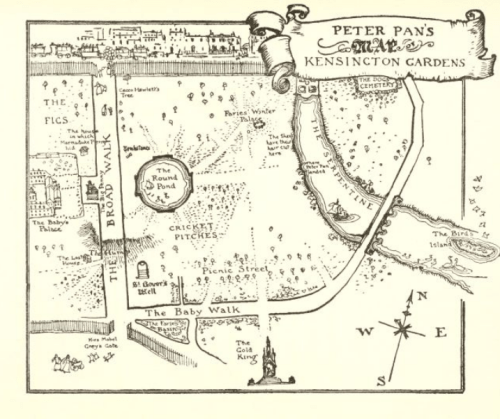
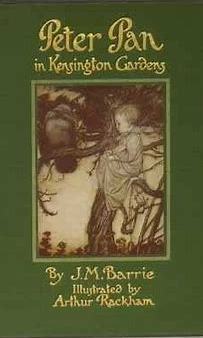 PETER PAN IN KENSINGTON GARDENS – Here at Balladeer’s Blog I like to cover neglected items, even when it comes to popular subjects like Peter Pan. Before the figure became established in the public consciousness as the leader of the Lost Boys in Neverland, J.M. Barrie presented Peter in a very different form.
 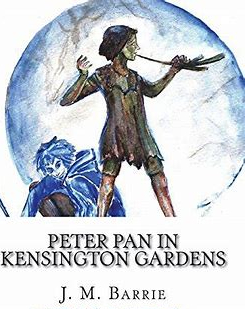 This was followed by the 1904 stage play about Peter Pan, which established the more well-known lore regarding the character. In 1906, the six chapters from The Little White Bird were published in a separate book as Peter Pan in Kensington Gardens. That was followed by the 1911 novelized version of the 1904 play, with the novel adding some finishing touches to Peter Pan lore.
 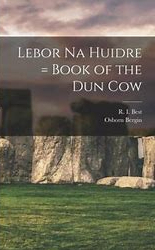 PART ONE – This opening segment examined the Six Ages of the World section, a mythological look at the history of the world from Creation to the coming of Jesus Christ. The Book of the Dun Cow contains a mix of pagan and Christian materials, and in Part One I also reviewed its presentation of myths regarding Great Britain, legends of Saint Columba and its version of the story of Tuan mac Cairill, the only non-Ark survivor of the Great Flood and who chronicled the ancient races of Ireland like the Tuatha de Danaan, Fir Bolg and Milesians. Click
  PART TWO – The four sections covered in Part Two: Two Sorrows of the Kingdom of Heaven, featuring Elijah and Enoch in Heaven and their observations regarding the Antichrist, the end of the world and the Final Judgment; The Intoxication of the Ulstermen, about the Samhain partying of the Ulstermen and the peril it led to; The Raid on Dartaid’s Cattle, about a raid to rustle the cattle of the she-warrior Dartaid; and The Raid on Fliodhaise’s Cattle, featuring Queen Maeve, King Ailill, Fergus mac Roich and Queen Fliodhaise, her lusty ways and her cattle. Click
  Balladeer's Blog