Category Archives: Ancient Science Fiction

THE SPEEDY JOURNEY (1744) ANCIENT SCIENCE FICTION

The Air Ship departs the Earth as Fama and the Astral Body look on.

The Air Ship departs the Earth as Fama and the Astral Body look on.

THE SPEEDY JOURNEY (1744) by Eberhard Christian Kindermann. This work of proto-science fiction begins with the fictitious discovery of a moon orbiting the planet Mars over a century before Phobos and Deimos were observed in real life. From there it features a journey through space to reach this celestial body.  

The Speedy Journey represents an odd but entertaining fusion of scientific speculation and elements of Christian mythology. Fama (“Fame”), an actual angel from Heaven heralds the discovery of the fictitious moon of Mars and even sings the public praises of the team of scientists who set out to explore the satellite. In the peculiar fictional world presented by Kindermann in this book the general public takes in stride these visitations from angels who serve as virtual P.R. flacks for men of science.   Continue reading

14 Comments

Filed under Ancient Science Fiction

THE UNPRETENTIOUS PHILOSOPHER (1775): ANCIENT SCIENCE FICTION

The spacecraft departs from Mercury.

The spacecraft departs from Mercury.

THE UNPRETENTIOUS PHILOSOPHER (1775) – By Louis-Guillaume de La Follie. The original French title of this work of proto-science fiction was Le Philosophe sans Pretention ou l’Homme Rare, but in the 21st Century it’s more generally known by the slightly shorter title. 

One of the central characters of this story is an Earth scholar named Nadir, and I have no idea if it’s a coincidence or if the people behind the 1960’s film Frankenstein Meets The Space Monster were paying sly homage to de La Follie by naming one of the characters Nadir. At any rate Nadir is visited by Ormisais, a space traveler from the planet Mercury.

Ormisais regales Nadir with details about life on Mercury and also informs him that he has crash-landed on Earth and needs rare elements to repair his electrically -powered craft so that he can return to his home planet. The Mercurians had a planetary version of the British Royal Society and the French Academy, but it had a much more limited membership. Continue reading

6 Comments

Filed under Ancient Science Fiction

ANCIENT SCIENCE FICTION: NAVIS AERIA (1768)

Navis AeriaNAVIS AERIA (1768) – By Bernardo Zamagna. Written in 1768 Navis Aeria (“Ship of the Air”) was the Italian Zamagna’s attempt to take concepts we of today would associate with science fiction and present them in the old, quaint format of Epic Poetry.  

The verse story detailed a flight around the world in a flying machine which was basically a sailing ship with four huge balloons around the sails and connected to a main mast. Zamagna presciently observed that one day aircraft would constitute “other Argos to carry chosen heroes” on their adventures. Continue reading

18 Comments

Filed under Ancient Science Fiction

THE VOYAGE OF LORD CETON TO THE SEVEN PLANETS (1765)

RoumierTHE VOYAGE OF LORD CETON TO THE SEVEN PLANETS (1765) – Written by Marie- Anne de Roumier. Though written by a French woman in 1765 this example of “ancient” science fiction was set in 1640’s England. (?) A young Lord in the court of King Charles I travels – along with his sister Monime – into space thanks to an accomodating angel.

This angel is named Zachiel and safely transports his charges all over the solar system and home again. The sun turns out to be inhabited by a studious and thoughtful people devoted to philosophy and natural science. Mercury was inhabited by a hot-tempered and impatient race of semi-humanoids. Continue reading

10 Comments

Filed under Ancient Science Fiction

ANCIENT SCIENCE FICTION: THE MEN OF THE MOON (1809) BY WASHINGTON IRVING

Washington Irving giving us his sexiest come-hither stare.

Washington Irving giving us his sexiest come-hither stare.

THE MEN OF THE MOON (1809) – Several decades before H.G. Wells would use his fictional invasion from Mars in War of the Worlds as an allegorical condemnation of colonialism the American author Washington Irving beat him to it. In Irving’s work The Men of the Moon a technologically advanced race from the moon conquered the Earth and treated its inhabitants the way that European and Muslim colonialists treated the indigenous inhabitants of the areas they subjugated.

Irving tongue-in- cheekly called his invaders from the moon “Lunatics” and depicted them as green-skinned humanoids with tails and one eye each instead of two. Their most bizarre feature is the fact that they carry their detached heads tucked under one arm with a spinal column “cord” attaching the head to the body. For refreshment the moon men drink liquid nitrous oxide.  Continue reading

67 Comments

Filed under Ancient Science Fiction

HENRY MORE: ANCIENT SCIENCE FICTION FROM 1647

Henry MoreHenry More was a Platonist philosopher at Cambridge. Inspired by Keplers’ work of “ancient science fiction” titled Somnium More wrote a poem titled Insomnium Philosophicum which was published in 1647.

In this work More depicted his astral body departing his physical form to fly into space, rowing “with mine own arms in liquid sky” for fans of the cult movie of that name. Continue reading

6 Comments

Filed under Ancient Science Fiction

A VOYAGE TO THE WORLD OF CARTESIUS: MORE “ANCIENT” SCIENCE FICTION FROM BALLADEER’S BLOG

Voyage to the World of CartesiusA VOYAGE TO THE WORLD OF CARTESIUS (AKA DESCARTES) (1690) – By Gabriel Daniel. This book dealt with a journey to the moon, the planets and ultimately to the “space beyond the universe”. The author’s use of “space” in this sense is often cited as the oldest known use of the word regarding concepts of “outer space” and “space travel”.

If you enjoyed Monty Python’s Philosopher Drinking Song you should enjoy A Voyage to the World of Cartesius (Descartes). Daniel depicted himself on a search to contact the soul of the philosopher Rene Descartes. In keeping with Cartesian philosophy’s separation of mind and body Descartes was shown drifting through space, employing his philosophy to “correct” mistakes that were made by the Mad Genius Creator of the Universe. Continue reading

8 Comments

Filed under Ancient Science Fiction

TEN NEGLECTED EXAMPLES OF “ANCIENT” SCIENCE FICTION

Forget the stories written by the usual science fiction pioneers like Jules Verne and H.G. Wells. This list will examine some of the nascent works of science fiction going back to before the world at large even used those words to describe this emerging genre. Though technically this examination could begin as far back as 150 C.E. with the Greek philosopher Lucian’s works like Icaromenippus and True History – both involving journeys to the moon via man-made craft – I will instead begin in the 1600s and move on to the early 20th Century.

Somnium10. SOMNIUM (1634) – Written by Johannes Kepler. Yes, this is THE Johannes Kepler the famed astronomer so this may be the earliest work of proto-science fiction written by a figure with a grounding in something approaching our own notions of rational science (which, of course, excludes Michael “the false Nobel Prize winner” Mann). Somnium depicted a fictional visit to the moon with story details based very loosely on observations Kepler had made while observing Earth’s natural satellite through a telescope – a fairly new device at the time.  

Kepler’s work depicted the moon as a celestial body of extremes which was bisected into two regions of blazing heat and freezing cold. Nights on the moon were very mild on the side facing Earth because of the amount of reflected sunlight that our planet sends its way. Believe it or not life existed in this world of extremes – reptilian creatures which lived in caves and breathed in the lunar atmosphere. Kepler also depicted plant life – cone-shaped vegetation which went through its entire life-cycle within two weeks.

Fearing the type of persecution that Galileo had faced Kepler never published Somnium during his lifetime and even wrote it in Latin accompanied by copious technical footnotes, possibly to try to disguise it as a thesis. Even though Kepler’s story came out posthumously he might have been spared any persecution for his Copernican views even if he had published it earlier since he took the precaution of explaining the lunar journey away as a mere dream (the meaning of the word “somnium”).   

Man in the Moone9. THE MAN IN THE MOONE (1638) – Written by Bishop Francis Godwin. The Man in the Moone depicted Godwin’s fictional hero Domingo Gonsales who trained a huge flock of specially-bred swans to transport him to the moon. The book was written in the style of the accounts that the great nautical explorers of the age wrote of their travels and is often considered the first science fiction story written in English. 

Despite the tale’s thoroughly unscientific method of reaching the moon Gonsales dealt with sensations of weightlessness on his space journey in a nicely prescient bit. Godwin came very close to stating a theory of gravity even before Isaac Newton! In a nod to Dante’s Divine Comedy from centuries earlier the story also featured some of the spirits of deceased humans inhabiting the space between worlds.

Godwin depicted the moon itself as fairly Earth-like and inhabited by a race of Continue reading

221 Comments

Filed under Ancient Science Fiction

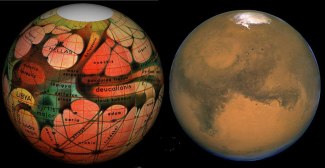
ANCIENT SCIENCE FICTION: ARMATA (1817)

Picture courtesy of wikipedia

Picture courtesy of wikipedia

ARMATA (1817) – Written by Thomas Erskine, this work of very early science fiction is one of the great neglected works of that genre.

Erskine tells the story in the first person and in the style of the memoirs of great explorers. He is sailing from New York City back to England when an enormous waterspout sucks his ship up in the air and deposits it on the planet of Deucalia.

Deucalia is a twin of the planet Earth and is, oddly enough, connected to our own planet at the Continue reading

10 Comments

Filed under Ancient Science Fiction

ANCIENT SCIENCE FICTION: TWO TALES OF LUNAR EXPLORATION FROM 150 AD

IcaromenippusHere’s a look at two forgotten early ventures into the form of story- telling that we now call science fiction.  My fondness for the ancient Greeks prompts me to examine a pair of works by Lucian, the Greek philosopher who lived in the 2nd century C.E. Lucian was noted not just for his philosophical observations but also for two works that defied definition by his contemporaries but would easily fall into the category of science fiction today. Both works are from roughly 150 C.E. 

1. ICAROMENIPPUS – The title, obviously, was inspired by the myth about Icarus using wings crafted by his father Daedalus to fly too close to the sun, which hubristic act led to his death. In this work Lucian depicted his hero Menippus using one wing from an eagle and one from a vulture to fly to Mt Olympus, and from there to the moon. He discovered that the moon (on which he could breathe just like on Earth) was populated by the souls of the deceased (roughly twelve hundred years before Dante’s Paradiso). From the moon Menippus made the astonishing observation that Continue reading

4 Comments

Filed under Ancient Science Fiction