 PSI CASSIOPEIA, or STAR: A MARVELOUS HISTORY OF WORLDS IN OUTER SPACE (1854) – Written by Dr Charlemagne Ischer Defontenay, a French M.D. and author. Long before J.R.R. Tolkien churned out obsessive amounts of fine detail about his fictional Middle Earth, Defontenay produced this volume of history, poetry and drama from his fictional planets in the star system Psi Cassiopeia.
The narrator of the story is supposedly translating alien documents which he discovered in an artificial meteor that crashed in the Himalayas. The documents were from a planet called (incongruously enough) “Star.”
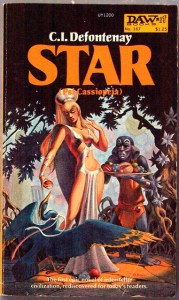 The system where that planet is located is a three-star system. Ruliel is the large, white star at the center, around which orbit the two lesser stars Altether (green) and Erragror (blue). The planet called Star is orbited by large planetoids/ moons named Tassul, Lessur, Rudar and Elier. Throwing all science to the winds the planet is also orbited by a small red star called Urrias.
Star and its satellites are inhabited except, of course, for Urrias. The translated documents cover a roughly 1,000 year period of events regarding these worlds. The ancient Starian humanoids formed a united world-wide culture which started as an Empire before becoming a socialist planet economically and politically. The documents also claim that their culture boasted beautiful architecture, incredible feats of engineering and awe-inspiring works of art.
At one point a plague swept the globe, reducing the proud Starian civilization to chaos. A Nihilist Cult formed as the plague kept whittling away at the population over the course of years. In the post-apocalyptic ruins the Nihilists formed a fanatical religion devoted to ending all life on Star. The zealots formed armies which exterminated millions of Starians with the intention of taking their own lives when all non-members of their cult had been wiped out. Continue reading →

 THE ABYSMAL INVADERS (1929) – Written by Edmond Hamilton. This is a nice mish-mash of elements that are part Creature Feature, part Doctor Who and part Jurassic Park. Hamilton gets bashed as a hack but his stories are harmless fun.
 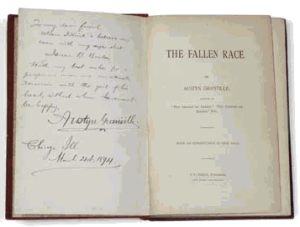 THE FALLEN RACE (1892) – Written by Austyn Granville. If you’ve ever thought to yourself “How come nobody ever combined science fiction, H. Rider Haggard-style Lost Race tales AND kangaroo rapists” then THIS is the story for you. (And please stay away from children.)
  THE SHIP OF SILENT MEN (1920) – Written by Philip M Fisher. The crew of a ship called the Lanoa set out from Hawaii. A few days later an abnormally powerful electrical storm strikes, leaving the area unusually cold in its wake.
 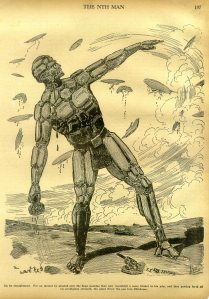 THE Nth MAN (1920 – 1924?) – Written by Homer Eon Flint, who died in 1924. Though this short novel was not published until 1928 many fans of the author argue that it was actually written in 1920.
  FUNGUS ISLE (1923) – Written by Philip M Fisher. Fungus Isle has the same proto-Creature Feature feel to it that The True Inheritors (qv) had. In the case of the previously reviewed story it was a forerunner of various giant spider flicks. In the case of Fungus Isle it seems like the inspiration for Attack of the Mushroom People, aka Matango, the Fungus of Terror.
 THE MAN FROM SATURN (1890) – By an unknown author. This work also appeared under the title Willmoth the Wanderer, a cutesy reference to the classic Melmoth the Wanderer. A young, unnamed American encounters Willmoth, a male humanoid who states he is from the planet Saturn and is hundreds of thousands of years old.
  THE WAR UNDER THE SEA (1892) – Written by Georges Le Faure. This sci-fi work was intended as an escapist societal salve to a French public still smarting from their loss to Germanic forces during the Franco-Prussian War just over two decades earlier.
 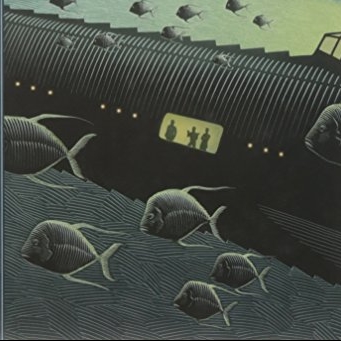 Interestingly enough, despite this threat the Germans are not depicted as being any more bloodthirsty than the alleged “heroes” of this story as we will see. Though the Count and his allies prove equally callous about large-scale killing (and worse) their attitude is romanticized and approved of by the narrative since Andre and the others are fighting France’s traditional Continental foes the Germans. Instead of Film Noir think of this novel’s approach as callous enough to be called World Noir. Or at least Politics Noir.
  THE WRECK OF A WORLD (1889) – Written by W. Grove. (No other name available) This novel is the sequel to Grove’s A Mexican Mystery, an ahead-of-its-time work about a train engine devised to have artificial intelligence. The machine – called only The Engine in that story – rebelled and took to preying on human beings in horrific fashion. For Balladeer’s Blog’s review of that novel click
 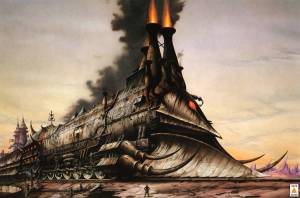 Our story begins in what was to Grove “the far future” of 1949. After a fairly superficial depiction of the world’s political and scientific situation in this imaginary future the meat of the tale begins. All in all the author did not present 1940s technology as being much more advanced than what was available in the 1880s. Grove might have done better to set his tale in 1899 or just into the 1900s to detract from his lack of vision on this particular element.
