
FOR THE FIRST PART CLICK HERE. FOR THE SECOND PART CLICK HERE. FOR THE THIRD PART CLICK HERE.
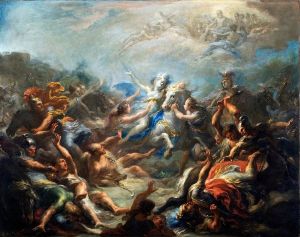 FOUR – A council of the gods is held on Mount Olympus as the goddesses Venus and Juno make their cases for and against Aeneas and his fellow survivors of fallen Troy. Venus argues for them since Aeneas is her son, while Juno retains her position against Aeneas because she wants to prevent the founding of Rome.
Events move back to the battlefield as Aeneas finally arrives back at the Trojan camp with an army of his Tuscan and Arcadian allies. In the following battle casualties are again high. King Turnus – Aeneas’s rival for the hand of King Latinus’s daughter Lavinia – kills the Arcadian Prince Pallas, whose father King Evander had sent him forth to fight on the Trojan side.
Elsewhere on the battlefield, Aeneas wounds Mezentius, but the man’s son Lausus leaps between his father and Aeneas. While the two younger warriors fight each other, Mezentius flees back to his camp and Aeneas kills Lausus.
Word of his son’s death reaches Mezentius at camp and he feels ashamed for fleeing. He returns to the battlefield and seeks out Aeneas, whom he attacks with a series of javelins. Ultimately, Aeneas kills Mezentius as well, and Mezentius dies asking to be buried beside his son Lausus.
After a temporary armistice to bury their respective dead, both sides resume fighting. Aeneas and his forces have King Turnus and his allies on the defensive. One of Turnus’s allies is the Amazon warrior Camilla, despite the fact that the Amazons were allies of the Trojans during the Trojan War.
Camilla volunteers to lead her female troops and others to distract the approaching Trojan and Etruscan cavalry while Turnus defends the walls of his kingdom of Rutuli. Camilla and her troops clash with the enemy cavalry in a series of assaults and retreats until Camilla’s slaying of Ornytus, Orsilochus, Butes, and the figure known only as “the son of Aunus” turns the tide against Aeneas’s side.
The god Jupiter inspires the Etruscan hero Tarchon to rally the faltering army. He shames the retreating Etruscans and mocks Camilla, then leads a counterattack. Aruns slays Camilla with his spear but is slain in turn by the goddess Diana’s herald Opis.
Eventually, both sides agree to permit single combat between Aeneas and Turnus to decide the war. Before the official one-on-one combat can begin, the river goddess Juturna is prompted by Juno to make the Rutulians break the agreement and resume attacking the Trojan side. (Juno is convinced that Aeneas could easily defeat Turnus in combat.)
The full-scale battle between the armies drags on and on. Ultimately, Aeneas leads troops in threatening Latium, the city ruled by King Latinus, whose daughter Lavinia is being fought over by Turnus and Aeneas.
Turnus spares Latium from a full frontal attack by again agreeing to face Aeneas in personal combat to decide the war. That one-on-one clash goes in favor of Aeneas, and Turnus winds up on his knees begging to be spared. Aeneas ponders letting Turnus live but then notices that his opponent wears the belt of the slain Pallas as a trophy.
Aeneas kills Turnus on the spot, winning the war and Lavinia. As plenty of prophecies from the earlier installments of this story made clear, a victory for Aeneas ensures that he, his followers and their descendants will establish glorious Rome.


Pingback: THE AENEID: FOURTH AND FINAL PART – El Noticiero de Alvarez Galloso
Logged, thank you!
Interesting post as always.
Thank you very much!