
FOR THE FIRST PART CLICK HERE.
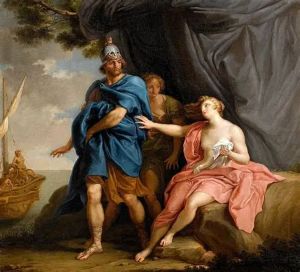 TWO – Aeneas and his companions, the survivors of the Fall of Troy, are still lingering in Carthage. Queen Dido, not knowing that the Roman State which Aeneas will spawn will also be the future destroyer of Carthage, remains deeply in love with Aeneas.
He returns her love, and having Aeneas remain with Dido and never found Rome fits the schemes of the goddess Juno (Naturally, Roman names are used for the gods and goddesses throughout this epic poem by Virgil). During a Royal Hunt in which Dido and Aeneas are accompanied by their courtiers, Juno causes a storm that drives the entire hunting party to seek shelter in an extensive system of caves.
 Playing into (or maybe establishing) the enduring cliche about people in a burgeoning romance being driven closer by needing relief from a downpour, Dido and Aeneas start to feel even friskier. Juno manipulates things further by having nature and animal life in the cave behave in ways that parallel a wedding ceremony.
Dido is convinced that she and our hero really are married in the eyes of the gods now, so she and Aeneas not only consummate their love but openly live as man and wife during the days that the supernatural storm confines them and their respective retinues to the caves. They continue this arrangement even after returning to Queen Dido’s palace.
Fama, the goddess of fame and renown, fuels the spread of gossip about the two lovers and word reaches the neighboring realm of King Iarbus, one of the rulers who yielded some of his territory to Dido so she could form Carthage. (This is Virgil’s version of events. Other sources differ greatly.) Iarbus had even asked Queen Dido to marry him, but she declined the offer.
Iarbus is an illegitimate son of Jupiter (actually of Hammon, but the Romans associated Hammon with Jupiter) and devoted adherent of the deity. He prays to Jupiter complaining that he has not gotten the reward (Dido) that he deserves for his devotion.
 Jupiter decides to remove Aeneas from competition for Dido by having his messenger god Mercury remind Aeneas of his destiny as the founder of a glorious new empire that is decidedly NOT Carthage. Aeneas yields, breaks things off with the pleading queen and sets sail with his fleet of Trojan survivors to fulfill his destiny.
Queen Dido, influenced by her passionate love for Aeneas and by her fear that his departure will leave her with no choice but to marry King Iarbus, resolves to kill herself. As the Trojans sail away, she has her own funeral pyre built, mounts it and stabs herself to death with Aeneas’ parting gift – one of his swords.
As she dies, the queen unleashes her infamous Curse upon Aeneas and the nation he will form. She wants eternal enmity between her people and his. Dido also calls for Aeneas to be “harried by war, separated from his son, forced to witness the unjust deaths of close friends, have the name and culture of his new nation eclipse those of his homeland Troy and to die before his time, unburied on the seashore.”
Aeneas and his people put in at Sicily to mark the anniversary of his father’s death with funeral games – a boxing match, a foot race, a boat race and an archery contest. After the games, Aeneas’ son Ascanius leads young males in a military parade and mock battle which Virgil claims is the origin of the Lusus Troiae tradition that Ascanius would establish while building the Walls of Alba Longa in the future.
Juno, still hoping to thwart the founding of Rome, sends her messenger goddess Iris to rabble rouse among the Trojan women in Aeneas’ party. They want to stop the wandering and settle on Sicily by burning all of the ships. They set fire to the vessels, but Aeneas prays to Jupiter for rainfall to douse the flames and Jupiter accommodates him.
Soon after, the ghost of Aeneas’ father Anchises appears to the dispirited hero and tells him to go to the entrance to the underground realm of the dead at the Cave of the Cumaean Sibyl near Naples and Lake Avernus. He is then to descend so the dead can grant him visions of the future glories of the nation he will found.
Our title character and his followers set sail. Jupiter, to ensure no more interference with Aeneas’ journey by his fellow deities, agrees to sacrifice one of Aeneas’ close comrades – his flagship’s steersman Palinurus. That night, Jupiter has the god Somnus make Palinurus fall asleep at the steer, fall into the Mediterranean Sea and meet his doom.
Along the way to the Cave of the Cumaean Sibyl another close friend of Aeneas dies. This time it is his trumpeter and fellow warrior Misenus, who was personally drowned by Neptune’s son Triton for having the hubris to challenge him to a musical contest playing the conch shell – Triton’s signature instrument.
Presently, the Trojan fleet lands in the vicinity of the Cave of the Cumaean Sibyl. Aeneas appeals to the Sibyl in her hundred-doored cavern temple to help him visit the Underworld realm of the dead. She agrees on two conditions. First, he must grant full burial honors to Misenus, whose body has washed ashore. Second, he must obtain the Golden Bough from a nearby grove to ensure safe passage through the land of the dead. The Golden Bough serves as a gift to Proserpine, Queen of the Underworld.
 Aeneas obeys, with Milenus getting a lengthy, elaborate burial, following which the love goddess Venus sends two doves to lead our hero to the Golden Bough in the grove, where it “shines like mistletoe in winter.” The Sibyl is pleased and performs rituals to the goddess Hecate as a prelude to accompanying Aeneas to the Underworld.
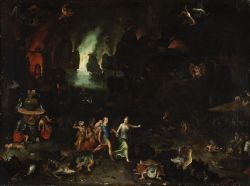
Aeneas and the Sibyl pass through the Gates of Pluto and pass by various monsters and illusions before reaching the River Acheron. Charon, the Ferryman of the Dead, notes their possession of the Golden Bough and transports them across the river so they can continue their journey. They pass by the souls of Milenus, Palinurus and others, including Dido, who pointedly ignores Aeneas despite his attempt to apologize.
The Sibyl placates the three-headed dog Cerberus with cakes and guides Aeneas past other sites along the way to Elysium, where the blessed dead dwell. The pair meet up with Anchises, who is delighted to see his son again.
Anchises goes on to show Aeneas some of the future glories of Rome and the Caesars and the Roman conquest of Greece and other lands. Inspired and fortified, Aeneas takes his leave of his late father and has the Sibyl guide him back to the surface world, where he rejoins his people and leads them on the final leg of their journey.
*** I’LL MOVE ON TO THE NEXT PART VERY SOON.


Excellent installment! Hell hath no fury like a woman scorned!
LOL. How true!
Wonderful post.
Thanks!
Pingback: THE AENEID: SECOND PART – El Noticiero de Alvarez Galloso
Logged, thank you!