
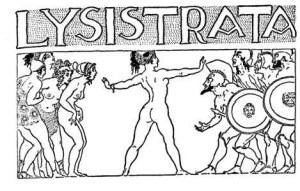
Lysistrata
LYSISTRATA (c 411 B.C.) – When I first started examining ancient Greek comedies here at Balladeer’s Blog I jokingly stated that surely readers would want me to start with Aristophanes’ most notorious and bawdiest satire.
Lysistrata was written by the Big A himself, Aristophanes, and this comedy always makes a perfect introductory play for newcomers to Ancient Greek Comedy. Part of its accessibility to modern audiences obviously comes from the risqué premise of the play, of course. For me the notion that we can understand and laugh at the same simplistic but brilliant story that Athenian audiences from over 2,400 years ago laughed at and appreciated embodies the value of these ancient works.
THE PREMISE
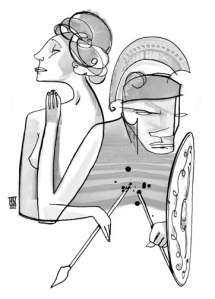 By 411 BC the Peloponnesian War between Athens (and its allied city-states) and Sparta (and its allied city-states) had been raging for roughly 20 years. The war provides the backdrop for many of Aristophanes’ surviving comedies and is especially relevant where Lysistrata is concerned. Weary of the long, drawn-out conflict the women of Athens, led by the title character Lysistrata (supposedly based on Lysimache, the Priestess of Athena in Athens at the time), join forces with the women of Sparta and decide to withhold sex from the men until they agree to bring an end to the war.
THE PLAY
Lysistrata convenes a covert meeting between the Athenian and Spartan women and, after the usual jokes about booze-hungry Greek women (“Patsy and Edina, 411 BC”), several ribald jokes about dildoes, jokes about the women hoping to get laid by Zeus in the absence of the men-at- war and other adult subjects the ladies are all in agreement: No peace, no “piece”. So much for Phase 1 of Lysistrata’s plan.
She assigns Phase 2 to the women of the Greek city- states who are supposedly too old to have an interest in sex. Phase 2 involves seizing the government treasuries to cut off any further funding for the war, a reflection of the role of ancient Greek women in managing the household budget but here raised to the level of municipal finance.
Next, amid menstruation jokes and a ribald parody of sacred oaths, the women all finalize their agreement. Lampito, the leader of the women from Sparta and its allies, leads her contingent back to their respective homelands to carry out their end of the plan.
The elderly women of Athens seize the Parthenon, where the city-state’s reserve funds, consisting of a fortune in silver, are held. With all of the able-bodied young men off fighting the war, the only men left in Athens proper to oppose the women’s plot are depicted as elderly, foolish “Grandpa Simpson” types.
The ineffectual old men spring into action, imagining all sorts of conspiratorial motives behind the seizing of the Parthenon. These dialogue portions consist partly of pokes at jingoistic paranoia common to all cultures at war and partly of grim humor about the real- life abundance of conspiratorial factions plotting to overthrow the current Athenian government as the war eroded the city-state’s finances and morale.
The elderly men talk themselves into trying to expel the elderly women from the Parthenon. They inspire themselves to action with comically overstated boasts about their own alleged heroics in previous wars, some taking credit for serving in battles fought over a century earlier.
The old men storm (well, kinda) the Parthenon with a battering ram, but the women hold the massive doors in place and repulse the men’s repeated attacks until the men are too exhausted to continue.
I always picture how this must have looked from the upper level seats at the Theater of Dionysus: a phallic battering ram failing to “penetrate” an opening, sort of like an ancient Greek version of a Terry Gilliam cartoon from Monty Python. (Tragically, none of the stage directions for the plays have survived, but as you get a feel for ancient Greek comedy it’s impossible to believe that the comic potential of such a sight gag was ignored, especially given the theme of the play)
Meanwhile, Lysistrata is having an increasingly difficult time keeping all the younger women from succumbing to their own passions and having sex with their husbands who are home on furlough. Some ladies are even trying to sneak off by pretending to be in labor, stuffing helmets under their cloaks to look pregnant.
After such situations are mined for some humor, Myrrhine, Lysistrata’s booziest ally, resists her husband Calonike’s attempts at seduction in one of the comic centerpieces of the show. Constantly teasing and denying Calonike with comical double- entendres and sexual puns, Myrrhine enacts an ancient (and bawdy) forerunner of the type of comedy piece known as a “slow burn”.
For those not familiar with that term, a slow burn is usually performed with one character increasingly exasperating a second character in a comedy sketch, just not with sex like in Myrrhine’s case. Aristophanes simply added a sexual element to an even older tradition in ancient Greek comedy – the “Herakles Without His Dinner” sketches. These “slow burns” from other comedies would consist of Herakles (who was frequently used in comedy), filled with his usual gluttonous hunger, as a dinner guest who blusters with increasing intensity as his desire to dig in is repeatedly frustrated by the other action of the play.
Calonike’s slightly different form of hunger and denial was easily recognizable to Athenian theater- goers of the time but, just in case some rubes didn’t get it, Calonike addresses the audience directly , bemoaning his frustration and says “Well this is quite a Herakles without his dinner!” (“breaking the fourth wall” was not a post-modern invention like some people have convinced themselves. It goes back to the world’s oldest surviving comedies and was a frequent device.)
Eventually a delegation of Spartan men arrive, their raging, frustrated erections so large they are mistaken for battle lances in another joke that needs no explaining, even 2400 years later. Despite some initial reluctance on both sides all parties agree to end the war amid nostalgic recollections of the days when the Greek city-states stood united. Relations between the Athenian Alliance and the Spartan Alliance and between the men and the women are normalized, and, as everyone gratefully acknowledges the wisdom of Lysistrata’s plan, the comedy comes to an end.
COMMENTS
Though Aristophanes wrote many plays making clear his opposition to the Peloponnesian War, he was not a pacifist, as some have claimed. The underlying theme of most of his anti- war comedies was his belief that the Greek city-states needed to stop fighting each other and unite against the Persian Empire, which was more than happy to exploit the discord in Greek territory for its own benefit.
When the women first assemble at the beginning of the play their loving list of phallic objects, including food items like Boeotian eels is another example of Aristophanes adding a sexual element to a fairly stock element of ancient Greek comedy.
I call those stock moments “food porn”. We take a ready supply of all manner of cuisine for granted today, but back then of course poor crops, bad sea weather and the ravages of war could deny a city access to many foodstuffs for an indefinite time.
A vehicle for “cheap applause” in the comedies was to have the characters lovingly describe various foods in such tempting detail that I came to refer to these scenes as food porn. Today when we go “Mmmm” listening to someone describe a meal we can relate a little to how the ancient Athenian audiences reacted.
Another bit in the play that breaks the fourth wall is a joke implying the audience watching the play should arrest Rhodia, the notoriously trouble-making and promiscuous wife of the politician Lykon.
And, as another example of the “anything goes” nature of ancient Greek comedy, references to Pandrosos, the goddess of the morning dew, are subtle jokes referring to the moistening genitals of the female characters during some scenes in the play.
NOTEWORTHY ADAPTATIONS
Lysistrata continues to be performed in outright translations or in adaptations more than any of Aristophanes’ other comedies, for obvious reasons. It was even my own introduction to his plays when I was 17. The comedy’s premise has been set in just about every historical conflict imaginable, even the Cold War.
In the 1980s an adaptation of the play depicted the women of South Africa withholding sex from their men to get them to end Apartheid. This stage adaptation proved very popular and toured the world. In the 21st Century there was also a Broadway adaptation (later a film) titled Lysistrata Jones about the women of Chicago trying to end the eternal, blood-soaked gang warfare in the city by withholding sex from their men.
FOR BACKGROUND INFORMATION IF YOU MISSED MY FIRST POST ON ANCIENT GREEK COMEDIES CLICK HERE: https://glitternight.com/2011/09/22/at-long-last-my-ancient-greek-comedy-posts-begin/
© Edward Wozniak and Balladeer’s Blog, 2011. Unauthorized use and/or duplication of this material without express and written permission from this blog’s author and/or owner is strictly prohibited. Excerpts and links may be used, provided that full and clear credit is given to Edward Wozniak and Balladeer’s Blog with appropriate and specific direction to the original content.
 Balladeer's Blog
This is a fave! Nice write-up!
Thank you very much!
Pingback: LYSISTRATA (c 411 B.C.) THE FIRST ANCIENT GREEK COMEDY I COVERED BACK IN 2011 – El Noticiero de Alvarez Galloso
Logged, thank you sir!
Wow, this made me laugh! I’d love to see this play performed; love the fact that the women have the power!
Yeah, not just with sex but with the money, too!
I think this Ancient Greek comedy is interesting. Well shared
Thank you very much!
😊
You’re the best!
Oh 😱😱😮😮😮
Hilarious!
Ha 😂😂 yes
Exactly!
🧡
Thanks! I appreciate it!
Great posts as always. I have never heard about “Lysistrata” before but it appears to be a fascinating Ancient Greek comedy.
Thank you!
This reflects on your earlier revisit of Lysistrata — a bold choice, casting ancient comedy as blunt-edged satire. The post remembers how the play shakes up social norms, gender, and power with humor and daring. A nostalgic, appreciative look at classical laughter that still stings today.
Thank you for such a nice, thoughtful comment!