
Balladeer’s Blog’s periodic look at silent movies and silent film stars continues with a sampling of Rudolph Valentino’s movies, from both before and after he became the Latin Lover sensation of his era.
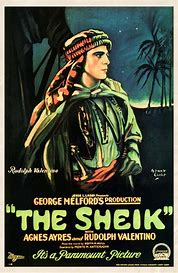 THE SHEIK (1921) – Edith Maude Hull’s 1919 novel came to the big screen to cement Rudolph Valentino’s rising star. He shone as Sheik Ahmed Ben Hassan with Agnes Ayers as Lady Diane Mayo.
Diane is an adventuress who has spurned all marriage proposals thus far and her latest escapade is a tour of the desert led by Arab guides. In a ritzy casino the night before her expedition departs, she dresses as a dancing girl to sneak into an exclusive event being held by Ahmed.
The Sheik is charmed and aroused by this wild and haughty Western woman who listens to no man, not even male relatives like her brother. Ahmed and his troops surreptitiously follow Diane’s caravan and when the time is right, the Sheik abducts her and carries her off to his elaborate tent-mansion deep in the desert.
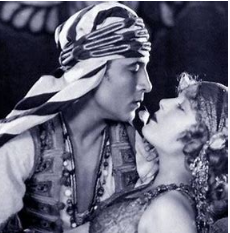 A lot of Gothic Romance Novel antics follow in this film that has not aged well. Valentino’s wide eyes and flaring nostrils were masterfully parodied by Peter Sellers in a comedy bit decades later.
It’s impossible to take his performance seriously through modern eyes, which is just as well since he is basically guilty of kidnapping and taking advantage of the young woman.
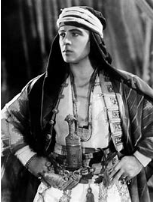 As their battle of wills goes on, Diane is seized by caravan robbers and taken to their leader’s lair. Sheik Ahmed leads his men to the rescue, and, with Stockholm Syndrome well and truly in charge, Lady Diane “realizes” how much she has fallen in love with her abductor.
The most laughable aspects of silent film histrionics make immersion in this 86-minute movie impossible. Luckily, it’s so ridiculous that you can never forget you’re watching a movie, and that Diane is never really in any danger from Valentino or anyone else.
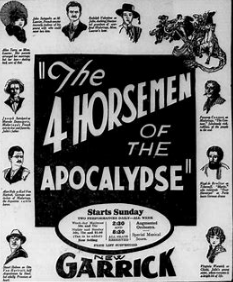 THE FOUR HORSEMEN OF THE APOCALYPSE (1921) – Earlier in 1921, Rudolph had basically stolen the show with his smoldering performance as the seductive Julio Desnoyers. Valentino was only the fourth lead in this adaptation of the Ibanez anti-war novel but his performance and especially his tango dance scene imprinted themselves on the global culture.
Tango scenes in comedies from the 1920s through the 1970s (at least) are parodying Rudolph’s dance with Beatrice Dominguez in this film. Yes, even Fred Flintstone’s tango. Though Valentino’s emergence overshadows The Four Horsemen of the Apocalypse in cinema history, it is a terrific drama with a miniseries-sized cast.
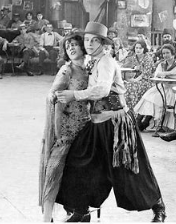 The tale begins in Argentina, where the grandfather/ patriarch of the sizable extended Desnoyers family soon passes away. Some members of the family relocate to Germany and others to France.
The outbreak of World War One lands family members on opposite sides of the war and years later, after various dramatic developments on and off the battlefield, Julio – who has been serving in the French Army – faces a once beloved relative who is serving with the German Army. Both men die in the battle.
The woman that Julio left behind finds love with another man with the blessing of Julio’s ghost. The Four Horsemen, who have served as metaphors throughout the film, ride off through the clouds in the final scene, which takes place after the war is over. 2 hours and 36 minutes long.
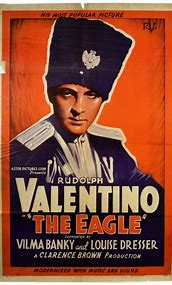 THE EAGLE (1925) – Valentino dabbled in Douglas Fairbanks territory as the masked hero of this tale set in Russia under Catherine the Great. Our man plays Vladimir Dubrovsky, a lieutenant in Czarina Catherine’s Imperial Guard.
Vladimir’s masculine heroics catch the eye of Catherine the Great (Louise Dresser), and she plans to make him her latest male conquest. She promises Dubrovsky a meteoric rise in the military … IF he climbs into bed with her.
The young officer declines the offer and rides off to avoid Catherine’s wrath. She puts a price on Vladimir’s head. The fugitive covertly visits his family estate, where he learns the land has been stolen from them by the evil nobleman Kyrilla Troekouroff.
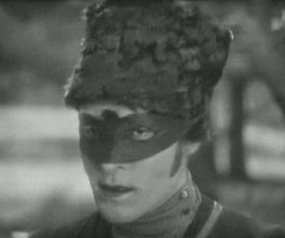 Dubrovsky is furious and wants revenge. He becomes the Black Eagle, the masked leader of a band of outlaws who go on to prey on Troekouroff’s interests everywhere in the region. Eventually, the bandit chief intercepts a letter of introduction from a French tutor on his way to instruct Kyrilla’s daughter Mascha (Vilma Banky).
Since no one in Troekouroff’s household has ever met the tutor, Valentino impersonates him in order to infiltrate his enemy’s home. The Black Eagle falls in love with Mascha and drags out his time as her tutor while repeatedly delaying avenging himself on her father to avoid causing her emotional pain.
Ultimately the disguised Vladimir and Mascha flee together, but our hero is caught up with by the military. Just to have a happy ending, Catherine the Great lets bygones be bygones and allows the young lovers to flee to France under assumed names. 73 minutes.
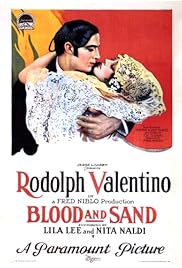 BLOOD AND SAND (1922) – This was a remake of a 1916 silent film of the same title, which was also adapting the Ibanez novel. Valentino stars as Juan Gallardo, the son of a poor shoemaker in Seville.
Juan longs to become a famous bullfighter and pursues that dangerous line of work despite his mother’s fears for his safety. In the years ahead, Gallardo works his way up the toreador ladder to achieve nationwide fame and marries his longtime sweetheart Carmen (Lila Lee).
Having risen from rags to riches, Juan continues excelling in his chosen profession of butchering poor dumb bulls bullfighting. Eventually he meets and falls for the sultry, seductive Dona Sol (Nita Naldi).
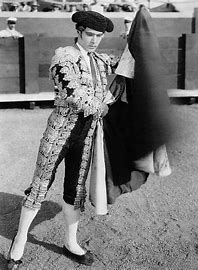 After a time, Gallardo’s conscience gets the better of him and he breaks things off with Dona Sol. Not one to take rejection lightly, Naldi exposes her affair with Juan to his mother and his wife Carmen.
With his mother disgusted with him and his marriage on the rocks, Gallardo plunges into depression. He becomes very reckless in the ring, little caring at this point if he dies on the horns of a bull or under its hooves. (Hey, fight one without your sword and cape if you feel that way.)
In the end, Valentino gets fatally wounded by a bull, but as he dies, Carmen rushes to his side to reconcile with him. This movie was remade multiple times over the decades. 1 hour and 43 minutes.
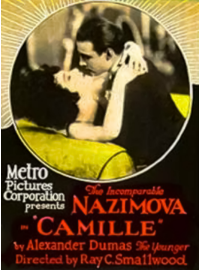 CAMILLE (1921) – Before becoming an established star, Rudy was the male lead in this umpteenth silent adaptation of the novel by Alexandre Dumas fils. Iconic Alla Nazimova as the title character was the real draw in this film, which took the move of updating the setting of the novel to 1920s Paris.
If you’re new to the story, Camille is a courtesan who advertises her availability or lack of it by wearing different colored flowers. Valentino portrayed Armand Duval, a law student who falls for Camille and pursues her despite knowing her profession.
 She and Armand come to genuinely love each other until his father breaks up the romance to avoid a shadow on the family name. Armand throws himself into the Paris nightlife to try forgetting Camille, who, for her part, goes on to die of tuberculosis.
Rudolph Valentino later married this movie’s Art Director, Natacha Rambova. 72 minutes.
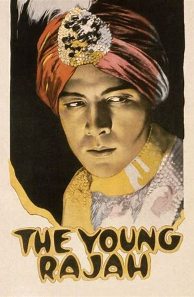 THE YOUNG RAJAH (1922) – Long thought to be one of the many, many silent films that had not survived, an incomplete copy of the movie – a notorious flop – eventually surfaced. The opening two-thirds were sadly decomposed beyond salvage, but roughly 54 minutes of the production were saved and have been screened since 2006.
Though not a comedy, The Young Rajah‘s premise is ridiculous. Valentino plays Amos Judd, a southerner who goes on to attend Harvard and learns he is really the son of a deposed Rajah in India. Not only that, but he’s the semidivine descendant of Prince Arjuna from The Mahabharata and has the gift of prophecy.
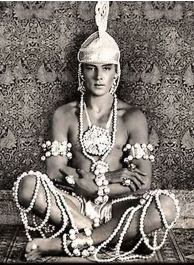 An Indian sage comes to America and convinces Amos to postpone his impending marriage to his true love Molly (Wanda Hawley). He talks our hero into returning to his native land to lead a revolt against the evil Ali Khan, who stole the throne from Valentino’s real father.
Judd agrees, returns to his true homeland and inspires the army to rise up against Ali Khan. In the end the villain kills himself, our hero assumes the throne and plans his royal wedding to Molly. God help us if Adam Sandler ever decides to remake this movie.
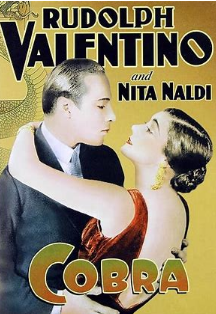 COBRA (1925) – Mediocre, lukewarm romance of sorts. Rudy stars as Italian Count Rodrigo Torriani (meaning he actually got to play his real ethnicity for once). Rodrigo romances many women around Europe, and presently decides to accept an invitation to New York City from his friend Jack Dorning.
The Count travels in the antiquing circles of his pal Jack and becomes interested in assorted women in New York. The film’s title comes from the way we are told that women enthrall Rodrigo like a cobra enthralling its prey.
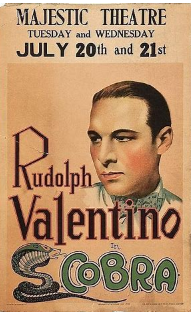 Two of the Big Apple babes that the Count becomes involved with are Jack Dorning’s secretary Mary Drake (Gertrude Olmstead) and wife Elise (Nita Naldi). Conscience stricken, Rodrigo stops himself from consummating his affair with Elise, who is waiting for him at a hotel room.
Bizarrely, the hotel catches fire and Elise dies in the flames. (?) Next, the Count refrains from pursuing his attraction to Mary Drake, choosing to fix her up with the grieving Jack Dorning. Making the whole thing even more anticlimactic, our hero then returns to Italy. I get that by film’s end he’s “freed” himself from women’s hold on him, but c’mon. 75 minutes.
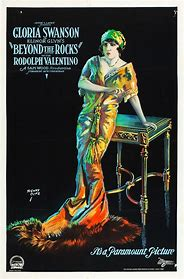 BEYOND THE ROCKS (1922) – Not only do you get Rudolph Valentino AND Gloria Swanson as the leads in this film, but it’s another example of a presumed lost silent movie that at last turned up – this time in 2003 in the Netherlands!
Swanson is Theodora Fitzgerald, whose poor family’s future rests on her beauty attracting a wealthy husband. She enters into a loveless union with a grocery store magnate, but then falls in love with the dashing Lord Hector Bracondale, played by Valentino.
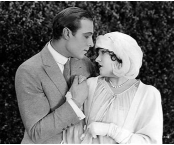 After fate keeps casting her and her husband at the same high society locales as Hector and his ladies of the moment, Theodora and the British Lord confess their love for each other, but she refuses to cheat on her husband.
A conniving woman who wants Lord Bracondale for herself tries to expose Theodora’s feelings to her husband and therefore ruin her marriage. Though exposed, Swanson still refuses to leave her hubby for Valentino. Her husband conveniently dies on an African safari, and our lovebirds marry. 80 minutes.
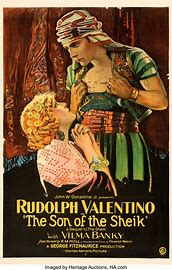 THE SON OF THE SHEIK (1926) – Having had more flops than hits in recent years, Valentino jumped at the chance to try reviving his box office mojo by playing both father and son in this sequel to his mammoth hit The Sheik.
Agnes Ayres returned as the Sheik’s wife Diane, and in old age makeup she and Rudy reprised their roles from the 1921 film. Via split-screen technology, Valentino’s aged Sheik interacted with his son, also named Ahmed.
The younger Ahmed falls in love with a dancing girl named Yasmin (Vilma Banky), who acts as the honeypot to lure wealthy suckers into her father’s web of con artist scams. The attraction is mutual, and Ahmed and Yasmin begin regular rendezvous at desert ruins near the city of Touggort, where she dances and her father’s gang pulls off their cons.
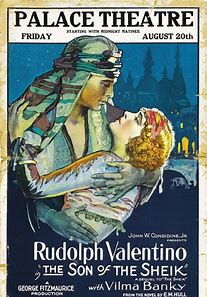 Ghabah the Moor, to whom Yasmin was promised by her father, is furious at this betrayal, but he and the international grifters realize who Ahmed’s father is. During the next assignation between Yasmin and Ahmed, Ghabah leads the gang in abducting the young man.
They relay a ransom demand to the Sheik and rough up his captive son, who mistakenly believes that Yasmin intentionally set him up. Will our hero survive? Will he learn that Yasmin is innocent? And will the villains be overcome? You know the answer to those questions. 69 minutes.
*** Valentino died shortly after this film’s release at age 31. The mourning frenzy of his female fans and the chaos at his funeral are legendary. Actress Pola Negri’s exploitation of Rudolph’s death makes Courtney Love look dignified.
OTHER VALENTINO MOVIES:
 MONSIEUR BEAUCAIRE (1924) – Rudy had the title role in this adaptation of the Booth Tarkington tale. Beaucaire is a barber who blackmails the Duke of Winterset into introducing him into high society under the false name the Duke de Chartris.
The rascal pulls it off and romances Lady Mary (Doris Kenyon) while hobnobbing with the French King and Queen among other aristocrats. Eventually, the irked Duke of Winterset plots to bring Monsieur Beaucaire down in flames. Too long for the material. 1 hour and 46 minutes.
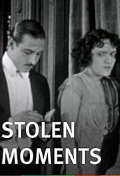 STOLEN MOMENTS (1920) – Our man Rudolph plays the mustachioed villain in this Marguerite Namara vehicle. She portrays Vera Blaine, a romance-minded young woman in the southern United States. When a Brazilian author (Valentino) comes to town he seduces her then breaks her heart.
Years later their paths cross again after Vera is married. The dastardly Brazilian threatens to reveal their sordid affair to her husband unless she oinks and boinks with him again. 1 hour long.
 MORAN OF THE LADY LETTY (1922) – Valentino portrays Ramon Laredo, a soft, good-timing young man in San Francisco. His fecklessness leads to him getting shanghaied and terrorized by evil Captain Kitchell.
While enduring his harsh servitude as one of Kitchell’s crew, Laredo is on hand when the villain seizes the boat owned by Moran Letty (Dorothy Dalton), a tomboyish young lady whom he met – and found attractive – before he was abducted. To save them both, Ramon must toughen up. 68 minutes.
 THE MARRIED VIRGIN (1918) – Rudy was a bad guy once again in this early effort. Many of his early villainous roles were so small he’s on and off the screen in just a few minutes, but this role had some meat to it and the actor makes the most of it.
Valentino plays Count Roberto di San Fraccini, who not only blackmailed Mary McMillan into marrying him, but is having an affair with the new bride of Mary’s father. It’s all part of a plan to steal their family’s fortune. 71 minutes.
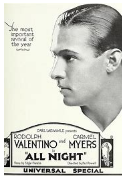 ALL NIGHT (1918) – Valentino proved he could do comedy in this flick about Rudy and his dream girl posing as husband and wife so that the real man and woman of the house can try to sell an abrasive millionaire on investing in the man’s business venture.
When all is said and done there’s a happy ending for everybody, as Valentino gets his girl (Carmel Myers) and the entrepreneur gets his seed money. 58 minutes.
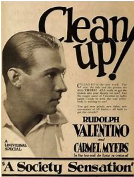 A SOCIETY SENSATION (1918) – The setting of this 24-minute comedy short is the fishing village of Saint Margaret’s in the spring of 1917. Rudolph plays wealthy society playboy Dick Bradley, who falls in love with Sydney Parmelee (Carmel Myers) under the mistaken impression that she too is from a “prominent” family.
His hoity-toity family throws obstacles in the way of their romance when it is revealed that Sydney is really just the daughter of a fisherman. Love conquers all and even Dick’s snobbish family is content when it turns out that – to her own surprise – Sydney really is from an upper crust family after all!
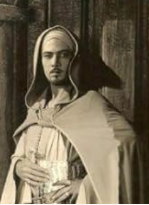 THE HOODED FALCON – This unproduced film adapted from stories of El Cid was tentatively scheduled for a 1924 release. Valentino and his wife Natacha Rambova pushed this passion project but unfortunately it never really got much past the planning stage.
When I first heard of this venture I thought it meant that Valentino was intended to star as El Cid himself, but he and Rambova instead planned on having Rudy portray a Moorish warrior who romances a Moorish beauty in 14th Century Spain.
FOR A SIMILAR LOOK AT DOUGLAS FAIRBANKS MOVIES CLICK HERE.
FOR A SIMILAR LOOK AT ACTRESS THEDA BARA’S MOVIES CLICK HERE.
 Balladeer's Blog
Pingback: RUDOLPH VALENTINO: HIS SILENT FILMS – El Noticiero de Alvarez Galloso
Logged, thank you sir.
An excellent post about a great area and an extraordinary actor!🤙🙏
I really appreciate the kind words, friend!
You are most welcome.
😀
At that time the actors and actresses had some special abilities to make people understand what they were trying to do without sound. Well shared. Great actor 👏
Thank you very much for saying so!
😊🫡🫡
😀 😀 😀
♥️💚❤️ Great post 💯 Happy and blessed Thursday from Spain 🇪🇸 🏵️🌹🍀🍀
Thank you! Same to you!
Great posts as always. I have not heard about these silent movies before but they all definitely sound promising to me. The silent films remind me a lot of great movies about Hollywood that I have watched. For instance, the film “Camille” (1921) reminded me a lot of the great movie “Babylon”. Set in 1920’s Hollywood, it tells a similar story of an actress pursuing success in the film industry. It shares common themes of stardom with the classic silent film. One of the most underrated movies of 2022 which didn’t get the recognition that it deserved. If you’re interested in the Golden Age of Hollywood time period, it is definitely worth watching.
Here’s why I recommend it strongly:
Thank you! Your review of Babylon is great!
Brilliant – and much appreciated.
Gwen.
Thank you very much for saying so!