
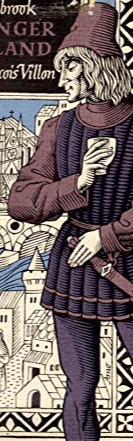
 FRANCOIS VILLON (1431-1463?) – The swashbuckling legends that surround this real-life French poet have sometimes been compared to tales of Robin Hood or Dick Turpin. Like Dick Turpin, Villon really did exist, but in his case he left behind an impressive body of literary work and he is still considered one of France’s greatest poets.
However, a vast body of folklore embellishing the man’s outlaw career and romantic speculation surrounding his final fate make it difficult to separate fact from fiction. Villon’s lifetime output of poetry – much of which has been lost – went on to influence generations of artists to this very day.
The Pre-Raphaelites including Lord Byron translated the Frenchman’s works, embraced his aesthetic philosophies and circulated the tall tales and legends surrounding him. Composers like Debussy based some of their musical works on Francois’ captivating verse.
Often called the poet of rebels, outlaws and the oppressed, Villon’s moving depiction of the suffering endured by the underclasses at the hands of uncaring royalty and corrupt religious leaders has been called “keening for the living.” Francois’ legacy as the poet who led French literature out of the Middle Ages and into the Renaissance Era is undeniable, so this item will instead emphasize his swashbuckling legend.

Ronald Colman as Villon
Villon was born in Paris, France in April of 1431, amid a virtual post-apocalyptic tableau in the aftermath of the Hundred Years’ War and the bubonic plague. Skilled working-class people were in demand for the practical necessities their labors provided for all levels of society.
Cynicism toward royalty and religious leaders was becoming common among the people, but even iconoclasts like Francois Villon were proud of their heritage and still revered God though they distrusted his lecherous, larcenous clergy.
Villon was a very bright student and went on to study at the Sorbonne University, already one of France’s top institutions of higher education. Like other such institutions, the Sorbonne was steeped in religion, but Francois and other students couldn’t help but note the hypocrisy of stern clergymen who preached against sin but had mistresses visit them in their chambers and who often made free with funds that were supposedly the church’s.
In a France still splintered into several rival regions, our hero sided with Paris and vicinity, especially against the Burgundians, who had sided with the English in the Hundred Years’ War and who had even besieged Paris. Villon idolized Joan of Arc, who had led French forces against the Brits and the Burgundians.
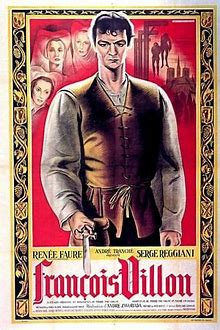 Such sympathies, ironically enough, left him among the minority at the Sorbonne, most of whose faculty and “intellectuals” sided with the Duke of Burgundy despite living in Paris. Francois had first picked up his sense of patriotism from his adopted father Guillaume Villon, chaplain of the parish of the St. Benoit Quarter.
In those pre-university years, Francois saw Guillaume and allied church lawyers defend the late Joan of Arc from charges of witchcraft. The clergy at Notre Dame looked down on Joan for fighting the Burgundians and their English allies and wanted to taint her memory forever by declaring her a witch.
The upstart Benoit side of the years-long trial won out in the end, with Villon’s idol Joan found not guilty. The harrumphing Notre Dame ecclesiastical authorities and other pro-Burgundians had been defeated by the underdogs.
Tensions between St. Benoit and their Notre Dame superiors ran high long afterward. At age 15, Villon’s earliest poetry took the form of satirical jabs at the pomposity and materialism of the snobs from Notre Dame.
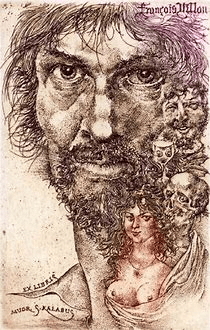 When Francois moved on to the Sorbonne his reputation as “the Rhymester Rogue” flourished as he churned out more poetry that was pro-Paris, pro-working-class and passionately anti-authority. Sadly, none of those poems have survived and are known only by contemporary references to Villon’s scandalous output.
Our hero earned his Bachelor’s Degree in 1449 and his Master’s Degree in 1452. His time at the Sorbonne was marked by frequent clashes with the law and other figures of authority. Francois’ illegal activities weren’t political much of the time but instead centered around gambling and drinking at taverns open after curfew.
Though today Villon is often depicted with sword in hand, his weapon of choice during his college years was the same wielded by fellow agitating students – short wooden staffs with iron caps.
*** FOR PART TWO CLICK HERE.
 Balladeer's Blog
Excellent post! Thank you. 👍✌️
Thank you very much!
Excellent post! Thank you for this interesting story.👍🙏
Thank you very much! Glad to do it!
You’ve received double the prize from me you surely deserved: The first comment is via Email, and the next one is directly through WP!😉😊👍
Thanks! I have still not received the email, I’m afraid. I even checked my spam folder.
Oh, sorry! I referred to two comments which I sent you after another. If you’ve noticed, one is from my WP site, and the other is under my name, Aladin Fazel. That is all I wanted to explain. Sorry again for making it complicated!🙏😅
Oh, okay, I did get that email! Thank you very much!
Frogs and I don’t share any kind of sympatico. Rostand is the exception. You take Rabelaise [please, take him], the scat monger, touted [by froggies, I ‘spect] a tiring and redundant sort. Father of humor? From under which pile of literary rocks did you [not you Balladman, the generally inclusive other critic “yous”] creep? Before reading [trying to, but failing] I was led to expect something of a Benny Hill with an accent. Benny has his moments. Robbie does not. While you make this [Villon] possibly worth consideration, I’m ruined on anything Franco except Chef Boy-ar-dee, and that only because Clutch, my faithful canine, loves to roll around in it when he cannot find a skunk two weeks past ripe. See ya in a few, Balladman.
Wow! Such Francophobia (I’m kidding.) Rabelais praised Villon so you probably would not like Villon’s poetry. You may get a kick out of his wild life as this look at him continues, though. See ya Espy!
You know me. Whadja expect?
Ya got me there!
Another great post. I find the tales of the Villon Legend to be fascinating. He’s an intriguing character that reminds me of heroes in classic movies. For instance, the legendary character brings to mind the film “Les Miserables”. Based on the beloved Broadway play, it tells the story of a man wrongfully convicted of crime in 19th Century France. The main hero of the play bears a striking similarity to the Villon.
“Les Miserables” is one of the greatest musicals I’ve ever seen. Here’s why it’s worth watching:
https://huilahimovie.reviews/2013/01/04/les-miserables-2012-movie-review/
Excellent posts as always. I have never heard of the Villon Legend before but he does appear a fascinating character. He reminds me a lot of Jean Valjean from the “Les Miserables” film. Tom Hooper’s movie was a breathtaking adaptation of the beloved Broadway play that blew audiences away. The play is set in 19th Century France, the same time period as the Villion Legend. It also shared the similar themes of heroism which you discussed in this insightful post. It’s one of my favorite movies of 2012, and one of the better musicals I have seen in recent years.
Here’s why it’s a must-see: