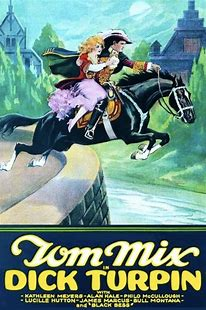
 DICK TURPIN (1925) – Western star Tom Mix took a break from his Wild West movies by starring in this highly romanticized film about the real-life English thief and highway robber Dick Turpin. John G. Blystone directed the movie for Fox Film Corporation. Tom swapped his six-guns and rifles for a sword and pistols in this flick.
The story in this 70-minute movie starts out in the mid-1730s. In this version of events Dick Turpin is already well-known for committing masked highway robbery against the carriage trade of well-to-do passengers. Among his men is burly Tom King, played by Alan Hale after his 1922 turn as Little John to Douglas Fairbanks’ Robin Hood.
 The main villain of the film is Lord Churlton (Philo McCullough), who not only resents having been robbed by Turpin, but abuses his power and influence by menacingly trying to force Lady Alice Brookfield (Kathleen Myers) to marry him.
Out and about without his mask on one day, Dick spots a rival gang of highway robbers attacking the carriage of said Alice. Smitten with our heroine’s beauty, Turpin comes to the rescue, single-handedly driving off the bandits and flirting with the young lady. Continue reading
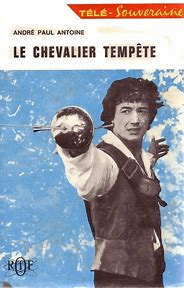 THE FLASHING BLADE (1967) – This 13-episode French adventure series was later dubbed – a bit clumsily – into English. Each English-dubbed episode was in color and filled a half-hour time slot with commercials. The French title was actually The Tempestuous Knight or The Stormy Knight but was changed to The Flashing Blade for the English dubs. The original French airings were in four 75-minute episodes.
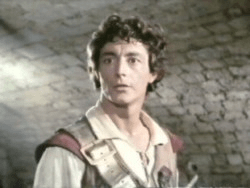 FRANCOIS, THE CHEVALIER DE RECCI (Robert Etcheverry) – The hero of the story. He and his sidekick Guillot (Jacques Balutin) reach the Fort of Casale, which is under siege by the Spanish forces in the alps near Savoy and Monferrato. (Some reviews of the show say the castle is on the border between France and Spain, but I believe that mistake comes from the reviewers casually noting that the war is between French and Spanish forces and just assuming that meant the war was being fought along their national borders.)
 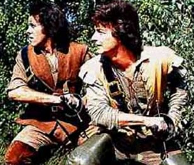 The castle garrison’s French commander, Thoiras (Gilles Pelletier), is a mopey, less than inspirational leader and our fiery hero Francois clashes with him over his lethargy and lack of initiative. Soon, de Recci disobeys a direct order from Thoiras by raiding the Spanish forces for supplies.
 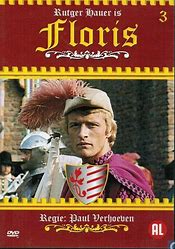 FLORIS (1969 and 1975) – Actor Rutger Hauer and director Paul Verhoeven first worked together for this adventure series set during the very early 1500s. The program aired on Netherlands television in 1969, then was remade – again with Hauer in the swashbuckling title role – in 1975 for German television and ran for even more episodes than the original series.
 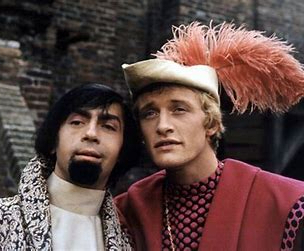 Around the year 1502, word finally caught up with our wandering hero that his father and two older brothers had died. Floris returned home, accompanied by his adventuring sidekick Sindala (Jos Bergman), an Indian Fakir. (Floris and the Fakir was originally going to be the title of the series.)
 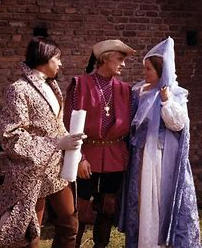 Floris and Sindala fought their way out of the hands of the enemy and wound up allied with Wolter van Oldenstein and his men at Castle Oldenstein. I often wonder if the 1991 film Robin Hood, Prince of Thieves took partial inspiration from the premise of Floris, with a returning nobleman fighting oppression alongside a nonwhite comrade from his overseas adventures.
 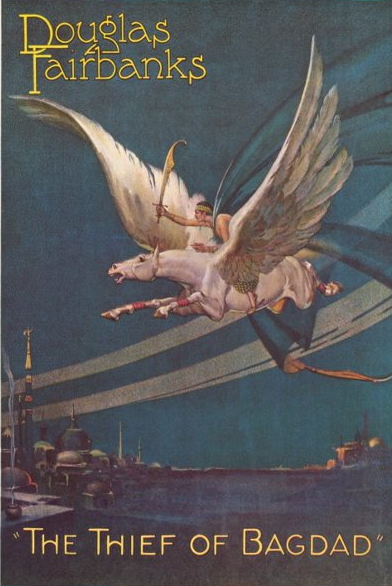 Regular readers of Balladeer’s Blog may remember that I’m a silent movie geek, and have reviewed some of them in the past. Today, I decided to post this beautiful silent era movie poster for Douglas Fairbanks’ forerunner of modern-day special effects blockbusters – his 1924 version of The Thief of Bagdad.
 THE SEA HAWK (1915) – In the late 16th Century, English gentleman Sir Oliver Tressilian is betrayed into galley slavery by his jealous half-brother Lionel. After a time, the galley on which Oliver has been condemned to serve as an oarsman is raided by Barbary Corsairs in the Mediterranean Sea.
  Alexandre Dumas pere is synonymous with swashbuckling historical adventures like The Three Musketeers, The Count of Monte Cristo and The Man in the Iron Mask.
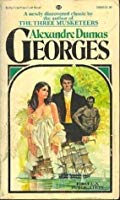 GEORGES (1843) – Published just one year before The Three Musketeers, this novel is not only a rollicking adventure full of action, romance and double-crosses but it deals with racial issues in such a way that you would have thought it would have been adapted for film four or five decades ago. The title character uses his sword to fight slavery!
  Regular readers of Balladeer’s Blog will remember my review of three neglected swashbuckler novels by Alexandre Dumas. (For those three – Georges, Captain Pamphile and La Dame de Monsoreau click
  When I was a little boy thrilled with the Musketeers, Monte Cristo and Iron Mask I excitedly grabbed The Black Tulip to read, assuming it, too would feature derring-do and swordplay. Much to my disappointment the novel instead dealt with attempts to cultivate a black tulip, the mob-slaying of Netherlands politicians Johann and Cornelius de Witt, romance and the redemption of personal honor.
  LA DAME DE MONSOREAU (1846) – A collaboration with Auguste Maquet. The title refers to the beautiful and fascinating Countess Diana de Monsoreau and her illicit romance with the novel’s male lead, Louis de Clermont de Bussy d’Amboise. Both characters are real but naturally Dumas and Maquet take the usual poetic license accorded to historical fiction.