
 Last March Balladeer’s Blog examined several pioneering silent movies made in Cuba, from Havana’s Fire Drill (1897) – the very first Cuban-made film – to 1901 coverage of the Constitutional Assembly, to 1906 film footage of the religious festival La Tutelar de Guanabacoa, which could be openly celebrated back then.
Wrapping up the nine shorts was Cuba’s first horror film – 1907’s La Leyenda del Guije del Rio Sagua – about an evil man being transformed into a clawed, hairy monster called a guije.
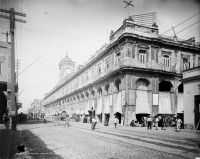 A TOURIST IN HAVANA (1908) – A documentary short depicting the sights to be seen by tourists in 1908 Havana. The director was Enrique Diaz Quesada, who founded the first film studio in Cuba alongside his brother Juan. This short debuted on September 15th at Havana’s Payret Theater.
EL CABILDO DE NACION ROMUALDA (1908) – Another Quesada short, this one capturing a publicly performed Cabildo Afro-Cuban religious ceremony. Such Cabildos dated back centuries and originated as figurative “bread and circuses” for the Cuban slave population, but they also preserved songs, dances, chants and drum music dedicated to the deities that had been worshipped back in Africa. No copies of this movie have survived. The work was filmed at a garden in the Esquina de Tejas. Pepe Acosta produced.
RESTORATION OF THE REPUBLIC (1909) – Part of the silent newsreel series Cuba al Dia, this covered the departure from Cuba of the disgraced and corrupt Provisional Governor Charles E. Magoon.
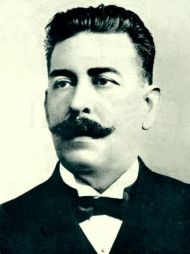 INAUGURATION OF PRESIDENT GENERAL JOSE MIGUEL GOMEZ (1909) – Another newsreel, this one filming the inauguration of Magoon’s elected successor.
JUAN JOSE (1910) – First filmed version of the irreverent Spanish satirical play of the same name written in 1895 by Joaquin Dicenta. The storyline involved a worker fighting with his employer over a woman they both love. This 1910 production ran 16 minutes and starred Boffield Garrido. Continue reading
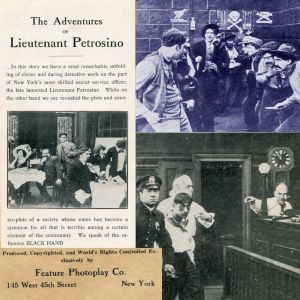 THE ADVENTURES OF LIEUTENANT PETROSINO (1912) – This 47-minute silent movie was a rushed look at the career of New York City Police Detective Joseph Petrosino, who specialized in fighting organized crime. I meant to cover Petrosino years ago, but other topics kept taking priority.
  THE REEL PETROSINO – Still in uniform, Joseph has made a name for himself as a tough cop capable of dealing with Italian gangs like the Black Hand, the Mafia and the Camorra. When Mafia bank robbers humiliate a pair of policemen who try taking them in, the storied Petrosino is sent for.
 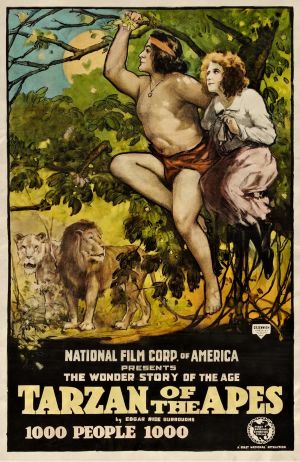 TARZAN OF THE APES (1918) – Though Elmo had been appearing as an extra or in small supporting roles since 1913, his portrayal of Edgar Rice Burroughs’ Tarzan in this movie put him on the map. For nitpickers, Gordon Griffith of silent Tom Sawyer fame played the very young Tarzan when his parents died early in this film, but Elmo Lincoln was the first adult Tarzan performer in movie history.
 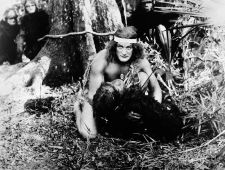 Binns the sailor realizes Tarzan is the long-lost Greystoke heir and an expedition heads to Africa, headed by Professor Porter. The professor’s daughter Jane Porter (Enid Markey) accompanies her father’s expedition and winds up abducted by a villain only to be saved by our King of the Jungle.
 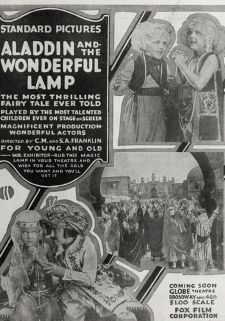 ALADDIN AND THE WONDERFUL LAMP aka Aladdin and His Wonderful Lamp (1917) – Remember how the 1976 movie Bugsy Malone presented a gangster tale with children in all the roles? And how Shirley Temple starred in an entire series of Baby Burlesque shorts with all-child casts in assorted genres? Well, this 80-minute silent film was earlier than all of them.
 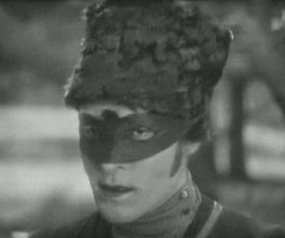 THE EAGLE (1925) – Valentino dabbled in
  RIN TIN TIN (1918-1932) – Here at Balladeer’s Blog, I’m even fonder of dogs than I am of silent movies, so this post will combine the two topics. Sadly, most silent films have become so little remembered that few people even realize that there actually WAS a real Rin Tin Tin, adopted by American soldiers during World War One.
 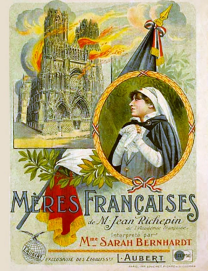 MERES FRANCAISES (1917) – This silent film was made and set during World War One. It starred the legendary stage actress Sarah Bernhardt, whose career spanned from 1862 to 1923. She was practically royalty when she deigned to appear in a few silent films.
  SHERLOCK HOLMES IN THE GREAT MURDER MYSTERY (1908) – Shamelessly, the Crescent Film Company of New York adapted Poe’s Murders in the Rue Morgue but replaced his master detective Auguste Dupin with Sherlock Holmes and the orangutan of the original story with a gorilla.
 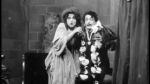 THE SEALED ROOM (1909) – Poe’s The Cask of Amontillado was adapted by film pioneer D.W. Griffith in this movie. Besides changing the title, Griffith altered the story to feature a philandering man and woman being walled up to die. Showing up in small parts during this 11-minute short were America’s future sweetheart Mary Pickford, and Mack Sennett, future comedy icon.
 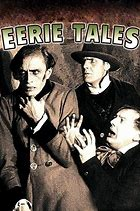 EERIE TALES (1919) – Conrad “Major Strasser from Casablanca” Veidt is, in my opinion, the most neglected figure from silent horror films. In this German work Veidt co-stars with Reinhold Schunzel and Anita Berber. The three portray various characters throughout the film.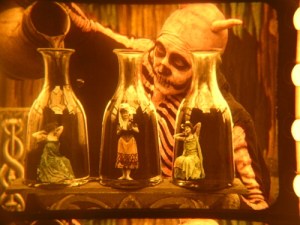
 Balladeer's Blog