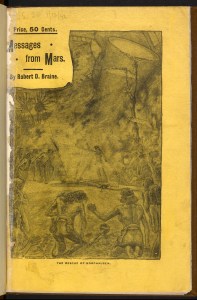
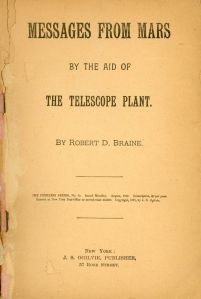
 MESSAGES FROM MARS BY THE AID OF THE TELESCOPE PLANT (1892) – Written by Robert D Braine. I shortened the title for the blog post headline. The main character of this novel is a sailor named Nordhausen. After leaving Madagascar our hero winds up shipwrecked on an uncharted island.
While roaming this island Nordhausen finds plants with thick transparent leaves which refract light like lenses do. The sailor breaks off one of the leaves to study it more closely, only to be seized by the island’s native inhabitants, who have been watching him from hiding.
 The natives take him through a cave entrance to their hidden village which is a blend of the primitive and the futuristic. For the “sacrilege” of damaging one of the telescope plants Nordhausen is to be executed. The means? A device formed from several of the lens-like leaves which magnify the sunlight into a makeshift heat-ray, like holding a magnifying glass over a piece of paper to catch it on fire.
Our hero is saved at the last minute by a beautiful woman named Raimonda, who wants him spared. When her own words are not sufficient to stay the execution she enlists the King of Mars to persuade the natives to spare Nordhausen.
Raimonda explains to the freed sailor that the island is called Roxana and its inhabitants Roxanans. Long ago two shipwrecked scientists from Europe showed the Roxanans how to use the incredible leaves of the sacred plant to construct telescopes.
The telescopes led to the discovery of intelligent and advanced life on Mars (Oron to the people of the Red Planet) and eventually two-way communication between the islanders and the “Martials” as the book calls the inhabitants of Mars – interchangeably with “Oronites, as the aliens call themselves. Continue reading →

 ELEKTROPOLIS (1928) – By Otfrid von Hanstein. Readers are introduced to Fritz, a young German engineer who has been having trouble finding a job. On what turns out to be a lucky Friday the Thirteenth for him, he gets a job offer from a mysterious Mr. Schmidt.
  LAS SERGAS DE ESPLANDIAN AKA The Adventures of Esplandian (1510) – There were many subsequent editions of this Spanish novel by Garci Rodriguez de Montalvo but 1510 is the year of the oldest known version. Part fantasy, part proto-science fiction and part chivalric romance saga, The Adventures of Esplandian is best remembered today for its supposed role in naming California.
 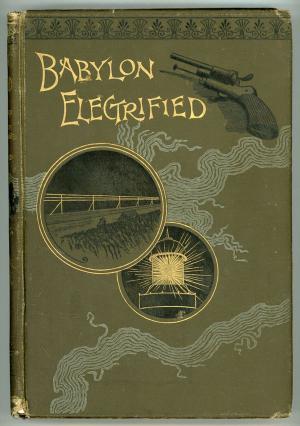 BABYLON ELECTRIFIED (1888) – Written by Albert Bleunard. In the tradition of his fellow Frenchman, Jules Verne, Bleunard crafted this work of science fiction with an international cast.
  CHRISTMAS IN THE YEAR 2000 (1895) – This was written by Edward Bellamy as one of the additions he made to the lore surrounding his look at the world of the “future” year 2000 AD in Looking Backward (1888).
  THE DOMINION IN 1983 (1883) – Written by “Ralph Centennius,” the presumed pseudonym of an unknown author.
  Canadian technology leads the world, with rocketships that can fly at a mile per second and electric automobiles for ground transport. Electricity is the predominant energy source, and Electropolis, the first all-electric city, was recently completed.
  CONVERSATIONS ON THE PLURALITY OF WORLDS (1686) – Written by Bernard le Bovier de Fontenelle. The author offered up some science fiction concepts that were considered real possibilities in 1686. These ideas were presented within the frame of conversations, as indicated in the full title. The conversations happened over the course of six evenings.
  MOUNTAINS, SEAS AND GIANTS aka BERGE MEERE UND GIGANTEN (1924) – Written by Alfred Döblin, later famous for the novel Berlin Alexanderplatz. A 2021 translation of the book uses the title Mountains Oceans Giants: A Novel of the 27th Century.
 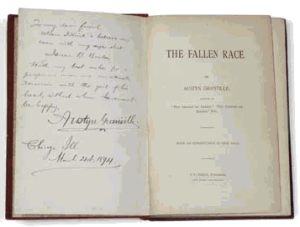 THE FALLEN RACE (1892) – Written by Austyn Granville. If you’ve ever thought to yourself “How come nobody ever combined science fiction, H. Rider Haggard-style Lost Race tales AND kangaroo-human hybrids” then THIS is the story for you.
 THE GERM GROWERS (1892) – Robert Potter wrote this work of “ancient” or vintage science fiction dealing with biological warfare and alien abductions.
  Balladeer's Blog