
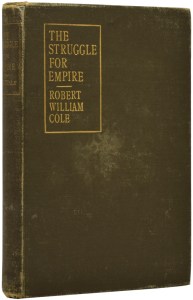
 THE STRUGGLE FOR EMPIRE: A STORY OF THE YEAR 2236 (1900) – Written by Robert W Cole. I left out the first half of the title for the headline, since The Struggle For Empire sounds like a mundane history book. In reality this novel was a very, very early example of the Space Opera sub-genre.
In 2236 A.D. Earth’s dominant geopolitical entity is the Anglo-Saxon Federal Union, consisting of Great Britain, the United States and Germany. This union of nations came about during a World War that was fought during the early Twentieth Century. That conflict pitted the Americans, British and Germans against the French and the Russians.
The Anglo-Saxon Federal Union emerged triumphant, with France carved up and lost to the mists of history. (The author was British.) London, now a megalopolis spreading out for hundreds of miles, is the Earth’s capital city. It also serves as the capital for the star-spanning empire which Earthlings have established.
 Initially the Earth colonized and inhabited the planets and certain moons of our own solar system all the way out to Neptune. (Pluto was not discovered until 1930.) In a quaint quasi-Steam-Punk way, all of those planets and moons have Earth-like atmospheres and conditions.
The perfection of anti-gravity and other technology led to the construction of space ships that could fly at the speed of ten million miles per hour. Robert W Cole takes H.G. Wells’ colonialism analogy from War of the Worlds into space, as humanity is depicted settling and colonizing planets in multiple star systems.
Earthlings also stripped uninhabitable planets of all their minerals, precious metals and other natural resources. Power and greed rule the zeitgeist. Complications arise when humanity at last encounters another intelligent race in the 23rd Century. Continue reading
 THE GUARDIAN OF MYSTERY ISLAND (1896) – Written by Dr Edmond Molcini. Mystery Island lies off the coast of Maine and everyone near the coast considers the place haunted by a true monstrosity – a large ghost-dog.
  Last month Balladeer’s Blog gave an overview of the German sci-fi hero Captain Mors the Air Pirate
  MASTER OF THE SKIES – The first short story featuring Kapitan Mors der Luftpirat is set in 1905. This origin tale saw him visit the mountain graves of his wife and children before leading his European and Indian crew against the villains responsible for their deaths and for his fugitive status.
 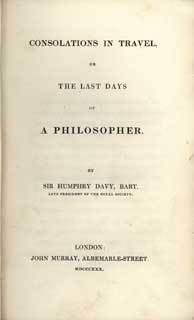 CONSOLATIONS IN TRAVEL or THE LAST DAYS OF A PHILOSOPHER (1830) – Written by THE Sir Humphrey Davy, this is largely a work of philosophical discourse but with one section devoted to a science fiction tale: The Vision.
  The first planet they travel to is Saturn, where Davy is awestruck by the alien landscape. Strange clouds fill the skies and among the oddest planetary features are large columns of liquid which flow from the ground upward. Saturn is inhabited by intelligent beings with three pairs of wings and organs like elephant trunks dangling from their bodies.
 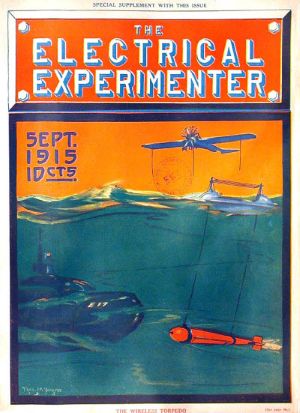 OMEGON (1915-1916) – Written by George Frederick Stratton, this serialized story dealt with a fictional war of super-scientific weaponry between the United States on one side and China, Japan and Mexico on the other.
 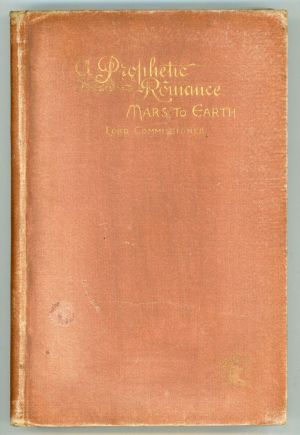 A PROPHETIC ROMANCE; MARS TO EARTH (1896) – Written by Boston’s John Mccoy in the form of reports sent from future Earth to Mars.
  A TRIP TO THE NORTH POLE or DISCOVERY OF THE TEN TRIBES AS FOUND IN THE ARCTIC OCEAN (1903) – Written by Otte Julius Swenson Lindelof.
 IN THE CLUTCH OF THE WAR-GOD (1911) – Written by Milo Milton Hastings and serialized in the July, August and September 1911 issues of Physical Culture magazine.
  EL HOMBRE ARTIFICIAL (1910) – This story was written by Uruguayan-born writer Horacio Quiroga under the alias S. Fragoso Lima. Quiroga moved to Argentina in 1902. Upon being diagnosed with stomach cancer in 1937 he committed suicide.
  ELEKTROPOLIS (1928) – By Otfrid von Hanstein. Readers are introduced to Fritz, a young German engineer who has been having trouble finding a job. On what turns out to be a lucky Friday the Thirteenth for him, he gets a job offer from a mysterious Mr. Schmidt.
