
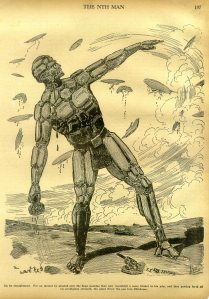
 THE Nth MAN (1920 – 1924?) – Written by Homer Eon Flint, who died in 1924. Though this short novel was not published until 1928 many fans of the author argue that it was actually written in 1920.
The story is set in what was then the near future of the 1930s. The Nth Man is an enormous humanoid figure with hardened skin like the shells of certain species of animals. He is supposedly 2 miles tall, but that would make many of the events in the novel impractical if not impossible.
The mysterious giant is at first regarded as half rumor and half Tall Tale as he sets the world talking with some incredible actions. He tears apart some of the Great Wall of China, he removes the head of the Sphinx and places it on top of one of the pyramids and he picks up a ship bound for Australia and carries it for thousands of miles.

BALLADEER’S BLOG
Showing more cognitive purpose the Nth Man also makes off with an entire building to thwart a plot by anarchists and saves a little girl from drowning. All of the preceding deeds have been accomplished under cover of darkness but now the colossus comes out into the open, emerging from San Francisco Bay to tower over the city.
The Nth Man walks from coast to coast, easily defeating the aerial and land forces that attempt to stop him. You would think this proto-Kaiju sequence would have inspired a film adaptation long ago. The gigantic figure goes to Washington D.C. and lays down some demands from on high. Continue reading
 THE WAR UNDER THE SEA (1892) – Written by Georges Le Faure. This sci-fi work was intended as an escapist societal salve to a French public still smarting from their loss to Germanic forces during the Franco-Prussian War just over two decades earlier.
  UNDERWATER HOUSE (1899) – Written by Frank Bailey Millard, this short story was first published in the March 1899 issue of The Black Cat magazine.
  THE ULTIMATE INHERITORS (1914) – Written by Berg Bellair. This is a very entertaining work of vintage or “ancient” science fiction and is especially noteworthy for the way it anticipates the many “big bug” movies of the 1950s and later.
  Veterans Day is tomorrow, so here’s another World War One post.
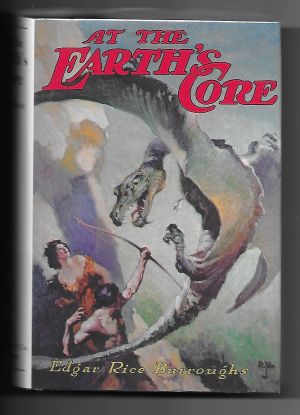 AT THE EARTH’S CORE (1914) – This tale was originally serialized in several issues of All-Story Weekly in 1914, then was assembled in novel form in 1922. American mining heir David Innes and his much older inventor friend Abner Perry test-drive Abner’s diesel-punk subterranean tunnel-drilling vehicle the Iron Mole.
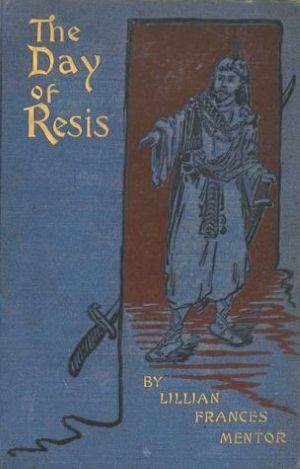
  THE DAY OF RESIS (1897) – This sci-fi novel was written by Lillian Frances Mentor. The main character is Enola Cameron, a strong-willed 20-year-old American woman from a well to do family. She purchases a very old goatskin document describing a hidden African kingdom called On.
  The participants consist of her lady friends, mixed male and female relatives and Henry, who is in love with her. In a gross element common to a lot of stories back then, he is also her cousin. Enola boldly leads the expedition to Africa and a march to the interior.
 PSI CASSIOPEIA, or STAR: A MARVELOUS HISTORY OF WORLDS IN OUTER SPACE (1854) – Written by Dr Charlemagne Ischer Defontenay, a French M.D. and author. Long before J.R.R. Tolkien churned out obsessive amounts of fine detail about his fictional Middle Earth, Defontenay produced this volume of history, poetry and drama from his fictional planets in the star system Psi Cassiopeia.
 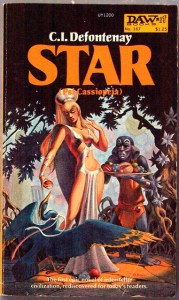 The system where that planet is located is a three-star system. Ruliel is the large, white star at the center, around which orbit the two lesser stars Altether (green) and Erragror (blue). The planet called Star is orbited by large planetoids/ moons named Tassul, Lessur, Rudar and Elier. Throwing all science to the winds the planet is also orbited by a small red star called Urrias.
  WITHIN AN ACE OF THE END OF THE WORLD (1900) – Written by Robert Barr. No doubt about it, Barr was obsessed with the notion of humanity possibly bringing on its own demise through ill-considered scientific tampering. Recently Balladeer’s Blog reviewed another of his stories, The Doom of London, which mined the same creative territory.
 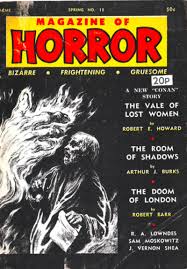 THE DOOM OF LONDON (1892) – Written by Robert Barr. In the “far future” of the mid-Twentieth Century the narrator of this tale looks back at the catastrophe that hit London in the 1890s.
