
 THE BRICK MOON (1872) – Written by Edward Everett Hale, best known for The Man without a Country. This novella started out as a serialized story published in 1869 in the October, November and December issues of Atlantic Monthly. A follow-up installment, titled Life in the Brick Moon, was published in the February 1870 issue.
In 1872, the entire four-part piece was published by Roberts Brothers as part of His Level Best and Other Stories, which contained works by multiple authors. The Brick Moon was published again in 1899 as part of Edward Everett Hale’s The Brick Moon and Other Stories.
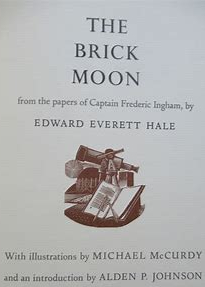 The story begins in the 1840s when Frederic Ingham, the tale’s narrator, and his college friends Orcutt and Halliburton plan a dream project which winds up taking decades to fulfill – a manmade artificial satellite, the first recorded in science fiction stories.
The possibility of wireless communication was unknown in that time period, so the three friends don’t plan to use their Brick Moon to transmit and receive communications. They instead plan for it to serve as a heavenly object that ships at sea can use as a marker. Continue reading

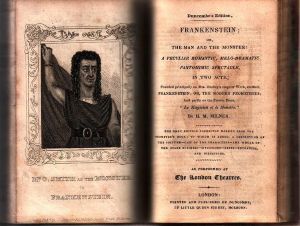 THE MAN AND THE MONSTER – Written by Henry M. Milner, this stage adaptation of Mary Shelley’s Frankenstein differs significantly from her novel and was first performed on July 3rd, 1826 at the Royal Cobourg Theatre.
  UTOPIA or THE HISTORY OF AN EXTINCT PLANET, PSYCHOMETRICALLY OBTAINED (1884) – Written by Alfred Denton Cridge. An unnamed narrator comes across the remains of a meteor that entered Earth’s atmosphere. This narrator has the gift of psychometry (the author’s uncle was THE William Denton) and after he picks up the tangerine-sized chunk of black rock from another planet he begins getting impressions from it.
  The planet was just 2,500 miles across and was home to a race of roughly 5 1/2 feet tall humanoids, some with yellow skin, some with brown skin and others with gray skin. All the races had long, black hair. Utopia sported Earthlike plains, mountains, lakes and rivers with just one huge ocean.
  THE LUNARIAN PROFESSOR AND HIS REMARKABLE REVELATIONS CONCERNING THE EARTH, THE MOON AND MARS TOGETHER WITH AN ACCOUNT OF THE CRUISE OF THE SALLY ANN (1909) – Written by James B Alexander back in the glory days of titles so long they might not fit in a 140 character limit.
  THE NEW HUMANS (1909) – Written by B Vallance. No other name has come to light for the author of this thought-provoking work. Explorer Montgomery Merrick is roaming around the wilds of 1909 Uganda when he falls down a mountainside and into a concealed valley.
  BEYOND THE ETHER (1898) – Written by W. Cairns Johnston. This little honey is so jam-packed with enjoyable weirdness that it’s sort of like “If Ed Wood wrote Steampunk.”
  A JOURNEY IN THE TWENTY-NINTH CENTURY (1824) – Written by Faddei Bulgarin, who had served in the Polish Legion of Napoleon’s Grand Army in his youth before going on to work for the Czars of Russia. In this fascinating tale an unnamed narrator gets swept overboard in the Gulf of Finland in 1824. The cold water and another element somehow put him in suspended animation and when he comes to he is all the way over in Siberia, where his body was recovered in the waters of Cape Shelagski centuries after he was lost at sea.
 FUNGUS ISLE (1923) – Written by Philip M Fisher. Fungus Isle has the same proto-Creature Feature feel to it that The True Inheritors (qv) had. In the case of the previously reviewed story, it was a forerunner of various giant spider flicks.
  THE SHIP OF SILENT MEN (1920) – Written by Philip M Fisher. The crew of a ship called the Lanoa set out from Hawaii. A few days later an abnormally powerful electrical storm strikes, leaving the area unusually cold in its wake.
