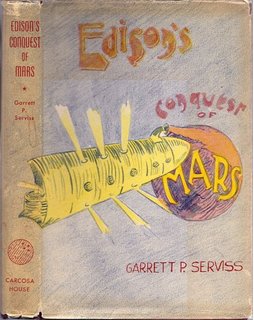
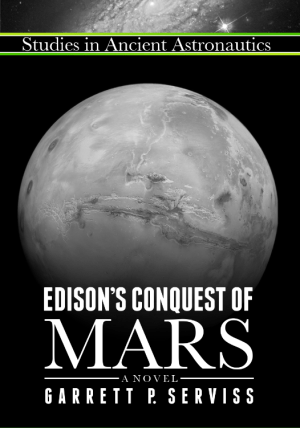
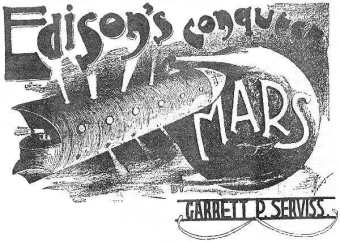
 A new serialized feature begins here at Balladeer’s Blog! Plenty of regular readers expressed interest in one of the works of “ancient” science fiction that I touched on awhile back – Edison’s Conquest of Mars by Garrett P Serviss.
That book was the sequel to Serviss’ earlier novel Fighters From Mars (also from 1898) which was, shall we say … reminiscent … of H.G. Wells’ War of the Worlds. Oh, hell, it was basically the same story but was set mostly in Boston, MA.

Too late Edison learned the awful price to be paid for repeatedly asking if his bikini made him look fat.
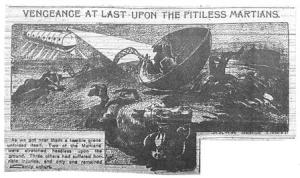
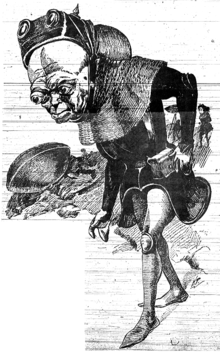
Edison’s Conquest of Mars featured the people of Earth reverse- engineering the spacecraft of the defeated Martians. Humanity then constructed a fleet of its own and set off for Mars to kick the Martians’ butts for trying to conquer our planet.
The lead scientist of the expedition was none other than Thomas Alva Edison himself, accompanied by plenty of other real-life scientists and world leaders. Yes, copyright and personal licensing laws back then weren’t quite what they are today so Garrett P Serviss got away with what amounted to a massive work of fan fiction … if fan fiction was about real-life scientists and political figures. (And no, I’m not counting slash fiction about Stephen Hawking, you perverts.) Continue reading →

 Balladeer’s Blog continues its examination of Garrett P Serviss’ odd sequel to Fighters From Mars, his blatant imitation of War of the Worlds.
  Balladeer’s Blog continues its examination of Garrett P Serviss’ odd sequel to Fighters From Mars, his blatant imitation of War of the Worlds.
  Balladeer’s Blog continues its examination of Garrett P Serviss’ odd sequel to Fighters From Mars, his blatant imitation of War of the Worlds.
  Balladeer’s Blog continues its examination of Garrett P Serviss’ odd sequel to Fighters From Mars, his blatant imitation of War of the Worlds.
 Balladeer’s Blog continues its examination of Garrett P Serviss’ odd sequel to Fighters From Mars, his blatant imitation of War of the Worlds.
  Balladeer’s Blog continues its examination of Garrett P Serviss’ odd sequel to Fighters From Mars, his blatant imitation of War of the Worlds.
 Balladeer’s Blog continues its examination of Garrett P Serviss’ odd sequel to Fighters From Mars, his blatant imitation of War of the Worlds.
  Balladeer’s Blog continues its examination of Garrett P Serviss’ odd sequel to Fighters From Mars, his blatant imitation of War of the Worlds.
