

HAPPY FRONTIERADO! The first Friday of every August marks this holiday devoted to the myth of the old west rather than the grinding reality. For some of us the celebration kicks off Thursday night, for others they wait until the actual day of Frontierado to hold their festivities. Enjoy your buffalo steaks, rattlesnake fried rice, corn on the cob, tumbleweed pizza, cactus salad and more today and tonight, and enjoy the leftovers on Saturday and Sunday.
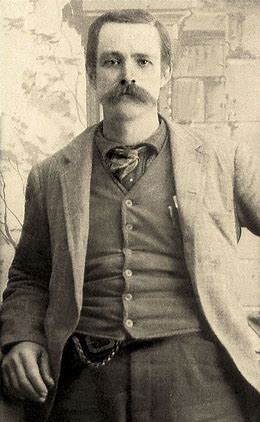 BUCKSKIN FRANK LESLIE – Franklyn Leslie, full name Nashville Franklyn Leslie, was better known as Buckskin Frank. “Nashville” was, he claimed, his actual first name, NOT a nickname.
Buckskin Frank Leslie had no connection to the popular 1800s magazine of that name, but that’s one of the few questions that can be answered about this gunslinger. Which side of the Civil War did he serve on? He claimed both at various times.
Was he pro or anti-Clanton Faction during the gang war in Tombstone, Arizona? He claimed to be a Lone Wolf, and news accounts of the time do feature him in conflict with figures from both sides. He definitely killed Billy Claiborne and MAY have killed Johnny Ringo. Even his own death is shrouded in mystery.
Nashville Franklyn Leslie was born March 18th, 1842 in Texas. Virtually nothing is known about his early life and at different times he claimed to have served on each side of the Civil War. Why he left Texas is not known, either. By some accounts it was because of a family conflict but by others it was to flee a criminal past, possibly under the surname Korrigan or Corrigan.
 Documentation starts to show up regarding Buckskin Frank on July 11th, 1869 when he arrived in San Francisco via the steamship Portland according to the passenger information published by the Daily Alta California.
After working as a bartender in San Francisco and possibly other California cities Leslie worked for Wells Fargo and similar outfits for a few years as a gunslinging guard before becoming an army scout under various commanders including Custer. He dabbled in law enforcement as a Deputy Sheriff and may or may not have met Wild Bill Hickok during the early 1870s, depending on which source you go by. Continue reading
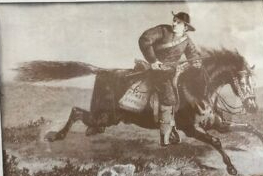 PONY BOB – Robert Haslam, better known as Pony Bob, holds multiple records set in the Pony Express during its year and a half history, including the longest individual round-trip ride – 380 miles – when one of his relay riders was put out of action during the Paiute War in 1860.
  With Frontierado rapidly approaching on August 5th – or for those of us who kick things off the night before – August 4th – let’s take a look at some of the most obscure but laughably weird Italian westerns. And what better way to start that list than with one of the countless Spaghetti Westerns with phony Django titles?
  1. DJANGO KILL (1967) – Originally titled If You Live, Shoot!, this was one of the many Eurowesterns to be re-released to theaters years later as a phony Django movie just so it could clean up on the guaranteed cash cow of the Django name.
 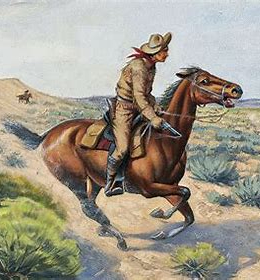 BOSTON – Warren Fremont Upson, better known by his one-word nickname, was one of the Pony Express Riders aka Expressmen to ride with the service for its entire existence from April 3rd, 1860 to October 26th, 1861. His real name was so seldom used in the old west that in some sources on Pony Express history he was listed only as “Boston.”
  Our hero spent most of his time riding and exploring in the Sierra Nevadas, hunting and cooking his own food and acquiring a familiarity with the mountain range’s often-treacherous curves and turns and sudden drops. That familiarity would pay dividends later in life when Boston was assigned to the most geographically dangerous route of the Pony Express.
 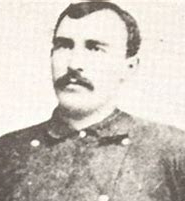 DUTCH HENRY – Henry Borne, spelled Bourne in some sources and Born in others, was born on July 2nd, 1849 in Manitowoc, Wisconsin. His parents were fresh from Germany and the old “Deutsch-Dutch” confusion on the part of non-German speakers led to Borne’s eventual nickname Dutch Henry.
 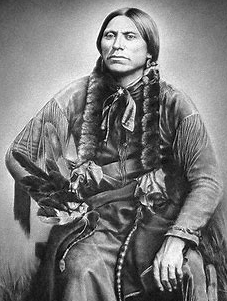 Come 1874 and Dutch Henry was living on the Texas Panhandle. He was on hand at the storied Adobe Walls store called Myers & Leonard’s when the Second Battle of Adobe Walls began on the morning of June 27th. A combined force of several hundred Arapaho, Cheyenne, Comanche and Kiowa warriors attacked, led by Comanche Chief Quanah Parker (at right).
 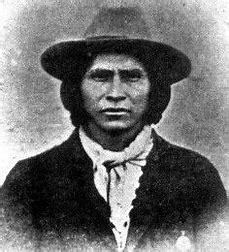 THE APACHE KID – This Native American gunslinger’s life on both sides of the law intrigued a lot of people. Some saw his saga as a western Robin Hood tale when he was funneling supplies to his put-upon people on reservations. The tantalizing mysteries regarding his ultimate fate cement his immortality in the public’s imagination. Click
 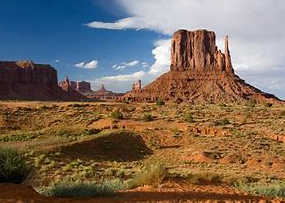 “All through the year we waited” as the song lyric goes, but in this case regarding Frontierado instead of Christmas. The first Friday of every August marks this holiday devoted to the myth of the old west rather than the grinding reality. For some of us the celebration kicked off Thursday night, for others they wait until the actual day of Frontierado to hold their festivities. Enjoy yourselves today and tonight, and enjoy the leftovers on Saturday and Sunday.
 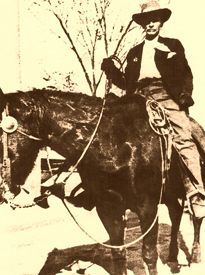 CHARLIE SIRINGO – Like a real-life Harry Flashman of the American West, Charles Angelo Siringo, cowboy, bounty hunter and lawman, fought alongside or against some of the biggest names of his era. Siringo crossed paths with the likes of Billy the Kid, Wyatt Earp, Bat Masterson, the Wild Bunch, Tom Horn, Clarence Darrow, Kid Russell, Will Rogers, William Borah and many others.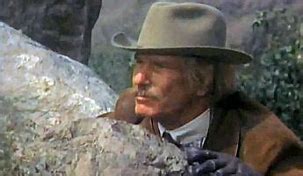
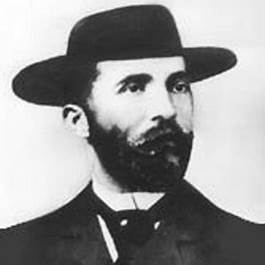 JEFFERSON “SOAPY” SMITH – This figure was one of the closest things to a 20th or 21st Century gangland chief in the 19th Century. Jefferson Randolph Smith II was born on November 2nd of 1860 in Coweto County, GA. In 1876 his family moved to Round Rock, TX, where his mother died of natural causes in 1877.
 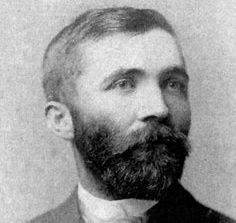 Shortly after that event Jeff moved to Fort Worth, TX. The story goes that Smith had begun working at confidence games to make money when he was 16 and in Fort Worth his savvy and leadership qualities let him gather around him a gang of talented and experienced crooks and con artists. The group traveled from town to town running rigged poker games plus 3-card Monte, the shell game and similar rapid-fire, uncomplicated cons and ripoffs.
 CANYON DIABLO: THE MOST LAWLESS TOWN OF THE OLD WEST – In 1880 construction crews for the Atlantic and Pacific Railroad reached the wide chasm called Canyon Diablo in what is now Coconino County, Arizona. Construction had to pause for several months when the crews discovered that the wrong size bridge had been manufactured and would not reach all the way across Canyon Diablo.
  While waiting for new bridge materials to be manufactured and shipped to the site, workers stayed in the area doing stonemasonry, surveying, cutting and preparing railroad ties and preparing the grade & bed. A quick Hell On Wheels town sprouted called Canyon Diablo, named after the canyon. Unlike most such towns this one lasted for decades, from 1880 into the 20th Century but was at its peak for just a few years in the 1880s.
 Canyon Diablo is not a household name like Dodge City, Tombstone, Deadwood, Silver City or others because not only law enforcement, but anything resembling newspapers, churches or schools or any other of the usual fixtures of civilization failed to survive there.
 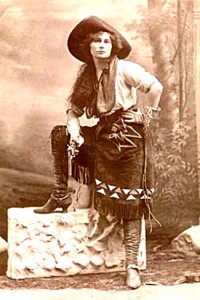 With the Frontierado holiday coming up on Friday August 6th it’s time for another seasonal blog post. Marie Lords is still remembered for her 1861 quote “A cowgirl gets up early in the morning, decides what she wants to do, and does it.”
  Balladeer's Blog