
With so many recent contemplations of potential alternate histories if various events had turned out differently, here are a few older examples from that burgeoning subgenre.
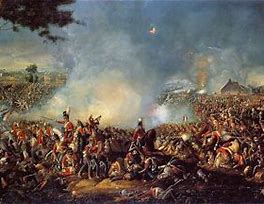 WHAT IF NAPOLEON HAD WON AT WATERLOO? (June 18th 1815) – In 1907 G.M. Trevelyan penned an essay on this topic. In Trevelyan’s take, Napoleon had been chastened by his temporary exile to Elba before escaping and regaining control of France.
Bonaparte’s health was failing badly. In fact, his erratic behavior during his ill-considered invasion of Russia has been attributed to a possible stroke in some theories. Feeling limited in his ability to once again lead armies of conquest to rebuild his continent-spanning empire, Napoleon decided to master diplomacy the way he had previously mastered warfare.
Dealing from his position of strength following his victory at Waterloo in this alternate timeline, the Emperor was astonishingly lenient in dealing with his defeated enemies. He imposed no harsh conditions on their surrender and ultimately emerged with his empire extending to the Rhine and with French hegemony of the Italian Peninsula recognized. Continue reading
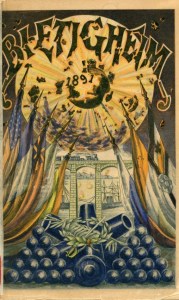 BIETIGHEIM (1886) – Published anonymously in 1886 this work of alternate history accurately predicted some of the actual results and fallout of the coming First World War (1914-1918). Bietigheim is presented as a series of John Minor lectures about world history as seen from “futuristic” 1932.
 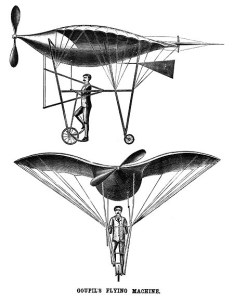 LOOKING FORWARD: A DREAM OF THE UNITED STATES IN 1999 (1899) – Written by Arthur Bird. This is speculative science fiction looking at world events and scientific advances from 1899 to 1999. Since the U.S. was coming off the 1898 war with Spain that accounts for the way Spain is presented as the major villain on the global scene.
  Balladeer's Blog