 Frontierado is celebrated the first Friday of every August, so this year it will be marked on August 4th. This holiday celebrates the myth of the old west, not the grinding reality. Here’s a seasonal post regarding my look at an opera version of the original Django spaghetti western from 1966, which strips the story down to its essentials, with no gold subplot.
 DJANGO: AN OPERA – Here at Balladeer’s Blog I love sharing my enthusiasms. My blog posts where I provide contemporary slants to Ancient Greek Comedies to make them more accessible have been big hits over the years, so I’m trying it with operas. A little while back I wrote about how Philip Wylie’s science fiction novel Gladiator could be done as an opera. This time I’m addressing the 1966 original version of the Spaghetti Western titled Django.
IF YOU HATE OPERAS AND YOU’D RATHER JUST READ MY MOVIE REVIEW OF THE 1966 DJANGO, CLICK HERE
DJANGO
 LANGUAGE: Spanish. I’ve resigned myself to the fact that most of my fellow English-speakers find English-language operas to be silly. The prosaic nature of the forced rhymes in a language we are well-versed in does seem to rob opera of its mystique and its grandeur.
I fall into that trap myself. I’ve noticed I can never lose myself in a Gilbert & Sullivan work like I can with La Forza del Destino or Tales of Hoffmann or any other opera sung in a less familiar language. At any rate, I’ve chosen Spanish for this opera because so much of the story takes place in Mexico during the war to dethrone Emperor Maximilian.
SINGERS: A Tenor, 2 Baritones, a Soprano, 3 Basses and a Mezzo-Soprano
For Django, I’m making it a two-act opera as opposed to the three-act format I used for Gladiator.
ACT ONE: MARCH 1867. A STRETCH OF BARREN DESERT ALONG THE US/ MEXICO BORDER.
 Scene One: The opera would open with a stage version of one of the most iconic visuals from the 1966 film. Our title character, DJANGO, clad in his long blue jacket with his well-worn Union Army uniform underneath it, slowly, wearily drags a coffin behind him as he walks along singing his mournful song. He pulls the coffin via a rope slung across one shoulder.
The coffin symbolizes the burden of grief that Django has carried with him ever since his wife was killed during the U.S. Civil War by Confederate MAJOR JACKSON. Django has pursued his ideological and personal enemy across the west and now to this battle-scarred border town.
The vile Major Jackson and his former Confederate soldiers have turned into outright Klansmen. Jackson and his men are among the former Confederate military men who took up Emperor Maximilian’s offer of land and citizenship in Mexico (where slavery was still legal). In exchange they had to fight to help Maximilian retain his throne. Continue reading →

 RIVERBOAT (1959-1961) – We are less than a week away from Frontierado 2023, observed on Friday August 4th this year. For a combination Frontierado and Forgotten Television post Balladeer’s Blog takes a look at some of the best episodes of the old western series Riverboat.
  Grey Holden captained the Enterprise, but the more experienced Chief Pilot was Ben Frazer, played by the one and only Burt Reynolds. Riverboat was, for a television western, atypically set during the 1830s and 1840s. Some of my favorite episodes are historical fiction, featuring our heroes aiding Texas rebels during the Texas Revolution, clashing with river pirates, or encountering young Abraham Lincoln and a few other historical figures here and there. Continue reading
 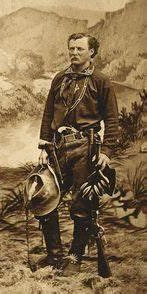 COMANCHE JACK – Balladeer’s Blog presents another seasonal post for the upcoming Frontierado Holiday, observed Friday August 4th this year. Frontierado celebrates the myth of the old west, not the grinding reality.
  During that four-year period, he developed his marksmanship, as well as his scouting, Indian fighting and wilderness survival skills. In the snowy months, Comanche Jack rode with hunting parties along the Beaver, Canadian and Wolf Rivers.
  ROSEBUD ROB, BALTIMORE BESS AND CINNAMON CHIP – Here’s another seasonal post for the upcoming Frontierado holiday on Friday August 4th. As always, Frontierado is about the myth of the old west, not the grinding reality.
 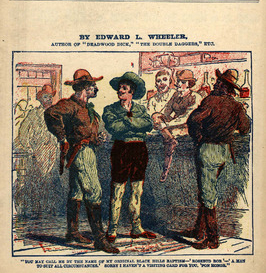 ROSEBUD ROB … the KNIGHT OF THE GULCH (February 1879) – Rosebud Rob was a Wild West detective, like the real-life Charley Siringo (covered
  LARCENY BOURBON – Making its debut on the Bourbon Breakdown for Frontierado is this Kentucky Bourbon which meets my usual standard of letting you blow flies out of the air after a swig.
  IRON SMOKE BOURBON – Hunker down with some Iron Smoke Bourbon to help you and yours celebrate Frontierado.
 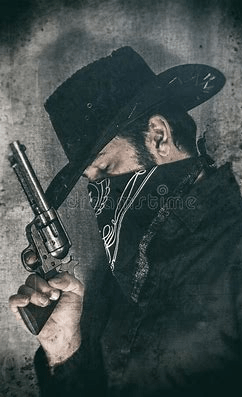 CALIFORNIA JIM – The Frontierado Holiday is coming up on Friday, August 4th, so here is another blog post in honor of the season. California Jim was also known as Six-Shooter Jim Smith and Six-Shooter Bill, but on his deathbed, he claimed that his real name was John Henry Hankins (some sources say Jankins or Hawkins).
 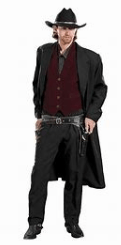 Jim lingered in Dodge City, Kansas for a time, committing various crimes. On August 17th, 1878 Deputy Marshal Bat Masterson himself arrested California Jim for stealing a horse.
  HURRICANE NELL, THE GIRL DEAD-SHOT (1877) – Written by Edward L. Wheeler. This blog post is dedicated to the prolific author and fellow blogger
  That brings us back to Hurricane Nell, the Girl Dead-Shot, also known as Hurricane Nell, the Queen of the Saddle and Lasso, and, in a misleading re-titling, as Bob Woolf, the Border Ruffian. (NOT three separate books.) Though published in May of 1877, Nell’s adventures were set earlier in the 1800s than most of the other big-name heroines of Dime Novels, so I am starting with her and will move on to the others in the next few weeks.
 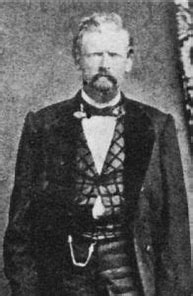 FERD THE DANDY (1821-1866) – The Frontierado holiday is coming up on Friday, August 4th this year, so here is another seasonal post from Balladeer’s Blog. This one covers a ruthless, yet often forgotten, gambler-gunslinger.
  Come 1859 Ferd the Dandy had acquired too big a reputation as a professional gambler to even get in a game anymore, so he gravitated to the Sailors’ Diggings Gold Rush near Waldo, Oregon. The mining town had already known the murderous rampage of the Triskett Gang by the time Patterson arrived to stain Waldo with his own activities.
 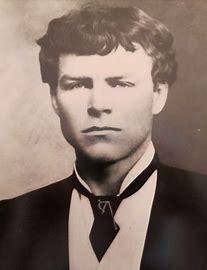 TEMPLE LEA HOUSTON (August 12th, 1860-August 15th, 1905) – This future gunslinging lawyer and last child of Sam Houston with his wife Margaret Lea-Houston was born in the Governor’s Mansion in Austin, TX. His storied father, the first president of the short-lived Republic of Texas was then serving as governor for the state of Texas.
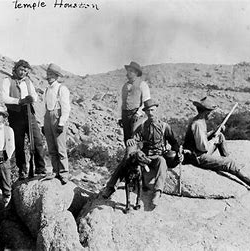 It was during this time that Temple met an old friend of his father, who arranged a job for the young man as a Senate Page in Washington, DC. Working in that capacity for 3 years, Temple developed an ambition to study law and enter politics himself someday.
 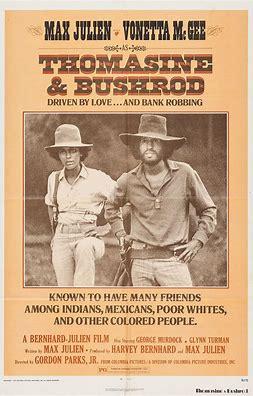 THOMASINE & BUSHROD (1974) – The Frontierado Holiday is Friday, August 4th this year, so here is another seasonal post – a review of the black western Thomasine & Bushrod. This tale of a pair of outlaw lovers is a nice change of pace since it is set in the fading Wild West of 1911-1915. Automobiles are beginning to show up here and there, making Thomasine & Bushrod a fascinating fusion of “Robin Hood Outlaw” tales bridging both the old west and the later Pretty Boy Floyd era.
 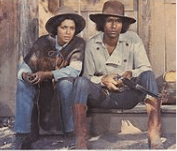 While collecting the money from her most recent success, Thomasine sees a fresh Wanted poster for her old boyfriend J.P. Bushrod, a gunslinging bank robber and rustler portrayed by Max Julien from the previous year’s blaxploitation hit The Mack.
  Balladeer's Blog