
 Konstantin Eduardovich Tsiolkovsky did real-life work crucial to space-flight and is one of the neglected pioneers of Science Fiction. Balladeer’s Blog takes a look at a few of his works.
DREAMS OF EARTH AND SKY (1895) – The opening section of this piece presents the well-worn Hollow Earth with an interior sun storyline. The real treasure is found in the “Dreams of the Sky” portion.
An asteroid in the Asteroid Belt between Mars and Jupiter is so large that today it would be called a Dwarf Planet like Ceres. The planetoid is inhabited by ambulatory plant-like humanoids who have wings instead of arms and who live in small versions of greenhouses.
 These flying plant-people from the Asteroid Belt obtain nourishment through chlorophyll and solar radiation. They also have advanced technology like the harnessing of dismantled asteroids into rings, resulting in lower gravity for manufacturing work.
The beings have even created “space-trains” capable of taking them on interstellar journeys.
**
 OUT OF THE EARTH (1920) – Coincidentally set in the year 2017 A.D. this tale features what readers are told is the first manned flight to the moon, some 48 years AFTER it happened in real life. An international team of tycoons and scientific adventurers are planning to explore the universe, with the moon an obvious first step.
This international fellowship is headquartered in the Himalayas and boasts members from Russia, America, England, France, Germany and Italy. Tsiolkovsky was ballsy enough to use millionaires and industrialists as the story’s heroes despite the disapproval of the (by 1920) Soviet government.
The fellowship uses a multi-stage rocket propelled by liquid fuel. After perfecting model rockets the group moves on to full-scale spacecraft. The explorers orbit the Earth first, and use space suits for extra-vehicular activities. Continue reading


 BLOOD AND IRON (1917) – Written by Robert Hobart Davis & Perley Poore Sheehan. Dramatic depiction of advanced technology being used in World War One. In Germany one of the Kaiser’s scientists is experimenting with replacing lost limbs and organs with mechanical replacements. He has been trying to create cyborgs out of maimed German soldiers from the front lines.
 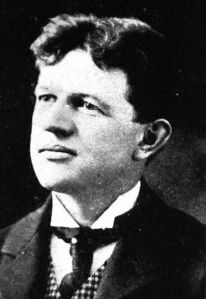 AN INTER-PLANETARY RUPTURE (1906) – Written by Frank L Packard. This work of Science Fiction is set in the far-off year 3102 A.D. Since the year 2532 all of the Earth has been united under one single government, which is headquartered in America’s Washington, D.C. (Yet this was written by a Canadian.)
  THE GUARDIAN OF MYSTERY ISLAND (1896) – Written by Dr Edmond Molcini. Mystery Island lies off the coast of Maine and everyone near the coast considers the place haunted by a true monstrosity – a large ghost-dog.
 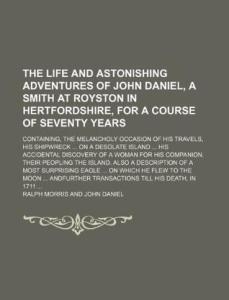 Full Title: A NARRATIVE OF THE LIFE AND ASTONISHING ADVENTURES OF JOHN DANIEL, A SMITH AT ROYSTON IN HERTFORDSHIRE, FOR A COURSE OF SEVENTY YEARS. (1751) – Written by Ralph Morris, supposedly a pseudonym used by an unknown man.
 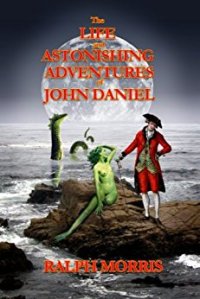 The unmarried son, Daniel (yes his name is Daniel Daniel) has a knack for inventing things and builds a flying machine. Its general shape is like one of our modern-day airplanes but the wings are leather over metal rod frames and in order to fly the wings must “flap,” which they do, powered by a pump.
 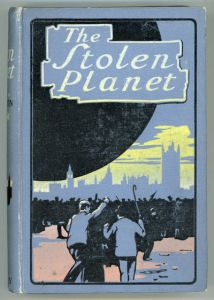 THE STOLEN PLANET (1906) – Written by John Mastin. Jervis Meredith, a wealthy young British man and his equally wealthy friend Fraser Burnley are so brilliant they invent anti-gravity. Next the young tycoons have a spaceship built so they can use their anti-gravity device to tour outer space.
  A PESTILENT VAPOR (1903) – Written by Alice MacGowan, this neglected story introduced a figure who should have become as famous in his way as H.G. Wells’ Invisible Man.
  BEYOND THE ETHER (1898) – Written by W. Cairns Johnston. This little honey is so jam-packed with enjoyable weirdness that it’s sort of like “If Ed Wood wrote Steam-Punk.”
  THE INCUBATED GIRL (1896) – Written by F.T. Jane, as in THE Jane who originated the Jane’s Guides.
  A DARWINIAN SCHOONER (1893) – Written by William Alden. With the latest Planet of the Apes movie hitting many theaters today I figured it was a good time to post a review of this story that’s in a similar spirit.
