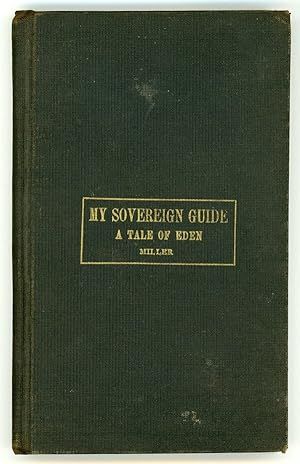
 THE SOVEREIGN GUIDE: A TALE OF EDEN (1898) – Written by American William Amos Miller and published under the title My Sovereign Guide: A Tale of Eden, so I have no idea why everyone now starts the title with The instead of My. Regular readers of Balladeer’s Blog know that many works of “ancient” science fiction mixed in religious elements with the sci-fi. The Sovereign Guide is one of the most inventive and features angels using advanced technology. Taking the novel section by section:
PART I: JOURNEY TO ROME – Miller himself serves as our narrator. He has received word that Manethoe, a former household aide who had embezzled money from him long ago, is on his deathbed in Rome.
Miller is filled with such a strong desire to see the man one last time and openly forgive him that an actual angel appears to him and offers to take him to Rome to see Manethoe. The angel – who has neither eyes nor ears but functions perfectly without them – has our narrator fly off with him in his chariot.
High above the Earth they pass by a multitude of angels singing a song which William’s guide joins in. At length the chariot descends toward Rome.
PART II: A SCENE IN THE CHAMBER OF DEATH – At Menethoe’s bedside, our narrator and the angel behold the Angel of Death waiting to claim the dying man’s soul. Miller sees the Angel of Death studying a high-tech instrument which it has implanted in Menethoe’s heart.
William forgives his former aide and when the device in the dying man’s heart indicates that he has died, Mary, Mother of God appears at the bedside, a vision so dazzling that our narrator faints. He comes to later on his angelic companion’s chariot. The angel informs him that he is taking him to see Eden and what is left of its Garden.
A weakness of the book is that we never get any indication why William Amos Miller is being granted this privileged tour.
PART III: SUBTERRANEAN VOYAGE TO EDEN – The chariot lands at the seashore, where our narrator is accompanied aboard a futuristic submarine crewed by angels. The vessel is egg-shaped but with spires at both ends. Continue reading →

 TO THE MOON & BACK IN NINETY DAYS (1917) – By John Y. Brown. Balladeer’s Blog presents more Ancient Science Fiction (or Vintage Science Fiction if you prefer). This story was first penned in 1917 and later published by the Lunar Publishing Company in 1922.
 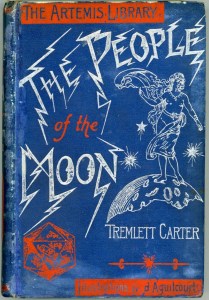 THE PEOPLE OF THE MOON (1895) – Written by Tremlett Carter. An unnamed narrator, a scientist of some sort, sees a glowing 18 inch object floating in the sky. A bird who makes physical contact with the glowing orb is killed by the object’s electric charge.
  THE ABLEST MAN IN THE WORLD (1879) – This short story was written by American author Edward Page Mitchell. The central figure – but not the title figure – is a wealthy bespectacled man named Fisher. Because of his scholarly appearance Fisher is mistakenly addressed as “doctor” and “professor” while staying at a spa in Baden, Germany.
  MR. GHIM’S DREAM (1878) – This anonymous work is set in the autumn of 1877. Mr. Ghim is a poor American who dreams of ending the “current” unemployment crisis through a massive construction project that will employ thousands. Ghim tries to enlist some of the most well-known tycoons of his day – William Vanderbilt, Robert Roosevelt, Jay Gould and others – in his scheme.
  PHILIP HALL’S AIR SHIP – This tale was first published in the October 11th 1879 edition of The Argonaut. Inventor Philip Hall has constructed a steam-powered flying machine that also uses controlled explosions from compressed cartridges.
  ACCOUNT OF AN EXPEDITION TO THE INTERIOR OF NEW HOLLAND (1837) – Written by multiple parties, with Lady Mary Fox, Richard Whateley and Lord Holland the likeliest authors. “New Holland” was an old name for Australia. In 1860 the novel was reissued under the title preface The Southlanders.
 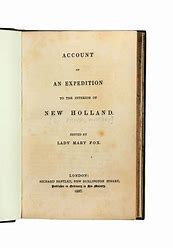 Southland boasts a population of roughly four million and is divided into eleven distinct regions which, though under one overall parliamentary government, enjoy a large amount of internal sovereignty. Some regions are republics and others live under a hereditary monarchy. In several of the republics, however, their chief executive figure is still called a king despite being elected.
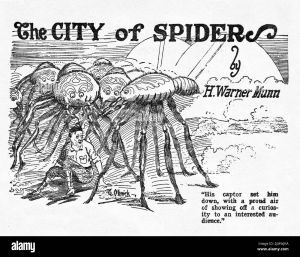 THE CITY OF SPIDERS (1926) – Short story by H. Warner Munn. This quasi-Creature Feature type tale featured biologist Jabez Pentreat.
 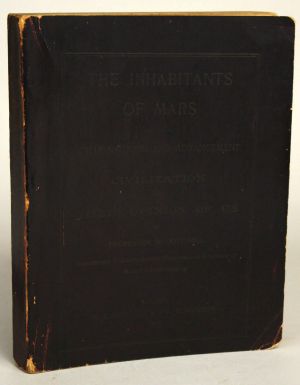 THE INHABITANTS OF MARS: THEIR MANNERS AND ADVANCEMENT IN CIVILIZATION AND THEIR OPINION OF US (1895) – I shortened the title for this blog post heading. This novel was written by Willis Mitchell, who called himself a professor but never elaborated.
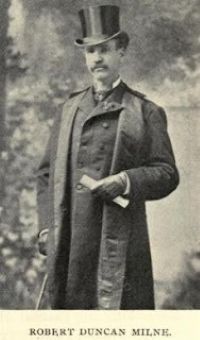
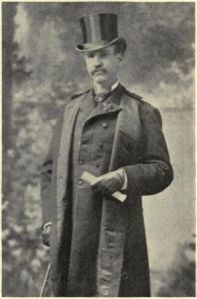 THE GREAT ELECTRIC DIAPHRAGM – This short story was written by neglected American science fiction pioneer Robert Duncan Milne. It was published in the May 24th, 1879 edition of The Argonaut in San Francisco.
