
For my larger entry on Shinto gods and goddesses click HERE.
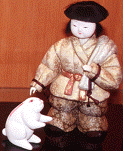 OKUNINUSHI – The Shinto god of medicine who eventually became the ruler of the Izumo area of Japan. Okuninushi lived in Izumo, which was under the control of the extended family of deities of the exiled storm god Susanowo.
The turning point in the medicine god’s life came when he used his healing powers to cure a rabbit that his brothers had cruelly abused. The healed rabbit transformed into his true form as the dwarf-sized Sukunabiko, a god who had fallen to Earth from Takamagahara, the heavenly home of the Shinto gods, like Mt Olympus, Asgard, etc, in other pantheons.
Okuninushi and the brothers who had abused Sukunabiko in rabbit form were rivals for the hand of Princess Yakami, so Sukunabiko used his magic powers to help his rescuer win the princess’ hand and survive his brothers’ attempts to do away with him.
Eventually, after being destroyed by his brothers and then reborn several times over, Okuninushi was advised by his mother (or by Sukunabiko, depending on the version) to hide in Yomi, the land of the dead.
Yomi was ruled over by the goddess Izanami, and it was where the storm god Susanowo had retired to live after his Earthly exile had ended. Okuninushi and Susanowo’s daughter Suseri fell in love but the tempestuous Susanowa refused to grant permission for the marriage.
Once, while Susanowo slept, Okuninushi stealthily tied the storm god’s hair to the rafters of his home in Yomi, and fled with Suseri plus Susanowo’s sword, bow and enchanted harp. The harp played itself to awaken the storm god, who raged and fumed, but who recognized Okuninushi’s bravery and cunning and granted permission for the medicine god and Suseri to marry.
Susanowo also appointed Okuninushi to rule over Japan, which he and then his son Omitsuno (see his entry) did until Amaterasu the sun goddess sent her grandson Ninigi down from Takamagahara to assume control of Japan and the world.
FOR MORE MYTHS FROM AROUND THE WORLD CLICK HERE.

